
M.C. Escher Exhibition Turns London Upside Down
 Vortixel
14 minutes read
Vortixel
14 minutes read
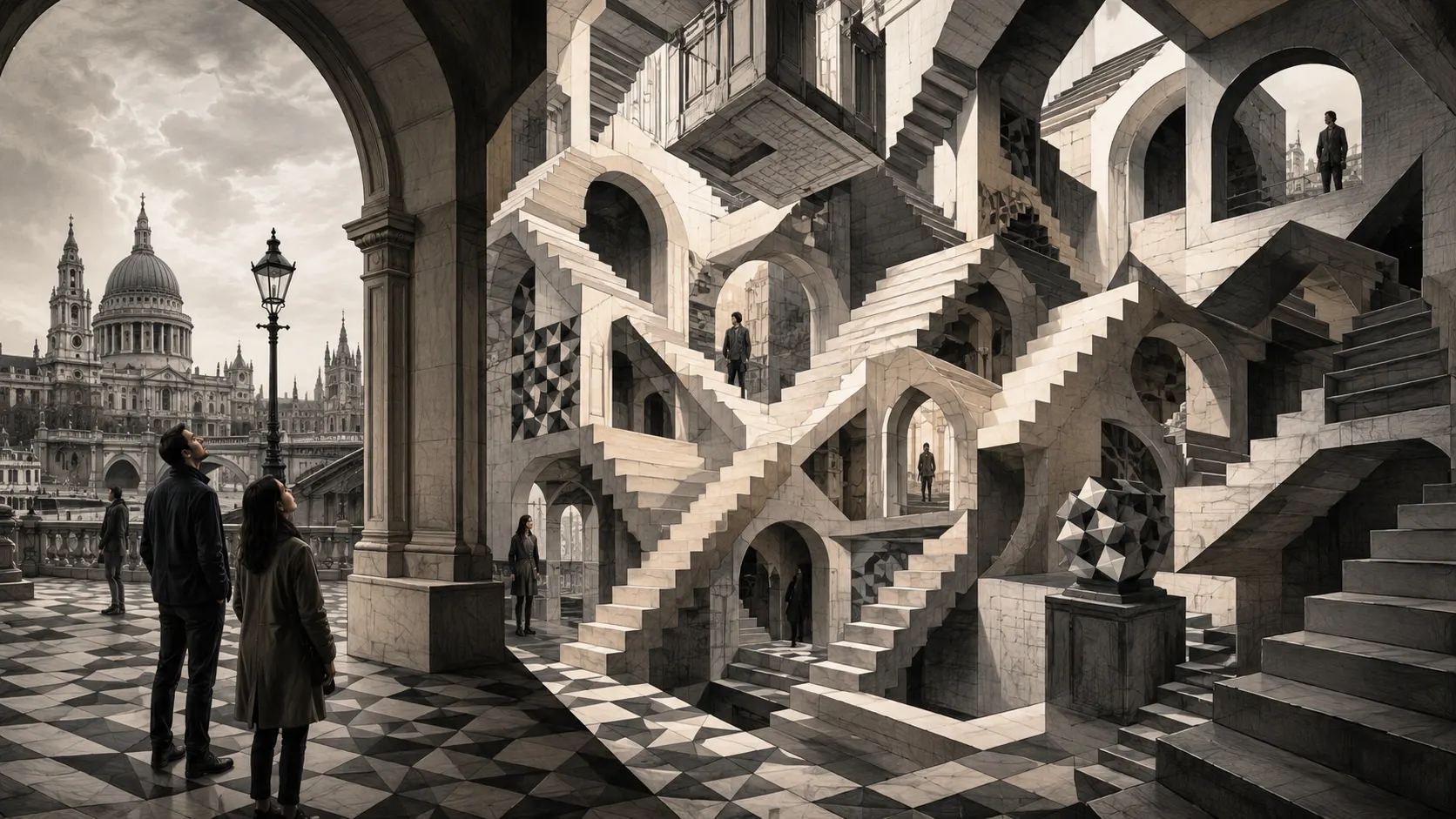
London has never been short on spectacle, but the arrival of the M.C. Escher exhibition at Somerset House feels like a different kind of visual event. It is not just another summer art show built around famous prints, familiar posters, and museum-shop nostalgia. It is a full collision between old-school graphic precision and the way modern audiences now think about images, screens, perspective, loops, and reality itself. Escher’s work has always lived somewhere between math class, dream logic, and visual entertainment, but in 2026 it lands inside a culture that is already obsessed with impossible spaces. That makes this show feel less like a throwback and more like a mirror held up to the present.
The hook is obvious the moment people hear the name Escher, because his images have a way of entering the brain before the viewer has even decided what they are seeing. Staircases climb and collapse at the same time, hands appear to draw themselves into existence, birds become fish, and architecture refuses to obey gravity. For younger audiences raised on infinite feeds, virtual environments, generative visuals, and game worlds, this language does not feel old at all. It feels strangely current, almost like Escher anticipated the visual internet before anyone knew what a screen culture would become. That is why the M.C. Escher exhibition is more than a gallery event; it is a reminder that visual innovation did not start with software.
Why the M.C. Escher Exhibition Feels So Timely
The timing of the M.C. Escher exhibition matters because visual culture is currently living through its own identity crisis. Artificial intelligence can now generate polished images in seconds, design tools can bend perspective with a click, and immersive installations have trained audiences to expect movement, interaction, and spectacle. Yet Escher created his most iconic illusions through hand, patience, geometry, and a stubborn curiosity about how the eye can be tricked. His work proves that the real power of an image is not only in how advanced the tool is, but in how deeply the artist understands perception. In an era where visuals are everywhere, Escher asks viewers to slow down and actually look.
That slower kind of looking feels almost rebellious now, especially in a city where creative experiences often compete for quick photos and social clips. Somerset House is a fitting home for this tension because it sits between heritage and contemporary culture, between grand architecture and experimental programming. The show’s setting gives Escher’s prints room to breathe, but it also places them in conversation with today’s design, animation, digital art, and immersive media scenes. Visitors are not only looking at historical works; they are walking through a visual grammar that still shapes how creators build strange worlds. The exhibition becomes a bridge between printmaking and the digital imagination.
A Visual Story Built on Impossible Logic
Maurits Cornelis Escher built his reputation by turning logic into a visual maze, but his work was never random weirdness for the sake of being weird. Behind every impossible staircase and repeating creature is a mind deeply invested in order, structure, and systems. His images often look playful at first, yet the longer someone stares, the more serious the questions become. Where does a surface begin, where does it end, and how much can the eye trust the brain’s first answer? This is the kind of tension that makes Escher feel endlessly fresh to designers, artists, architects, scientists, and visual storytellers.
The strongest part of Escher’s legacy is that he made complexity feel instantly readable. A viewer does not need a degree in mathematics to feel the pull of his patterns, just as they do not need an architecture background to understand that something is wrong with his buildings. The first reaction is usually instinctive, almost physical, because the eye recognizes space and then realizes that space has betrayed it. That moment of confusion is where Escher’s art becomes memorable. He turns perception into a story, and every viewer becomes part detective, part dreamer, and part willing victim of the illusion.
From Printmaking to Digital Culture
One reason this exhibition feels so relevant for Visual Vortixel readers is that Escher’s work quietly predicts many ideas now associated with digital art. Tessellations feel connected to procedural patterns, his impossible architecture echoes video game level design, and his metamorphoses resemble the smooth transitions found in animation and motion graphics. Even his self-referential images, where creation seems to generate itself, feel close to conversations around artificial intelligence and machine-made visuals. But Escher’s work also exposes a difference between automated output and authored vision. He did not merely produce complexity; he organized it into images that still feel emotionally strange, intellectually sharp, and visually addictive.
This is where the M.C. Escher exhibition becomes more than a historical display for fans of classic optical illusions. It gives today’s digital creators a chance to study the foundations of visual trickery before filters, plugins, 3D engines, and prompt-based image systems made distortion easy. Escher’s discipline matters because he understood that a mind-bending image only works when the internal rules are strong. His worlds may be impossible, but they are not careless. Every impossible object feels convincing because it has been constructed with enough precision to make disbelief arrive late.
The Power of Seeing the Originals Up Close
For many people, Escher is already familiar through reproductions, posters, textbooks, album references, and the endless life of images online. That familiarity can create a false sense that the viewer already knows the work. Seeing original prints, drawings, and graphic pieces in a physical exhibition changes the relationship completely. The scale, texture, line control, and density of detail make the images feel less like clever puzzles and more like acts of intense craft. In person, Escher’s precision is not just an idea; it becomes visible labor.
This physical encounter matters because digital culture often flattens the difference between an image and an artwork. A phone screen can make a masterpiece, a meme, a render, and an advertisement feel equally weightless. In the gallery, Escher’s work regains its objecthood, and the viewer can sense how much patience went into every transition and every impossible structure. The hand-made nature of the work becomes part of the experience, especially when placed beside immersive or interactive elements. That contrast creates a useful tension between analog mastery and contemporary presentation.
How Escher Turns Confusion Into Entertainment
Escher’s images are entertaining because they give confusion a shape. Instead of making viewers feel lost, they invite them into a game where the rules are visible but unstable. The pleasure comes from trying to solve the image and realizing that the image has been designed to avoid a final solution. This is why his work continues to attract audiences far beyond the traditional art crowd. His visual language is democratic without being simple, intellectual without being cold, and fun without becoming shallow.
That balance is difficult to achieve, especially in contemporary visual entertainment where spectacle can sometimes overwhelm meaning. Escher’s art shows that the strongest visual experiences do not always need volume, speed, or sensory overload. A black-and-white print can still compete with immersive projections if the idea inside it is powerful enough. His illusions keep working because they activate the viewer’s mind rather than simply filling the viewer’s field of vision. The exhibition benefits from that built-in engagement, because visitors are not passive spectators; they are constantly negotiating with what they see.
London as the Perfect Stage for Visual Paradox
London is a city built on layers, and that makes it an ideal stage for Escher’s visual paradoxes. Historic buildings sit beside glass towers, underground tunnels shape daily movement, and streets can feel like a maze even before art gets involved. Escher’s impossible spaces fit naturally into a city where the old and new already fold into each other. The exhibition’s presence at Somerset House adds another layer because the venue itself carries architectural weight and cultural energy. It gives Escher’s work a setting that feels elegant, busy, and slightly theatrical.
The show also arrives during a period when London’s art calendar is full of major exhibitions competing for attention. In that crowded environment, Escher has an advantage because his images already have mass recognition. People who might not follow contemporary art still know the feeling of an Escher picture. That broad accessibility gives the exhibition the potential to pull in families, students, designers, tourists, art historians, tech workers, and casual culture hunters. It is rare for a show to feel this friendly to both specialists and first-time visitors.
The Trend Behind the Hype
The excitement around the M.C. Escher exhibition also points to a larger trend in how audiences are engaging with visual culture. People are drawn to art that can be experienced intellectually, physically, and socially at the same time. They want something that photographs well, but they also want something that gives them a reason to stay longer than a quick content capture. Escher fits that demand because his work is instantly shareable but not instantly exhausted. A single image can spark a conversation about design, mathematics, psychology, architecture, technology, and dreams.
This trend is especially important in the age of artificial intelligence, where the internet is flooded with impressive but often forgettable images. The more visual output grows, the more audiences begin to value images with strong internal logic and cultural depth. Escher’s art has survived because it is not dependent on novelty alone. His pictures remain interesting after the first surprise because they reward repeat viewing. That makes the exhibition feel like a quiet challenge to the disposable pace of today’s image economy.
Why Designers Still Study Escher
Designers keep returning to Escher because his work is a masterclass in systems thinking. Every pattern has a rhythm, every transformation has a sequence, and every impossible structure is supported by a believable visual framework. His art teaches that complexity becomes beautiful when it is organized with intention. This lesson applies far beyond fine art and printmaking. It speaks directly to interface design, branding, animation, architecture, game environments, and interactive storytelling.
For creative professionals, the practical insight is clear: visual surprise works best when it grows from structure. A designer can make something strange, but making something strange and coherent is much harder. Escher understood how to guide the eye through contradiction without letting the whole image collapse into noise. That skill is highly relevant for anyone building visuals in crowded digital spaces. Whether someone is designing a campaign, a game level, a motion sequence, or a gallery installation, Escher’s work offers a reminder that attention is earned through control as much as imagination.
What Digital Creators Can Learn From Escher
Digital creators can learn from Escher by studying how he turns constraints into creative fuel. His limited palettes, controlled linework, and strict geometric logic never make the images feel small. Instead, those constraints create tension, clarity, and memorability. In a software-driven creative environment full of endless options, that lesson matters more than ever. Sometimes the most powerful image comes from narrowing the rules until the idea becomes unavoidable.
Another practical lesson is the importance of designing for discovery. Escher’s best-known works rarely reveal everything at once, which is why viewers keep returning to them. The image gives an immediate hook, then offers hidden logic, secondary details, and deeper conceptual questions. That layered approach is useful for digital storytelling, website design, visual branding, and immersive media. A strong visual should not only catch attention; it should give the audience a reason to explore.
Practical Takeaways for Visual Storytellers
- Build a clear visual rule before adding complexity, because audiences accept strange images more easily when the internal system feels consistent.
- Use repetition with transformation so patterns do not become static, especially in digital art, motion design, and interactive layouts.
- Create a second read by giving viewers something to discover after the first impression, whether through detail, symbolism, or spatial contradiction.
- Balance spectacle with craft because impressive visuals fade quickly when they are not supported by strong composition and intention.
- Respect the viewer’s intelligence by letting the image ask questions instead of explaining everything too quickly.
These takeaways are not just art-school theory; they are practical tools for anyone working in visual communication. Escher’s popularity proves that audiences enjoy being challenged when the challenge feels rewarding. A confusing image can fail if it feels messy, but it can become unforgettable if the confusion is carefully designed. That is the difference between chaos and visual invention. Escher’s work lives in that difference, and the exhibition makes the lesson easier to see.
The Human Side of Mathematical Art
It is easy to describe Escher as mathematical, but that label can make his art sound colder than it really is. His work is full of wonder, humor, anxiety, curiosity, and a strange sense of metaphysical play. The impossible staircase is not only a spatial puzzle; it also feels like a metaphor for effort, routine, and systems that loop without resolution. The hand drawing itself is not only a clever trick; it raises questions about creation, authorship, and control. That emotional ambiguity is one reason his images keep finding new audiences.
In 2026, those questions feel even sharper because creators are dealing with tools that can generate, remix, imitate, and extend visual ideas at unprecedented speed. Escher’s self-referential images suddenly feel connected to modern debates about who or what creates an image. His loops speak to algorithmic feeds, recursive design, and the strange feeling of being inside systems that reflect us back to ourselves. The exhibition does not need to force those connections; they are already present in the culture around it. That is what makes Escher feel less like a museum figure and more like a contemporary voice speaking through older tools.
Why This Show Works for Gen Z Audiences
Gen Z audiences are often described as visually fluent, but Escher tests a different kind of fluency. His work does not rely on speed, references, or platform-native humor. It asks for attention, pattern recognition, and the willingness to sit with uncertainty. That makes it surprisingly compatible with a generation used to decoding memes, edits, interfaces, game maps, AI images, and layered visual jokes. Escher’s art offers the satisfaction of solving something, even when the solution keeps moving away.
The exhibition also fits the current appetite for experiences that are both aesthetic and mentally engaging. It gives visitors the pleasure of seeing iconic images, but it also offers a deeper story about how visual systems are built. For young creators, it can function as inspiration without feeling like a lecture. For casual visitors, it delivers enough wonder to make the trip feel worthwhile. That mix of accessibility and depth is exactly why Escher continues to move across generations.
Visual Innovation Before the Algorithm
One of the most useful ways to understand Escher today is as a pioneer of visual innovation before the algorithmic age. He explored repetition, transformation, impossible geometry, and perceptual instability with tools that now seem almost modest. Yet the ideas behind those images remain as advanced as anything produced with modern creative software. This does not mean technology is unimportant, but it does show that tools are only as strong as the thinking behind them. Escher reminds us that innovation begins in perception before it becomes a feature.
That reminder matters at a moment when creative software is evolving faster than many creators can fully absorb. New tools can produce polish, but polish is not the same as vision. Escher’s work stands as proof that a strong concept can outlive the technology used to make it. His images still feel alive because they are built on questions that technology has not solved. What is real, what is constructed, and what happens when the eye becomes the most unreliable character in the room?
A Summer Exhibition With Long-Term Impact
The M.C. Escher exhibition may be framed as a summer cultural highlight, but its impact could stretch beyond the season. It arrives at a moment when museums and galleries are rethinking how to attract broad audiences without flattening art into pure entertainment. Escher offers a rare solution because his work is already popular, but it is not lightweight. It can draw crowds while still opening serious conversations about perception, design, mathematics, and visual culture. That combination gives the exhibition unusual staying power.
For London’s creative scene, the show also reinforces the value of historical artists who still speak directly to contemporary practice. Escher is not being revived because people forgot him. He is being revisited because the present has caught up with parts of his imagination. Our world is now full of loops, simulations, mirrored identities, impossible interfaces, and spaces that exist half physically and half digitally. In that context, Escher’s old impossibilities no longer feel distant; they feel familiar.
Conclusion: Escher Still Knows How to Bend Reality
The reason the M.C. Escher exhibition feels so magnetic is simple: Escher still knows how to make the eye doubt itself. His work turns looking into an event, and that is a rare power in a culture drowning in images. London’s latest encounter with his prints, patterns, and impossible structures is not just about celebrating a legendary graphic artist. It is about recognizing how deeply his ideas continue to shape design, digital creativity, visual entertainment, and the way people think about constructed realities. In the end, Escher does not merely bend space on paper; he bends the viewer’s confidence in what seeing is supposed to mean.
That is why this exhibition deserves attention beyond the usual art-world calendar. It connects the past of printmaking with the future of image-making, and it does so without losing the human spark at the center of the work. For artists, designers, students, and visual thinkers, Escher offers a reminder that the strongest images are not always the loudest or the most technologically advanced. They are the ones that keep unfolding after the first glance. The M.C. Escher exhibition proves that some visual puzzles never get old because every generation finds a new way to get lost inside them.