

Barbara Hepworth Color Sculpture Reframed
 Vortixel
14 minutes read
Vortixel
14 minutes read
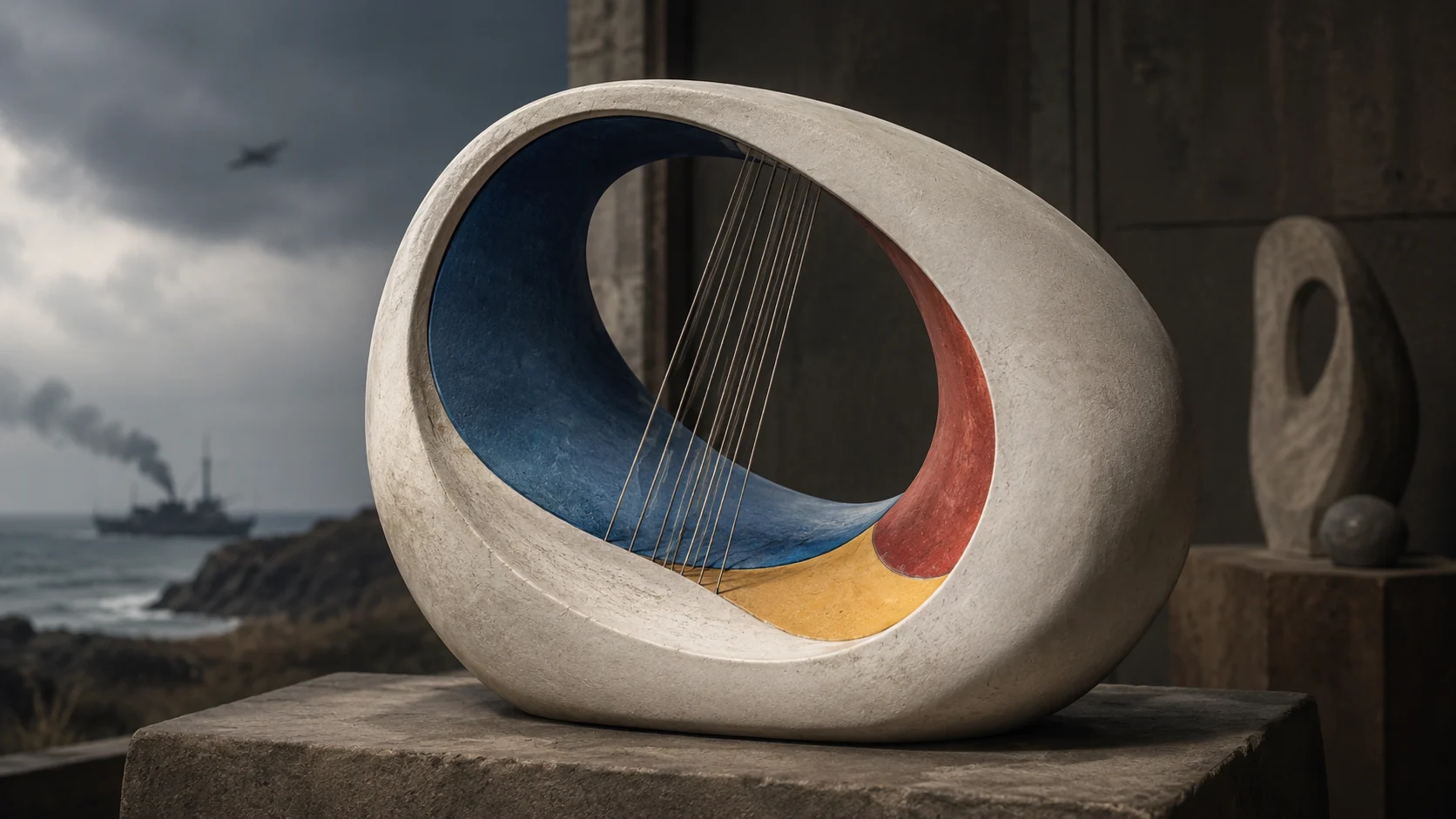
Barbara Hepworth color sculpture is having one of those rare cultural moments where an artist people thought they already understood suddenly feels new again. For decades, Hepworth has been filed in the public imagination as a sculptor of clean forms, pierced ovals, smooth curves, and modernist calm. That image is not wrong, but it is incomplete, and the missing piece is color. Her use of blue, red, yellow, green, and painted interior space was not a decorative side note, especially during the pressure of wartime Britain. It was a way of thinking through survival, limitation, motherhood, landscape, and the stubborn belief that beauty could still have structure when the outside world was falling apart.
The story becomes more powerful when we place Hepworth inside the actual tension of the 1940s, not inside the clean white rooms where her works are usually shown today. War changed where artists lived, what materials they could find, how they worked, and what kind of emotional language felt honest. Hepworth moved through scarcity, displacement, family responsibility, and the heavy atmosphere of World War II while still trying to make forms that felt open rather than defeated. Color entered that world like a signal, sometimes quiet and sometimes sharp, but always intentional. It helped her turn sculpture into something more intimate, more psychological, and more alive than the stereotype of cold modernism allows.
Why Barbara Hepworth Color Sculpture Feels Fresh Again
The renewed attention around Barbara Hepworth color sculpture shows how much the art world is still re-reading modernism through details it once treated as secondary. Hepworth was never just cutting shapes from wood, stone, plaster, or bronze; she was building relationships between inside and outside, body and landscape, mass and light. Color mattered because it changed how those relationships were felt. A painted interior could make a hollow form pulse, while a thin line of color could turn a carved opening into something closer to a horizon, a wound, or a hidden chamber. Once viewers notice that, Hepworth’s sculpture stops looking purely formal and starts looking emotionally charged.
This shift also fits the current visual culture mood, where audiences are paying closer attention to process, context, and overlooked creative decisions. People want to know how objects were made, what pressures shaped them, and why certain choices were made under difficult conditions. Hepworth’s color work answers those questions without needing to shout. It reveals an artist making serious visual experiments while dealing with the realities of wartime life and domestic responsibility. In a time when creative workers are again talking about burnout, uncertainty, and the pressure to stay productive, her story feels strangely present.
Color Was Not Decoration, It Was Structure
One of the easiest mistakes to make with Hepworth is to treat color as something added after the “real” sculpture was finished. That is not how her best colored works behave. The color does not sit on the surface like a cosmetic layer; it shapes how the viewer reads depth, movement, and tension. In many works, the painted interior becomes the emotional core of the piece, pulling the eye through an opening and into a more private space. The outside may appear calm and controlled, but the inside can feel charged, atmospheric, and almost cinematic.
This is why her wartime color experiments feel so important for contemporary design and visual culture. Modern audiences are used to interfaces, interiors, branding systems, and digital artworks where color controls navigation and mood. Hepworth was working in a very different era, but she understood something similar at a sculptural level. A small shift in tone could change how a viewer moved around an object, how they understood its center, and how they felt its energy. Her color was not noise; it was a visual system that helped sculpture communicate without becoming literal.
Wartime Pressure Changed the Studio Language
During World War II, Hepworth’s working conditions were shaped by more than artistic ambition. Materials were harder to access, daily life was unstable, and the emotional climate of Britain was marked by anxiety and interruption. For an artist known for direct carving and physical engagement with material, that kind of disruption could have narrowed her practice. Instead, it pushed her into new solutions and new visual languages. Painted plaster, wood, string, and works on paper gave her a way to keep building forms when ideal conditions were simply not available.
That wartime limitation is one reason the color feels so urgent. It was not produced from abundance, but from constraint. When resources are limited, every visual decision becomes heavier because nothing can be wasted. A blue interior, a red accent, or a painted surface becomes a concentrated act of attention. Hepworth’s color choices carry the feeling of someone refusing to let scarcity flatten imagination.
The idea of color in the middle of war can sound almost contradictory, but that contradiction is exactly where the work gets its force. War often turns public life gray through fear, rationing, damage, and waiting. Hepworth’s color does not deny that reality, and it does not become cheerful escapism. Instead, it creates spaces of focus, resilience, and inner intensity. Her forms suggest that color can be a way to hold tension rather than avoid it.
The Emotional Power of the Hollow Form
Hepworth’s pierced and hollow forms are among the most recognizable features of her work, but color makes those openings more complicated. A hole in sculpture can be read as absence, space, breath, or vulnerability. When that hollow is painted, it becomes even more active because the empty space gains temperature and mood. The viewer is no longer only looking through the object; they are looking into a zone that feels intentionally held. In wartime works, that effect can feel especially human, as if the sculpture is protecting a small, bright interior against a difficult outer world.
This is where Hepworth’s work becomes deeply relevant for modern visual storytelling. Contemporary audiences understand the power of interior worlds, whether through film frames, digital environments, product design, or immersive installations. Hepworth was creating that kind of spatial storytelling long before those categories became mainstream. Her hollows behave like scenes, and her colors work almost like lighting design. The object remains abstract, but the emotional atmosphere is surprisingly direct.
Motherhood, Labor, and the Myth of Effortless Genius
Any serious reading of Hepworth’s wartime work also has to consider the labor behind it. She was not creating in some fantasy version of the artist’s life, free from interruption and responsibility. She was a mother, a working artist, and a person trying to protect creative focus inside a demanding domestic reality. That matters because the clean precision of her finished works can hide the messier conditions that produced them. The polished form does not mean the process was smooth.
This tension gives her color work another layer of meaning. The brightness is not naive, and the balance is not effortless. It comes from someone who understood pressure at the level of body, time, and attention. In that sense, her sculpture becomes a record of persistence as much as invention. The work says that discipline can survive in fragments, and that visual clarity can emerge from days that are anything but clear.
That insight feels especially modern because creative culture still romanticizes nonstop output while ignoring the hidden cost of making things. Hepworth’s example complicates that myth in a useful way. She shows that great work can come from interrupted time, but only when society recognizes the seriousness of that work and the conditions needed to sustain it. Her practice does not turn struggle into branding. It turns struggle into form, color, and rhythm.
Cornwall, Landscape, and Color Memory
Hepworth’s move to Cornwall is often discussed through landscape, and for good reason. The Cornish coast, with its sea light, stone, horizon lines, and weather shifts, became central to the way she imagined form. But landscape in her work is rarely simple scenery. It becomes memory, structure, and feeling. Color helped translate that landscape into sculpture without turning it into a literal picture.
Blue, in this context, can suggest more than the sea. It can carry depth, distance, coolness, and mental space. Yellow can feel like light hitting a surface, but it can also suggest warmth inside a hard form. Red can introduce intensity, risk, or a pulse of human presence. Hepworth’s colors work because they are open enough to hold several meanings at once.
This is one reason her art remains useful for designers and digital creators today. She understood that color does not need to explain itself too directly to be powerful. It can guide feeling before language catches up. It can make an object feel grounded, alive, tense, or calm. In a visual world overloaded with instant messaging and aggressive palettes, Hepworth’s controlled use of color feels almost radical in its restraint.
Why Designers Should Study Hepworth Now
For designers, Hepworth’s color practice offers a lesson in how to make color structural rather than decorative. The most effective visual systems do not treat color as an afterthought added at the end of a project. They use it to define hierarchy, emotional tone, movement, and attention. Hepworth’s sculpture does exactly that in three-dimensional space. Her work reminds us that color is not only about taste; it is about how people move, feel, and understand what they are seeing.
There is also a lesson in restraint. Many digital visuals today rely on saturation, speed, and constant contrast to keep the viewer engaged. Hepworth’s color moves more slowly, but it lasts longer in the mind. It asks the viewer to notice placement, edge, surface, and depth. That kind of patience can be valuable for anyone building visual identities, exhibition concepts, product interfaces, or immersive environments.
Her practice also shows how limitation can create originality. When ideal materials were not available, she did not simply wait for better conditions. She adapted her language and let the available materials shape new possibilities. That lesson matters in creative software, digital art, and visual innovation, where tools change quickly and constraints are constant. The smartest work often comes from treating constraints as part of the concept rather than as an excuse for weaker ideas.
The Trend Impact: Modernism Gets More Human
The renewed focus on Hepworth’s color also reflects a wider shift in how museums, critics, and audiences are approaching modern art. For a long time, modernism was often presented through a clean story of innovation, abstraction, and formal progress. That story can be useful, but it can also erase the emotional, domestic, political, and material pressures behind the work. Hepworth’s color brings those pressures back into view. It makes modernism feel less like a sealed historical style and more like a living response to unstable conditions.
This matters because younger audiences often connect with art through context as much as form. They want to know why an artwork still matters, not just why it was important in a textbook. Hepworth’s wartime color gives them a strong answer. It shows an artist using abstraction to process pressure without turning that pressure into obvious illustration. That balance feels sophisticated, emotionally honest, and visually relevant.
The trend also pushes against the idea that serious sculpture must be neutral, monochrome, or emotionally distant. Hepworth’s work proves that color can be rigorous. It can be disciplined, architectural, and deeply intelligent. It can also make sculpture feel more accessible without making it simpler. That is a powerful combination for contemporary audiences who want depth but do not want art to feel locked behind academic language.
How to Look at Hepworth’s Color Work
The best way to approach Hepworth’s color work is to slow down and look at where the color lives. Is it on the outside surface, inside an opening, along an edge, or connected to string and line? That placement tells you how the sculpture wants to be read. Color inside a hollow form pulls attention inward, while color across a surface can change the weight of the object. Once you begin reading placement, the sculpture becomes more active and less static.
It also helps to move around the work, even if you are only imagining that movement through photographs. Hepworth’s forms shift as the viewer changes position. A painted interior may appear hidden from one angle and suddenly become central from another. This makes the viewing experience feel closer to discovery than simple observation. The work rewards attention because its visual information unfolds in time.
Another practical insight is to notice contrast between the material and the color. Wood, plaster, stone, and bronze all carry different emotional temperatures before paint even enters the conversation. When Hepworth adds color, she is not covering those materials so much as negotiating with them. The color either deepens the material’s natural mood or creates friction against it. That friction is often where the artwork becomes most alive.
What Visual Creators Can Learn From Her Wartime Palette
For today’s visual creators, Hepworth’s wartime palette is a reminder that color should answer a problem. It should not only make something look current, premium, nostalgic, or trendy. It should help the work think. In Hepworth’s case, color answered questions about interior space, emotional tension, landscape memory, and material limitation. That is why the works still feel fresh rather than trapped in a period style.
Creators working in digital art can take the same approach by asking what color is doing inside the structure of a piece. Does it guide the eye, create contrast, mark emotional change, or reveal hidden depth? Designers can ask whether a palette supports the user’s experience or simply follows a trend. Filmmakers and visual entertainers can study how Hepworth makes a small color field feel like a whole atmosphere. Her lesson is not to copy her palette, but to copy her seriousness.
There is also a useful lesson in quiet confidence. Hepworth did not need color to overwhelm the viewer. She used it with precision, often letting a small area carry the emotional weight of the whole form. That approach feels especially relevant in an age of visual overload. Sometimes the strongest image is not the loudest one, but the one where every visual choice has a job.
A Different Kind of War Story
Calling Hepworth’s wartime color work a war story may sound unexpected because there are no battle scenes, uniforms, explosions, or obvious symbols of conflict. But that is exactly what makes it powerful. It speaks to war through pressure, absence, adaptation, and the protection of inner life. The forms do not document events in a literal way. They show what it can mean to keep making when normal life has been fractured.
This kind of visual response is easy to underestimate because it does not perform trauma in an obvious way. Hepworth’s work is controlled, but control should not be mistaken for emotional distance. In a violent historical moment, control itself can become meaningful. To carve, paint, balance, and refine a form under pressure is to insist that order still matters. Her color becomes part of that insistence.
The result is not escapism, but resistance at the scale of form. A painted hollow, a colored string, or a bright interior can feel like a private refusal to let crisis define the entire visual field. That refusal is subtle, but it is not weak. It gives the work a quiet moral force. Hepworth’s sculpture does not shout against war; it builds another kind of space inside it.
Why Her Color Still Looks Contemporary
Hepworth’s color still looks contemporary because it is tied to experience rather than fashion. Trend colors age quickly when they are used only to signal the present moment. Hepworth’s colors last because they are connected to space, material, and feeling. They do not depend on being fashionable to make sense. They keep working because the visual problem they solve is still alive.
Her sculpture also aligns with current interest in sensory design. People are thinking more about how spaces feel, how objects affect mood, and how visual choices shape attention. Hepworth explored those questions through handmade forms and carefully placed color. She gives contemporary creators a historical model for making work that is minimal but not empty. Her art proves that restraint can carry emotion when the structure is strong enough.
That is why a renewed look at her color is not just an art history update. It is a design conversation, a creative strategy conversation, and a cultural memory conversation at the same time. Hepworth helps us see that visual innovation does not always come from new technology. Sometimes it comes from looking again at a material, a surface, or an opening that everyone else has stopped questioning.
Conclusion: Color as Survival, Not Decoration
Barbara Hepworth color sculpture matters because it changes the way we understand one of modernism’s most important artists. It reveals a maker who used color not as a soft extra, but as a structural and emotional force. During wartime, when materials, time, and certainty were all under pressure, Hepworth turned color into a way of holding space open. Her painted interiors and charged surfaces remind us that abstraction can be deeply human. They also show that beauty, when handled with discipline, can become a form of resilience.
For Visual Vortixel readers, the lesson is clear: color is never just color when it is used with purpose. It can guide attention, protect emotion, shape space, and carry historical memory. Hepworth’s wartime work still speaks because it understands that visual creativity is not separate from life’s hardest conditions. It is often made directly inside them. That is why her colors, born in a period of pressure and uncertainty, still feel alive enough to challenge how we design, look, and create today.