

Total Solar Eclipse Photography Takes Focus
 Vortixel
18 minutes read
Vortixel
18 minutes read
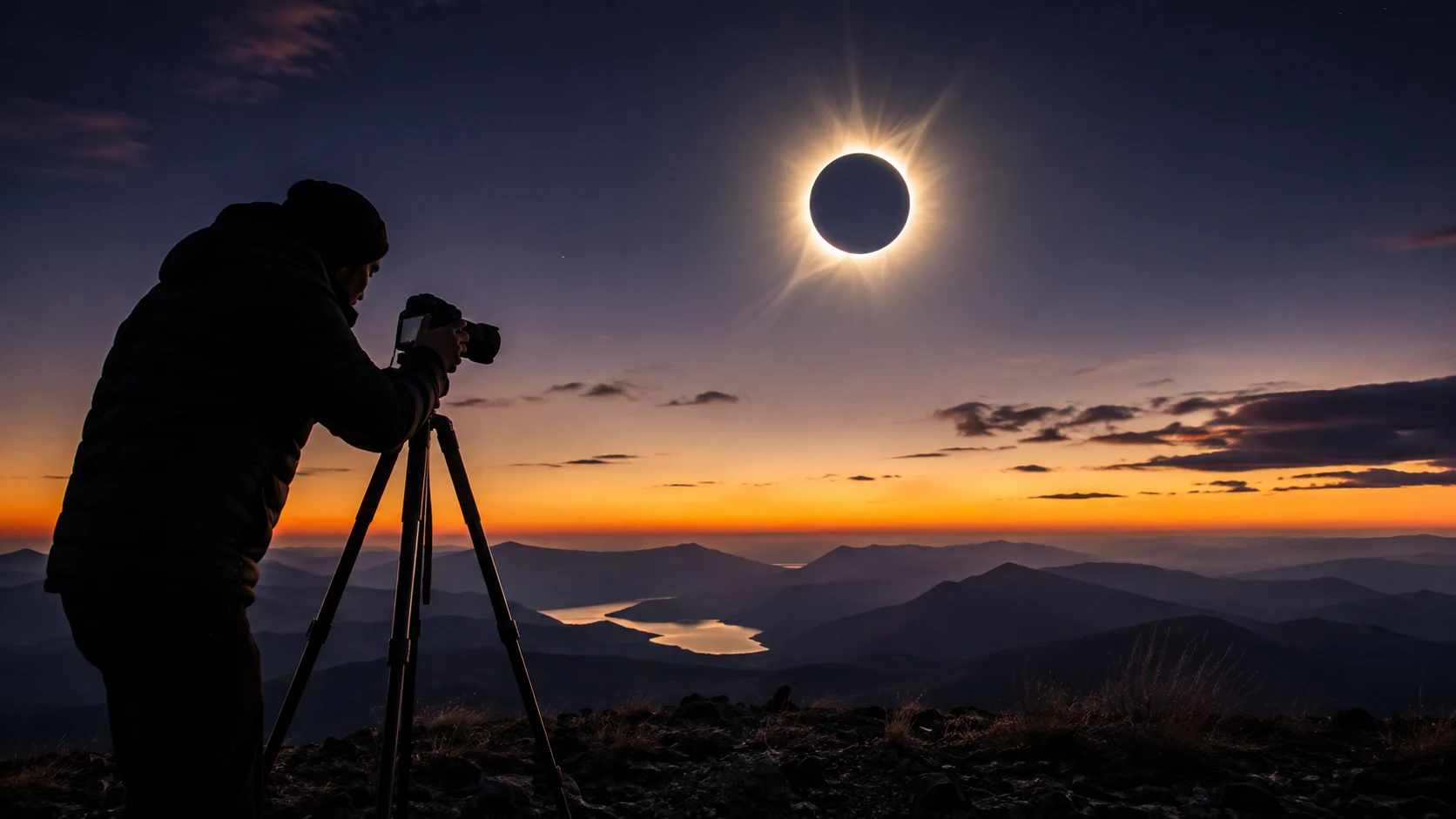
A camera bag can feel unusually heavy when the photograph you want exists for only a few seconds. On August 12, 2026, photographers across Greenland, Iceland, Spain, Portugal, and nearby regions will aim their lenses toward a sky that is about to perform one of nature’s fastest visual transformations. The growing excitement around total solar eclipse photography is not simply about recording a black circle in front of the Sun. It is about preserving the strange light, the changing landscape, the reactions of a crowd, and the glowing solar atmosphere that normally remains invisible. With the date approaching, experienced astrophotographers and first-time eclipse shooters are discovering that preparation matters almost as much as the shutter button itself.
This eclipse arrives with a visual personality unlike the midday spectacle many Americans photographed in April 2024. Across much of northern Spain, totality will occur late in the day, placing the darkened Sun close to the western horizon. That low angle can turn an astronomical event into a cinematic landscape photograph, with mountains, coastlines, old buildings, fields, or human silhouettes sharing the frame. It also creates practical problems involving haze, clouds, blocked horizons, and rapidly changing exposure. Photographers are therefore preparing not just for the eclipse in the sky, but for the environment surrounding it.
Why Total Solar Eclipse Photography Feels Different
Most photographic subjects give people another chance. A portrait can be reshot, a city can be revisited, and even a difficult sunrise may return with slightly different colors the next morning. A total solar eclipse offers no such comfort because the decisive sequence moves forward whether the photographer is ready or not. The partial phase develops slowly, but totality arrives with startling speed and can end before an operator has recovered from the first wave of excitement. That pressure is one reason total solar eclipse photography has become a distinctive challenge within modern visual culture.
The August 12 eclipse will cross remote Arctic areas before reaching Greenland, western Iceland, the Atlantic, a small corner of Portugal, and northern Spain. Many other locations across Europe, northern North America, and northwestern Africa will see a partial eclipse rather than totality. Inside the narrow totality path, the Moon will completely cover the Sun and reveal the corona, the pale outer atmosphere that spreads beyond the dark lunar disk. The longest total phase will last a little more than two minutes, although the exact duration depends on location. That brief window is generous compared with a ten-second exposure, yet incredibly short when a photographer must change filters, adjust settings, monitor focus, and remember to look up.
The visual difference between a partial eclipse and totality is also larger than newcomers often expect. Even when most of the Sun is covered, the remaining portion remains intensely bright and the landscape can still resemble an ordinary day. Once the last bright section disappears, the scene changes dramatically, temperatures may drop, shadows become unfamiliar, and the horizon can glow in multiple directions. Stars or bright planets may appear while the corona surrounds the Moon like delicate silver hair. A photograph of that transition is not simply an astronomy image; it becomes evidence of an entire atmosphere changing at once.
A Late-Day Eclipse Changes the Visual Story
Spain has become one of the main destinations for eclipse photographers because the path crosses a large section of the country. The timing near sunset offers a rare opportunity to frame the eclipsed Sun with recognizable features on Earth rather than isolating it against empty black space. A telephoto composition might place the Sun behind a ridge, lighthouse, castle, church tower, or distant group of observers. A wider composition could show the growing shadow spreading across farmland or a coastal town falling into temporary dusk. These possibilities are pushing photographers to think more like location scouts and cinematographers than traditional telescope operators.
However, a low Sun demands a clear western view, and that requirement may be more important than choosing a famous destination. A beautiful mountain valley can become useless when the Sun disappears behind a ridge before totality begins. A historic city center may offer striking architecture but limited sightlines, dense crowds, and fewer opportunities to reposition. Coastal sites may provide open horizons, although sea haze and wind can complicate long-lens work. The smartest preparations begin with maps, Sun-position planning tools, elevation data, weather patterns, and at least one alternative location.
Iceland and Greenland offer a different kind of visual drama. Their rugged terrain, ice, volcanic landscapes, and enormous open spaces can create photographs that feel almost otherworldly even before the eclipse begins. Yet northern weather is unpredictable, and cloud cover can erase the main subject no matter how expensive the equipment may be. Travel between potential shooting sites may also be slower or more restricted than it appears on a digital map. For photographers heading north, flexibility is becoming a more valuable asset than an elaborate shot list.
Planning the Photograph Before Packing the Camera
The strongest eclipse photograph often begins weeks or months before the camera leaves its case. Photographers must first decide whether they want a close study of the Sun, a wide environmental scene, a sequence showing the eclipse stages, or a documentary story about the people witnessing it. Each choice requires different lenses, positions, exposure plans, and expectations. Trying to capture every possible interpretation with one camera can turn a meaningful experience into a frantic technical exercise. A clear creative goal reduces that pressure and helps the photographer recognize which moments actually matter.
A detailed solar image usually requires a telephoto lens, stable tripod, secure solar filter, and careful focusing. A landscape image may work better with a normal or wide-angle lens, especially when the low Sun is combined with foreground elements. A composite sequence requires a locked composition and accurate knowledge of how the Sun will move through the frame. Documentary coverage benefits from mobility, fast reactions, and attention to faces rather than perfect astronomical magnification. Many experienced photographers use two cameras, but only when both systems can be operated without creating confusion.
Scouting should happen at approximately the same time of day as the eclipse whenever possible. This reveals whether buildings, hills, trees, or temporary structures block the western sky. It also shows how long shadows fall, where crowds may gather, and whether the ground can safely support a tripod. Photographers should mark more than one usable position because access rules, traffic, weather, or local events can change without warning. The most sophisticated visual plan still needs a practical route from the hotel, campsite, parking area, or public transportation stop.
Solar Filters Are Essential, Not Optional
Safety is the part of eclipse photography that cannot be improvised. During every partial phase, the Sun remains dangerous to eyes, camera sensors, and optical equipment when viewed without proper protection. Sunglasses, dark plastic, neutral-density filters, exposed film, and homemade materials are not substitutes for certified solar-viewing products. A dedicated solar filter must cover the front of the lens so intense light is blocked before it travels through the optical system. It should fit securely enough that wind, movement, or an accidental touch cannot knock it loose.
Photographers using optical viewfinders face an especially serious risk because the lens can concentrate sunlight directly toward the eye. Mirrorless cameras and live-view screens reduce direct viewing through the optical path, but they do not remove the need for a proper front-mounted filter. Anyone standing around the camera must also use safe eclipse glasses or an approved handheld viewer during the partial phases. Ordinary camera filters designed to control brightness for artistic purposes do not provide reliable protection from all harmful solar radiation. The correct safety setup should be tested calmly before eclipse day rather than assembled while the Sun is already disappearing.
The solar filter is removed only during totality, when the bright surface of the Sun has been completely covered. This is the moment when the corona becomes visible and ordinary solar-filtered settings are no longer appropriate. The filter must go back on before the first bright point of direct sunlight returns. Photographers often use an audible timer, a companion, or a scripted sequence to avoid losing track of this transition. Totality may feel dreamlike, but safety depends on treating its beginning and ending with precision.
The Gear That Matters and the Gear That Does Not
Eclipse photography encourages gear anxiety because the subject appears small, bright, distant, and technically demanding. In reality, reliability matters more than owning the newest camera body. A familiar DSLR or mirrorless camera with manual exposure control can produce excellent results when paired with a suitable lens and secure filter. A sturdy tripod helps maintain composition, while a remote release or short self-timer reduces vibration. Spare batteries, formatted memory cards, lens cloths, tape, and simple weather protection may save more photographs than an additional high-end accessory.
A long telephoto lens can reveal the corona, prominences, diamond-ring effect, and fine details around the lunar edge. Focal lengths around 400 millimeters or longer provide a substantial solar disk on full-frame cameras, although crop-sensor bodies can create a tighter apparent field of view. Extremely long focal lengths make tracking and composition more difficult, particularly when the Sun sits near the horizon. A wider lens offers fewer solar details but gives the eclipse a sense of place and scale. The “best” lens therefore depends on whether the intended story is about the Sun itself or the world responding beneath it.
Smartphones will also play a major role in documenting the event. They are not ideal for detailed close-ups of the corona without specialized accessories, but they are excellent tools for capturing environmental changes, crowds, shadow patterns, and quick video clips. A phone can record the photographer’s own reaction while a larger camera remains locked on the sky. It can also serve as a backup for location notes, timing alerts, weather updates, and behind-the-scenes material. Used thoughtfully, the smallest camera in the bag may preserve the most personal part of the day.
Rehearsal Turns Technical Chaos Into Muscle Memory
Photographers cannot recreate totality on demand, but they can rehearse nearly everything surrounding it. A practice session with the uneclipsed Sun allows users to test the filter, tripod, framing, focusing method, shutter controls, and battery performance. It also reveals whether the camera overheats, whether the display is visible in bright light, and whether the chosen lens is difficult to aim. Repeating the sequence builds muscle memory so important controls can be found without searching through menus. That familiarity becomes invaluable when excitement makes even simple tasks feel strangely unfamiliar.
Manual focus is often the safest choice because autofocus may struggle with a filtered solar disk or the rapidly changing contrast around totality. Photographers can focus carefully on the Sun before the main event, confirm sharpness using magnified live view, and then secure the focus ring with removable tape. The lens should still be checked occasionally because temperature changes or accidental contact can shift focus. Image stabilization settings may also need adjustment when the camera is mounted on a stable tripod. Every decision should be verified with the actual camera and lens combination rather than assumed from generic advice.
Exposure rehearsal is equally important, although no single setting can capture every eclipse phase. During the filtered partial phases, the Sun may require a relatively fast shutter speed at a low ISO and moderate aperture. During totality, the corona contains an enormous range of brightness, from the luminous inner region to faint streamers extending outward. Photographers often bracket multiple shutter speeds while keeping aperture and ISO relatively consistent. A planned bracket sequence creates raw material for later processing without requiring constant judgment during the shortest part of the event.
Automation Can Help Without Taking Over
Camera automation has become an important trend in contemporary eclipse work. Intervalometers, programmable camera controls, and specialized software can trigger exposure sequences according to a prepared timeline. This allows a photographer to step away from the screen, watch totality directly, or operate a second camera focused on the surrounding scene. Automation can also reduce touching the camera and create more consistent sequences. However, it introduces new failure points involving cables, permissions, battery drain, clock synchronization, and software behavior.
The most reliable automation is usually the simplest system the photographer has already tested several times. Eclipse day is not the ideal moment to install new firmware, learn an unfamiliar application, or connect a complicated network of devices. A fully manual backup plan should exist in case a laptop freezes, a cable disconnects, or an interval sequence fails to begin. Physical controls and printed exposure notes remain useful even in a workflow built around advanced software. Technology should protect attention, not consume it.
This balance between computation and human judgment reflects a wider shift in visual innovation. Modern imaging systems can recognize scenes, stabilize movement, merge exposures, reduce noise, and automate repetitive actions with remarkable speed. Yet an eclipse photograph still depends on where someone chooses to stand, what they include in the frame, and how they respond to uncertainty. Software can execute a sequence, but it cannot guarantee emotional meaning. The photographer remains responsible for transforming a celestial event into a visual story.
Why Weather Planning Needs Multiple Answers
Clouds are the variable no camera setting can defeat. A thin layer may soften the Sun and create atmospheric color, while a dense bank can hide every visible phase. This makes weather analysis a central part of eclipse preparation rather than a final check on the morning of the event. Photographers are comparing historical cloud patterns, regional geography, road networks, and short-range forecasts to understand where mobility may offer an advantage. The goal is not to find a location that guarantees clear skies, because no such promise exists, but to preserve options until the latest practical moment.
A useful plan includes a preferred site, one or two backup locations, travel times, and a deadline for deciding whether to move. That deadline matters because waiting for perfect certainty can leave a photographer trapped in traffic while clearer skies appear elsewhere. Local terrain can create weather differences across relatively short distances, especially near mountains and coastlines. Communication coverage may become unreliable when large crowds gather, so offline maps and saved coordinates are wise. A calm decision framework is more useful than repeatedly refreshing several weather apps without a strategy.
Wind deserves attention as well, particularly at exposed coastal overlooks and northern locations. Strong gusts can shake a long lens, move a filter, or turn lightweight equipment into a hazard. A stable tripod should be positioned carefully, weighted when appropriate, and kept away from busy walking paths. Photographers may need to lower the tripod, shield the setup, or choose a wider composition when conditions make extreme magnification unrealistic. The successful image is the one the environment allows, not always the one imagined months earlier.
The Human Scene May Become the Strongest Image
Technical preparation can make photographers forget that an eclipse is also a public event. Families, scientists, travelers, children, local residents, and dedicated eclipse chasers will share the same sudden darkness. Faces may shift from concentration to disbelief within seconds, creating photographs that communicate the experience more immediately than a perfectly centered solar disk. The horizon, crowd, and changing ambient light can reveal scale in a way that a tightly cropped astronomical photograph cannot. For visual storytellers, the people looking upward may be as important as the object they are watching.
A second camera with a wider lens can capture these reactions while the main telephoto setup remains pointed toward the Sun. Photographers working alone can simplify the task by recording video, setting an interval sequence, or choosing a fixed environmental composition. It is also worth photographing the hours before totality, including equipment setup, handmade signs, protective glasses, gathering crowds, and changing shadows. These frames create narrative context and make the final eclipse image feel like part of a complete story. Without them, a gallery may show what happened in the sky but not what the moment meant on the ground.
Ethical awareness remains important in crowded settings. People should not be blocked, pushed, or treated as props during a rare experience they traveled to witness. Tripods must not create hazards, and drones may be restricted or inappropriate around large gatherings, protected landscapes, and sensitive locations. Local instructions deserve respect even when they interfere with a planned composition. A memorable photograph loses value when it is produced by damaging the experience of everyone nearby.
Editing the Corona Without Losing Its Character
The work continues after the sky returns to normal. Eclipse files often require careful processing because the corona’s brightness range exceeds what a single exposure can comfortably preserve. Photographers may combine bracketed frames to reveal both the bright inner corona and the softer structures farther from the Sun. Alignment must be precise because the Moon and Sun move across the frame while the bracket sequence is being recorded. The final blend should preserve believable structure rather than turning the corona into a flat digital halo.
Modern editing software makes it easier to recover highlights, control noise, align sequences, and combine exposures. Artificial intelligence tools can help with masking, sharpening, upscaling, and removing sensor artifacts, but they also raise questions about authenticity. An algorithm that invents missing texture or aggressively reconstructs the lunar edge may create an attractive image that no longer represents what the camera captured. Transparent editing choices are especially important in astronomical photography, where viewers may interpret the image as a record of a natural phenomenon. Enhancement can reveal information, but fabrication changes the nature of the work.
Color is another area where restraint matters. The corona is often rendered in subtle whites and grays, while prominences may show pink or red tones depending on exposure and processing. A low-altitude eclipse can introduce warm atmospheric color around the horizon, making the surrounding scene visually richer than a high-noon event. Photographers may legitimately adjust contrast and white balance to communicate what the moment felt like. The strongest edit usually supports the visual structure already present instead of forcing the image into a fashionable preset.
A Practical Eclipse Photography Checklist
A checklist cannot eliminate uncertainty, but it can prevent avoidable mistakes. The most useful lists are personalized around the exact camera setup rather than copied without testing. Each item should have a clear purpose, and every critical component should be checked before leaving for the site. Reducing unnecessary gear makes it easier to move when weather changes or access becomes crowded. The following essentials provide a practical foundation for most eclipse photography plans.
- A camera and lens combination tested in advance
- A securely fitted front-mounted solar filter
- Certified eclipse glasses for personal viewing
- A stable tripod and remote shutter control
- Fully charged batteries and additional memory cards
- Printed timing, exposure, and filter-removal notes
- Offline maps for the primary and backup locations
- Weather protection for the camera and photographer
- A phone alarm or audible totality countdown
- A simple manual backup plan for automation failures
The checklist should also include non-photographic needs such as water, food, layered clothing, sun protection, and a safe light for packing after dark. Northern locations can become cold quickly, while Spain in August may remain hot even as the eclipse briefly reduces sunlight. Traffic delays may extend the day far beyond the duration of the event. A photographer who is hungry, dehydrated, or rushing is more likely to make technical and safety mistakes. Comfort is not separate from creative performance; it supports it.
The Bigger Impact on Visual Culture
The August eclipse will unfold in an era when visual events become global almost instantly. Professional images, phone videos, livestreams, satellite views, scientific recordings, and social media reactions will appear side by side. Millions of people outside the path will experience the event through screens, often seeing edited images before some photographers have packed their tripods. This speed creates pressure to publish immediately, but the most enduring work may come from photographers who take time to build thoughtful sequences. Being first is not the same as producing an image that remains meaningful.
The event may also influence travel photography, documentary practice, visual education, and public interest in astronomy. Local landscapes that rarely appear in international media could suddenly become recognizable through eclipse images. Schools and science organizations can use these photographs to explain the solar corona, orbital alignment, changing light, and atmospheric response. Designers may draw inspiration from the eclipse’s gradients, silhouettes, and unusual color relationships. A two-minute celestial event can therefore generate visual ideas that continue circulating for years.
At the same time, the flood of similar close-up images will challenge photographers to develop a more personal perspective. Technical perfection alone may not separate one frame from thousands of other sharp corona photographs. Location, foreground, human presence, timing, and narrative sequence will become the stronger markers of authorship. This does not mean every image needs a dramatic landmark or complicated concept. It means the photographer should understand why their chosen frame matters beyond proving that they attended the eclipse.
When Preparation Finally Meets the Shadow
On August 12, the months of planning will collapse into a sequence measured in minutes and seconds. Filters will come off, shutters will fire, crowds will react, and familiar landscapes will enter an unfamiliar twilight. Some photographers will capture every planned frame, while others will face clouds, technical failures, or compositions that no longer work. The event will continue without judging any of those outcomes. That indifference is part of what makes photographing an eclipse both frustrating and deeply compelling.
The best preparation creates enough confidence for the photographer to stop thinking about the camera for a moment. Totality should be seen directly with the unaided eye only during the safe, fully covered phase, because no photograph can reproduce the complete sensory experience. The temperature, silence, crowd noise, horizon glow, and sudden appearance of the corona belong to a moment larger than a camera sensor. Looking up is not a failure to document the event. It is the reason the documentation matters.
Ultimately, total solar eclipse photography is a meeting between precision and wonder. It requires maps, filters, exposure tests, weather decisions, and practiced movements, yet its emotional power comes from something no checklist can manufacture. The August 2026 eclipse will offer photographers a rare chance to combine advanced imaging technology with one of the oldest human experiences: watching daylight disappear and return. Those who prepare carefully will improve their chances of bringing home strong photographs. Those who remain present may also return with something harder to store but equally valuable—a memory of the sky changing faster than words could explain.