
AI Artist Royalties Enter a Real-World Test
 Vortixel
17 minutes read
Vortixel
17 minutes read
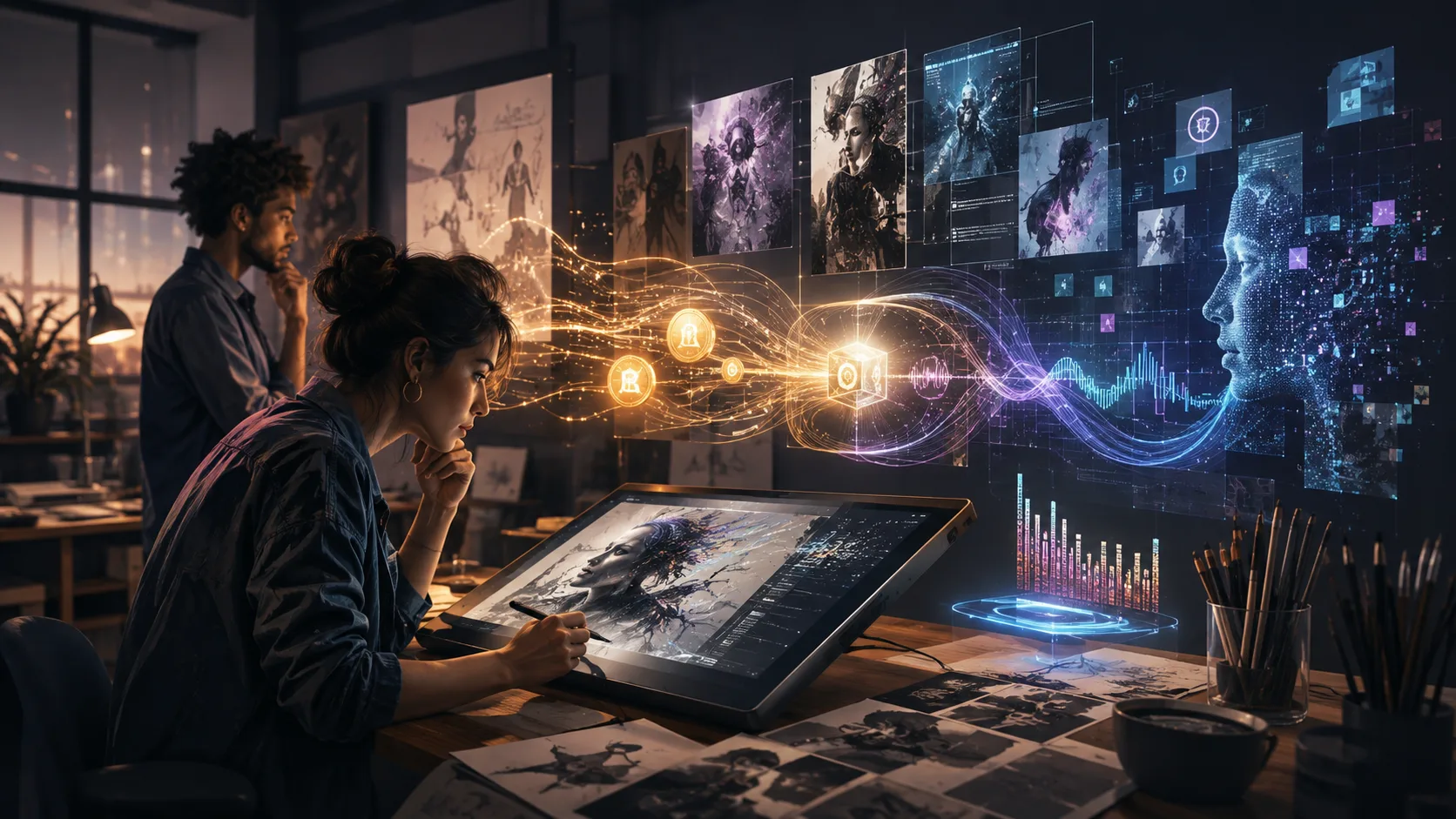
For years, visual artists watched generative AI companies build increasingly powerful image and video tools while one uncomfortable question remained unanswered: who gets paid when human creativity becomes training material? That question is finally moving beyond courtrooms, protest letters, and social media arguments into a messier real-world experiment. A new generation of platforms is testing AI artist royalties, offering illustrators, animators, and other creators a financial share when users generate visuals influenced by their licensed work. The idea sounds like a long-overdue compromise between technological progress and creative ownership, but its success will depend on far more than adding a payment dashboard. Artists now have to decide whether participation creates meaningful leverage or simply gives an ethically complicated industry a cleaner public image.
The timing matters because generative visual technology is no longer a strange side feature hidden inside experimental apps. AI images appear in advertising pitches, social feeds, music videos, product mockups, movie concepts, mobile games, and corporate presentations every day. Video generators can now produce polished scenes with convincing movement, lighting, camera direction, and character consistency, shrinking tasks that once required teams into workflows managed by a single person. As the technology becomes easier to use, demand for distinctive visual styles is rising alongside the supply of generic synthetic content. That tension has pushed AI artist royalties from a theoretical policy idea into a potential business model for the next phase of digital creativity.
Why AI Artist Royalties Are Emerging Now
The earliest wave of popular image generators was shaped by speed, scale, and an almost reckless desire to prove what the technology could do. Companies gathered enormous amounts of online material, trained models, and released tools capable of imitating countless visual traditions without establishing direct relationships with most of the people whose work helped shape those systems. Artists quickly recognized familiar compositions, signatures, character designs, and highly specific stylistic patterns inside generated images. Many creators argued that their portfolios had effectively been transformed into commercial infrastructure without permission, credit, or compensation. The resulting backlash turned AI training data from a technical detail into one of the defining cultural conflicts of the decade.
Legal battles followed, but lawsuits move more slowly than software releases. While courts examine copyright, fair use, ownership, and platform responsibility, creative professionals still have to make decisions about jobs, contracts, and tools in the present. Some artists refuse generative systems completely, while others use them carefully for ideation, editing, background work, or production assistance. A smaller group is exploring licensing because it offers at least some ability to set conditions rather than waiting for regulation to catch up. Royalty experiments have emerged in that gap, promising a route where artists can participate voluntarily and earn money when their creative contributions help generate new visual content.
One recent model combines tiny usage-based payments with a shared percentage of platform revenue. Under this type of structure, an artist might earn a small amount each time a licensed style contributes to an image or each second of generated video, while also receiving a portion of a broader subscription royalty pool. The individual payment may look microscopic, but supporters argue that volume could make the system meaningful if a platform attracts enough users. Critics immediately point out that “could” is doing a lot of work in that sentence. Without transparent usage numbers, minimum guarantees, and clear accounting, a royalty promise can remain more symbolic than economically useful.
A New Kind of Creative Licensing Model
Traditional visual licensing is usually attached to a recognizable asset. A publisher licenses an illustration, a brand pays for a photograph, or a studio commissions an animation for a defined campaign and period. Generative AI complicates that structure because the artist’s contribution may influence thousands of outputs without appearing as one clearly traceable image. The licensed material can shape texture, motion, color relationships, line quality, composition, or an overall visual language rather than being copied directly into a finished frame. That makes attribution technically difficult and turns royalty calculation into a question of both data science and contract design.
A workable system must explain what exactly is being licensed. Artists need to know whether they are providing finished images, training examples, style references, motion studies, character sheets, or access to an entire portfolio. They also need limits on how the resulting model can be used, including whether customers may create political advertising, adult material, misleading media, or content that damages the artist’s reputation. Geographic rights, licensing duration, model retraining, sublicensing, and termination procedures all matter as well. A friendly creator portal cannot replace a contract that clearly defines where the work goes and what happens after it enters a machine-learning pipeline.
The strongest royalty deals could resemble a combination of stock licensing, music residuals, and software revenue sharing. Artists would voluntarily submit verified material, select permitted uses, approve model updates, and receive recurring statements showing how their work influenced platform activity. The platform would maintain auditable records instead of asking creators to trust an invisible calculation. Ideally, artists could withdraw future participation without pretending that previously trained systems can be instantly untrained with one button. This structure would not eliminate every ethical concern, but it would move the relationship closer to negotiation than extraction.
Why Many Artists Still Do Not Trust the Offer
Compensation alone does not erase the history surrounding generative AI. Many visual artists believe the industry first used creative work without permission and is now offering small payments only after public criticism became impossible to ignore. From that perspective, royalty programs can feel less like justice and more like a reputation-management strategy. A company may spotlight a handful of paid contributors while continuing to rely on foundation models trained through less transparent methods. The artist-facing layer looks ethical, but the engine underneath may still contain the same unresolved data problems.
This creates a difficult distinction between licensing an artist’s work and licensing an artist’s identity. A creator may be comfortable allowing specific images to support a controlled model but deeply uncomfortable with customers generating endless content “in the style of” that person. Style imitation can affect future commissions even when no single output qualifies as a direct copy. Clients who once hired an illustrator for a distinctive campaign might decide that a cheaper synthetic approximation feels good enough. Royalties would then compensate the artist for helping create a substitute that could reduce the value of their primary career.
There is also a social dimension that platforms sometimes underestimate. Within creative communities, joining an AI licensing program may be interpreted as supporting tools that colleagues believe are harming employment and weakening professional standards. Some participating artists may prefer anonymity because they fear harassment, damaged relationships, or being publicly labeled as collaborators. That secrecy reveals how emotionally charged the issue remains, even when participation is voluntary. A market cannot claim genuine creator acceptance if many of its contributors feel unsafe attaching their names to the deal.
The Math Behind Tiny AI Royalty Payments
The financial viability of AI artist royalties depends on scale, attribution, and bargaining power. A fraction of a cent per image may become meaningful when millions of outputs are generated, but most artists cannot assume that their licensed influence will receive that level of demand. Platforms often promote aggregate possibilities while individual creators experience highly uneven results. A small number of visually popular contributors could earn steady revenue, while the majority receive occasional payments too low to change their working lives. This pattern already exists across streaming media, stock platforms, and creator marketplaces, where enormous total activity does not guarantee sustainable income for each participant.
Revenue pools introduce another layer of uncertainty. When a company allocates a percentage of subscription income to artists, creators need to know whether that percentage is calculated before or after discounts, refunds, platform fees, enterprise deals, and promotional access. They must also understand how the pool is divided among contributors whose styles or assets appear in different amounts. A system based entirely on generation volume could reward repetitive commercial trends while undervaluing experimental or culturally significant work. Transparent formulas are essential because a royalty rate means little when the underlying accounting remains hidden.
Minimum guarantees could make these agreements more credible. Instead of expecting artists to absorb all the risk, a platform could pay an upfront licensing fee, provide a guaranteed annual minimum, and add usage-based royalties on top. That structure would signal that the company believes the submitted material has real value before customers generate anything. It would also prevent creators from supplying professional archives in exchange for the possibility of future pennies. For established artists with recognizable styles, minimum guarantees may become a basic requirement rather than a premium benefit.
Attribution Is the Hard Technical Problem
Paying artists fairly requires knowing how much each artist contributed to an output, and that is not simple. Generative models do not usually store creative works like files inside a searchable folder. Training adjusts large networks of numerical parameters, allowing a system to learn patterns across vast collections of images, captions, frames, and motion examples. A finished visual may reflect relationships learned from thousands or millions of pieces of material rather than one identifiable source. That makes direct one-to-one royalty attribution much harder than tracking a song stream or stock-photo download.
Platforms can attempt to solve this by separating artist-specific adapters, fine-tunes, or licensed modules from a general model. When a user deliberately activates a particular artist’s licensed visual package, the system can record that choice and direct a payment to the contributor. This approach is cleaner because the royalty event is tied to an explicit tool rather than an uncertain estimate of influence. However, the base model may still carry visual knowledge acquired from broader internet data. The result is a layered system where one part is clearly licensed and another remains difficult to audit.
More advanced attribution methods could analyze how strongly different training materials affect an output. Researchers and developers are exploring data provenance, influence estimation, watermarking, content credentials, and model-level tracking, but none provides a universal answer yet. These techniques may become useful for verifying that licensed datasets were used correctly and that excluded material did not enter a training run. Still, technical complexity should not become an excuse for avoiding compensation. When perfect attribution is impossible, companies can create collective pools, minimum payments, or negotiated formulas that distribute value without pretending the science is more precise than it really is.
How Royalty Deals Could Change Digital Art
If royalty systems mature, they could create a new product category inside digital art. Artists might release licensed visual models alongside prints, commissions, tutorials, brushes, and asset packs. A creator known for dreamy architectural illustrations could offer a controlled generation module built from approved work, while an animator might license motion principles or character-expression studies. Customers would gain access to distinctive creative systems rather than generic prompt presets. Artists, in turn, could treat model access as an extension of their practice instead of seeing every AI tool as an external competitor.
This possibility is especially interesting for independent creators who already build recognizable visual worlds. A successful artist may have characters, environments, textures, and narrative rules that can support campaigns, games, films, merchandise, and interactive experiences. A licensed generative tool could help trusted collaborators explore that world without manually requesting every variation. The artist could remain the creative director while earning from controlled production at a scale that traditional commissions cannot match. The danger is that the tool could also separate the world from its creator if contracts grant the platform too much control.
Royalty deals may also influence how young artists think about portfolios. Instead of viewing every uploaded image only as promotion, creators may begin treating high-resolution files, layered documents, process recordings, and style studies as valuable training assets. That could encourage better rights management, clearer metadata, and more deliberate decisions about what is shared publicly. It might also make open creative culture less open, as artists protect material that could later support a licensed model. The long-term effect could be a web where visual work is increasingly divided between public previews and privately controlled training archives.
What Designers and Studios Should Watch
Designers considering a royalty program should begin by investigating the full technology stack. It is not enough to know that their personal uploads are licensed if the platform depends on a base model with unclear origins. Creators should ask which models process their work, whether the data is used for general training, and whether third-party providers receive access. They should also request an explanation of how generated content is labeled and what safeguards exist against impersonation or harmful use. A company that cannot answer these questions clearly is not ready to receive a professional archive.
Contract language deserves the same attention as payment rates. Artists should look for terms covering ownership, exclusivity, duration, sublicensing, termination, model deletion, derivative systems, and the company’s rights after an agreement ends. Broad language granting permanent, worldwide, transferable, and irrevocable rights can turn a promising royalty offer into a one-time surrender of control. Creators should also verify whether they remain free to license the same work elsewhere or build their own tools. Independent legal advice may cost money, but it can prevent far more expensive problems later.
Studios hiring artists must update their own agreements as well. A freelancer may not have the authority to submit commissioned work, client assets, confidential concepts, or production files to an AI platform. Ownership can be divided among agencies, brands, studios, and individual contributors, especially in animation and visual-effects pipelines. Companies need explicit policies explaining which materials may enter generative systems and who can approve that use. Without those rules, a well-intentioned artist could accidentally license work that belongs partly or entirely to someone else.
The Difference Between Consent and Real Power
Supporters often describe opt-in licensing as the clean solution because artists choose whether to participate. Consent matters, but consent does not automatically create a fair market. A freelance illustrator facing fewer commissions may accept unfavorable terms because refusing means earning nothing, not because the agreement reflects equal bargaining power. Platforms with funding, lawyers, infrastructure, and distribution can define the rules before individual creators even reach the negotiation table. Genuine fairness requires meaningful alternatives, understandable contracts, and the ability to say no without watching an unlicensed substitute reproduce the same aesthetic.
Collective bargaining could improve that balance. Artist associations, unions, licensing organizations, and professional groups can negotiate baseline rates that individual creators would struggle to secure alone. They could also establish standard definitions for training, fine-tuning, inference, style simulation, and commercial use, reducing the ambiguity found in many technology agreements. Collective systems may be particularly useful when exact attribution is impossible and revenue needs to be distributed across large groups of rights holders. The model would not be perfect, but it could prevent every artist from confronting a global technology company as an isolated individual.
Public pressure will remain important because companies respond to more than legal requirements. Customers, agencies, and enterprise buyers increasingly want to know whether AI tools expose them to copyright disputes or reputation risks. A platform built around licensed visual material may therefore gain a competitive advantage, even if its output is initially less flexible than that of unrestricted rivals. Ethical sourcing can become a product feature when brands need safe commercial workflows. The real test is whether buyers are willing to pay enough for that feature to support stronger compensation for creators.
Licensed Models May Produce Better Visual Culture
There is a creative argument for licensed systems beyond avoiding lawsuits. Generic models trained on enormous mixed datasets often produce familiar aesthetics: polished lighting, cinematic haze, symmetrical compositions, plastic skin, and details that feel impressive for a moment but forgettable afterward. Direct partnerships with artists could introduce more intentional visual languages, deeper cultural context, and better-defined artistic rules. Instead of asking one giant model to imitate everything, platforms could support smaller creative ecosystems built around particular communities and practices. That may lead to tools with narrower capabilities but much stronger identities.
Artists could also participate in the design of the generation experience. They might decide which parameters users can adjust, which subjects are restricted, how outputs are credited, and whether certain combinations violate the logic of the original work. This would shift the artist from passive data provider to active product collaborator. The platform would gain expertise that cannot be captured by scraping finished images alone, including process knowledge and creative judgment. Users would receive more than a digital imitation because the tool would reflect decisions made by the person behind the style.
That collaboration could produce a healthier distinction between inspiration and impersonation. A licensed model does not need to market itself as a way to replace a specific artist on demand. It can be framed as an authorized creative environment with boundaries, attribution, and shared economic value. Customers would know who shaped the system and why certain controls exist. Over time, audiences might begin treating authorized models like official collaborations, while viewing anonymous style-cloning tools as lower-trust alternatives.
Why This Experiment Could Still Fail
The biggest threat to royalty-based platforms is simple economics. Training and operating advanced visual models costs money, while customers are already used to low subscription prices and nearly unlimited generation. If companies allocate meaningful revenue to artists, maintain licensing systems, verify ownership, and build safety controls, their operating costs rise. Competitors using cheaper or less transparent data practices may offer more features for less money. Ethical platforms could therefore struggle unless users, investors, and enterprise clients value responsible sourcing enough to support it.
Another problem is artist supply. A platform needs enough high-quality licensed material to produce useful and diverse results, but many established creators remain unwilling to participate. Without respected artists, the product may generate visuals that feel generic, weakening the reason customers would choose it over larger competitors. Without customers, royalty payments remain too small to attract more contributors. This creates a classic marketplace loop where each side waits for the other to arrive first.
Trust can also collapse quickly if a company changes its terms. Startups may launch with creator-friendly promises and later face pressure to reduce payouts, broaden licenses, or prioritize growth after raising investment. Artists who helped build the early dataset could discover that the business no longer reflects the values that convinced them to join. Strong contracts and independent auditing can limit this risk, but they cannot remove it entirely. The credibility of royalty platforms will ultimately depend on years of consistent behavior rather than one polished announcement.
What a Fair AI Royalty Deal Should Include
A credible agreement should start with explicit opt-in consent for clearly identified material. It should explain whether the work supports training, fine-tuning, reference-based generation, style modules, or all of those activities. Artists should receive an upfront payment or minimum guarantee whenever the platform gains lasting value from their archive. Usage-based royalties should be additional income rather than the only possible compensation. The contract should also define a practical exit process and prevent future uses that were not disclosed when the creator joined.
Transparency should continue after the agreement is signed. Contributors need dashboards or statements showing generation volume, applicable rates, revenue-pool calculations, deductions, and payment dates. Independent auditing should be available when a platform’s internal attribution system determines how money is divided. Artists should be notified before major model updates or changes in permitted content categories. These practices may sound administrative, but they are what transforms a marketing promise into a professional licensing relationship.
Control over identity is equally important. Creators should decide whether their names appear in prompts, style menus, advertisements, and generated-content labels. They should be able to prohibit outputs that falsely imply personal endorsement or involvement. Platforms must also create fast processes for reporting harmful, deceptive, or reputation-damaging generations. Paying an artist does not give a company unlimited permission to simulate that person’s creative identity in every context.
The Future Will Be Negotiated, Not Automated
The arrival of royalty experiments does not mean the conflict between artists and generative AI has been solved. It means technology companies are beginning to recognize that creative labor cannot remain invisible forever. Some deals will provide meaningful new income, while others will likely offer tiny payments in exchange for rights far more valuable than the compensation. Artists will need to compare opportunities carefully rather than treating every opt-in program as automatically ethical. The market is entering a phase where the details of participation matter as much as the existence of payment itself.
For the visual technology industry, this is a test of whether innovation can mature beyond a culture of taking first and negotiating later. Licensed datasets, transparent attribution, collective bargaining, and creator-controlled models could establish a more stable foundation for generative tools. They could also encourage richer products by bringing artists into development as knowledgeable partners rather than anonymous sources of training material. None of this will happen through goodwill alone, because sustainable systems require enforceable contracts and business models that distribute revenue consistently. The companies that understand this may build deeper trust at a moment when synthetic media is making trust increasingly valuable.
Conclusion: AI Artist Royalties Face the Real Test
AI artist royalties represent one of the first serious attempts to turn years of creative conflict into a working economic relationship. The concept offers something artists have repeatedly demanded: consent, compensation, visibility, and a role in deciding how their work enters AI systems. Yet small usage fees and revenue pools will not be enough unless they come with transparent accounting, limited rights, strong safeguards, and meaningful creator control. The experiment will succeed only when artists earn more than symbolic payments and retain power over the visual identities they spent years building. Until then, royalty deals should be viewed not as the final answer, but as the opening round of a negotiation that will shape the future of AI and visual technology.