
Anti-ICE World Cup Posters Turn Art Into Action
 Vortixel
17 minutes read
Vortixel
17 minutes read
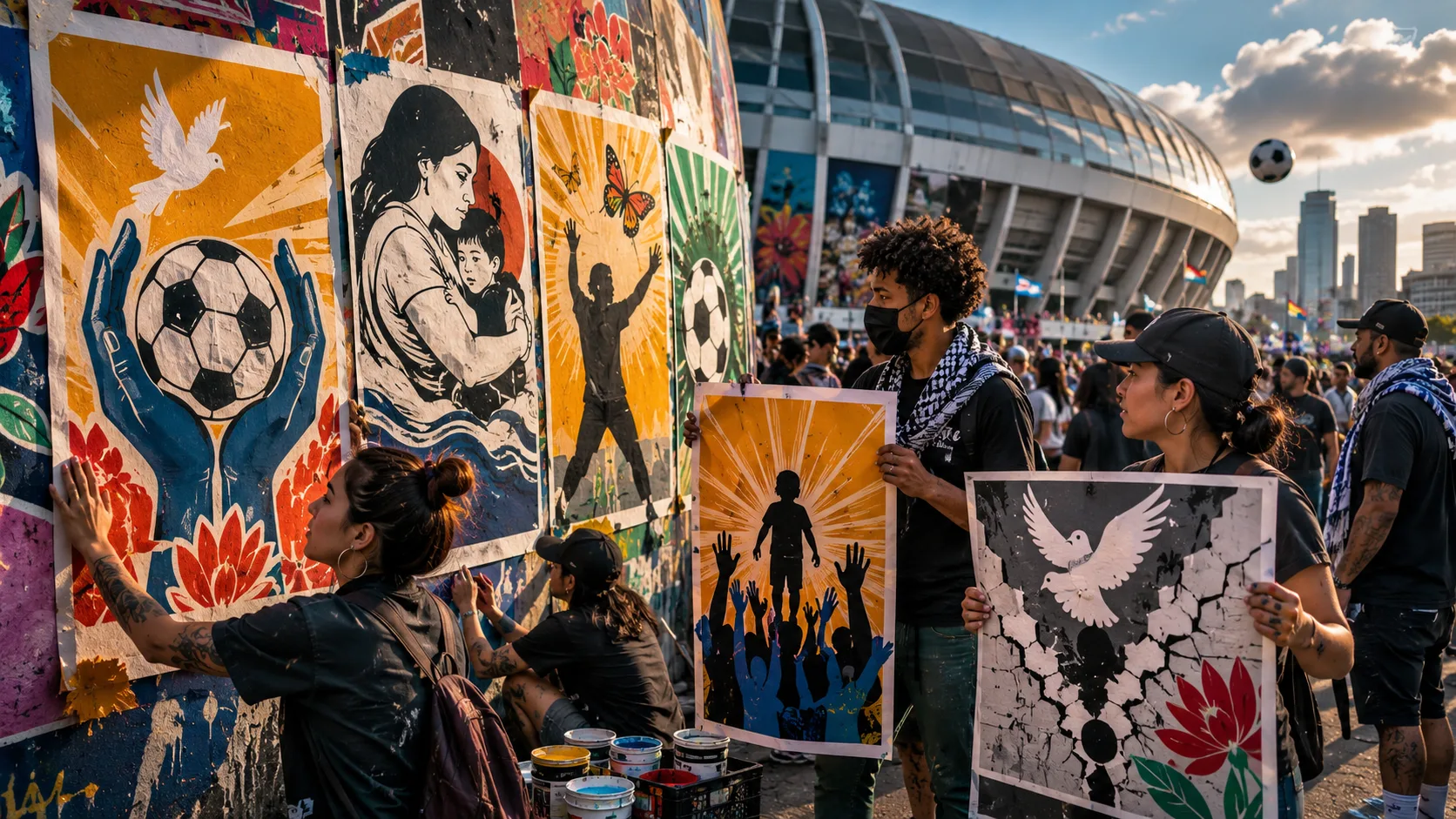
The most electric visual story around the 2026 soccer season is not only happening inside stadiums, fan zones, or broadcast graphics. It is also unfolding on posters, street walls, social feeds, and community spaces where artists are turning public anxiety into a clear visual message. The phrase Anti-ICE World Cup posters has quickly become more than a design description; it now points to a larger conversation about sport, migration, safety, and who gets to feel welcome at a global celebration. As the World Cup arrives across North America, artists are using bold colors, sharp typography, and emotionally direct imagery to challenge the potential presence of immigration enforcement around tournament spaces. Their work shows how protest art can move faster than official messaging because it speaks in symbols people understand before they even finish reading the words.
For a website like Visual Vortixel, this moment matters because it sits right at the intersection of design, public culture, and visual activism. Posters have always been one of the most accessible forms of political communication, but this campaign feels especially tuned to the way people experience images in 2026. It is made for sidewalks and rallies, but it is also made for screens, reposts, screenshots, and quick visual recognition. The best protest posters do not need long explanations to land emotionally, and that is exactly why this movement is gaining attention. In a tournament built around national flags, official mascots, and giant brand systems, independent artists are creating a counter-identity that asks a simple question: can the world’s most popular sport truly be joyful if some fans arrive feeling afraid?
Why Anti-ICE World Cup Posters Matter Now
The 2026 World Cup is being promoted as a massive cross-border celebration between the United States, Canada, and Mexico, which already makes it visually and politically different from previous tournaments. The event is not just about soccer; it is about movement, migration, travel, identity, and the temporary reshaping of cities into global gathering points. That context is why Anti-ICE World Cup posters have become such a powerful visual response. They are not simply objecting to one security detail or one government agency; they are questioning the emotional atmosphere around an event that depends on international visitors, immigrant communities, and multicultural fan energy. When artists put that tension into posters, they make the contradiction visible in a way official press statements usually avoid.
The campaign’s central visual idea is direct, memorable, and easy to carry: no ICE in the cup. That phrase works because it compresses a political demand into a sports-adjacent slogan that feels instantly shareable. It plays with the idea of a cup as both a trophy and a container, while turning the acronym ICE into a visual and emotional interruption. Good poster language often works like this, using simplicity to make a complex issue impossible to ignore. The result is a campaign that feels less like a policy paper and more like a public signal, which is exactly what strong graphic activism has always done best.
What makes this wave of posters especially interesting is the way it challenges the polished branding ecosystem around mega-events. Major tournaments usually arrive with strict visual systems, official posters, sponsor palettes, host city badges, and cinematic campaign videos. Those assets are designed to build unity and excitement, but they can also smooth over local conflicts and social unease. The anti-ICE posters do the opposite by bringing friction back into the frame. They remind viewers that visual culture around sport is never neutral, because every logo, banner, and poster helps decide what kind of story the event is telling.
The Visual Language of Protest Meets Soccer Culture
Soccer already has one of the strongest visual cultures in the world, from supporter banners and club scarves to stadium tifos and hand-painted signs. That makes it a natural space for protest design, because fans are used to seeing emotion expressed through graphics. The Anti-ICE World Cup posters tap into that tradition while adding the urgency of immigration justice. They use the language of crowds, flags, motion, and resistance, but they also carry the intimacy of local communities worried about who might be targeted during a global event. This mix gives the posters a layered identity: they are sports-adjacent, political, community-driven, and deeply visual all at once.
Many of the strongest protest visuals work because they feel handmade even when they are distributed digitally. Rough edges, bold contrast, limited color palettes, and imperfect textures can communicate urgency better than overly polished design. In this case, the poster format gives artists room to combine illustration, typography, symbolic objects, and regional references. A poster can look like a rally sign, a screen print, a street flyer, or a digital artwork, and each style brings a different emotional temperature. That flexibility allows the campaign to feel decentralized while still carrying a unified message.
The soccer connection also gives artists a rich set of symbols to remix. A ball can become a globe, a trophy can become a question mark, and a stadium can become a border zone in the viewer’s imagination. Even the idea of “the cup” becomes visually charged because it can represent celebration, competition, profit, or exclusion depending on how it is framed. This is why poster design is so effective here: it can turn familiar sports imagery into a critique without requiring viewers to read a long explanation. The best visuals make people pause first, then think, then talk.
A Campaign Built for Streets and Feeds
The modern protest poster no longer lives in only one place. It might appear at a community meeting, travel to a march, become a profile image, circulate in a carousel post, and then end up printed again by someone in another city. This hybrid life is central to the power of digital creativity today, because images can move between physical and online spaces without losing their core message. The anti-ICE World Cup campaign benefits from that movement because its design language is simple enough to recognize quickly but flexible enough to adapt. That is why it feels like a contemporary visual movement rather than a single poster drop.
Social media has changed the way protest art is judged, shared, and remembered. A poster now has to work on a wall from across the street, but it also has to work as a cropped image on a phone screen. It needs strong hierarchy, readable type, and enough visual punch to survive compression, reposting, and fast scrolling. This does not mean every protest poster must look like a meme, but it does mean clarity matters more than ever. The anti-ICE campaign understands that visual activism in 2026 has to be both printable and postable.
That dual function also changes the relationship between artist and audience. In older protest movements, viewers often encountered posters in public space and then carried the message mentally. Now, viewers can become distributors instantly by sharing the image, saving it, or printing it for another event. This turns the poster from a finished object into a circulating tool. For designers, that shift is important because it means the strongest campaign visuals are not only beautiful or clever; they are usable.
How Artists Turn Fear Into a Shared Image
The emotional center of the campaign is not abstract politics; it is fear. For many immigrant families and mixed-status communities, the possibility of enforcement presence around huge public gatherings can change how safe an event feels. A tournament that markets itself as welcoming the world can feel very different to people who worry that celebration could become surveillance. Artists are responding to that emotional reality by giving it a public shape. Through visual innovation, they transform private anxiety into a shared image that can be seen, discussed, and challenged.
This is one of the oldest strengths of protest art, but it still feels urgent in the current media environment. Policy debates can be technical, legalistic, and emotionally distant, especially for audiences outside the affected communities. A poster cuts through that distance by creating a mood before it delivers an argument. It can make absence feel visible, fear feel collective, and resistance feel possible. That is why visual activism often reaches people who might ignore a formal statement but stop for a powerful image.
The artists involved are also part of a broader history of using public graphics to defend vulnerable communities. From labor movements to civil rights campaigns to anti-war actions, posters have helped translate political urgency into everyday visual language. The anti-ICE World Cup posters continue that lineage while adapting it for a sports mega-event shaped by global tourism and digital attention. They do not rely on museum walls or elite design spaces to matter. Their natural environment is public circulation, which makes them both democratic and difficult to contain.
The Design Strategy Behind the Message
From a design perspective, the campaign shows how strong activism often depends on restraint. The message has to be clear enough for fast recognition, but not so flat that it becomes forgettable. Designers working in this space usually balance three forces: emotional impact, symbolic clarity, and reproduction quality. The Anti-ICE World Cup posters succeed when they make the viewer understand the conflict in seconds while still leaving enough visual depth to reward a longer look. That balance is what separates a lasting protest image from a disposable graphic.
Typography plays a major role because protest posters often rely on words as visual objects. A phrase like “No ICE in the Cup” needs type that can carry urgency without becoming chaotic. Big block letters can feel like a chant, while handwritten forms can feel personal and community-rooted. Color can also change the tone dramatically, making a poster feel urgent, mournful, defiant, playful, or confrontational. In this campaign, the strongest designs are likely the ones that understand how every visual decision affects trust and emotional readability.
There is also a practical reason poster design remains so powerful: it is easy to reproduce. A good poster can be printed cheaply, taped to a wall, carried at a protest, or uploaded as a square crop. It does not require a gallery budget, a large production crew, or expensive media placement. That accessibility is part of its political force. In a moment when major sports events are surrounded by corporate sponsorship and controlled imagery, a printable poster feels like visual speech that ordinary people can actually use.
Why This Story Fits Visual Vortixel
Visual Vortixel is the kind of space where this topic belongs because the story is not just about politics; it is about how images shape public feeling. The campaign sits comfortably inside Design, but it also touches Digital Art, Digital Creativity, and Visual Entertainment. The World Cup is one of the biggest entertainment machines on the planet, and its visual identity affects how millions of people understand the event before the first whistle. When independent artists create a counter-visual system, they are participating in the same arena of attention as official branding. That makes the posters not a side story, but a central example of how visual culture works during global events.
The campaign also raises a bigger question for designers and creative teams. What happens when the official story of an event does not match the lived experience of the communities around it? In that gap, unofficial visuals often become more emotionally honest than polished campaigns. They may not have the same budget, but they can have more urgency, sharper context, and stronger cultural memory. This is why many iconic images from major events are not always the official ones, but the ones that captured what people were actually feeling.
For younger creatives, this moment is also a reminder that design is not limited to aesthetics or commercial identity. A poster can be a tool for organizing, a record of dissent, a protective signal, and a cultural artifact. It can help people recognize each other in a crowd and feel less isolated in a tense public moment. That is a different kind of visual success than winning an award or matching a brand guideline. It is design working as social infrastructure.
The Bigger Trend: Protest Art in the Mega-Event Era
Mega-events have always generated protest, but the visual layer is becoming more sophisticated and more immediate. Olympics, World Cups, climate summits, and international expos now arrive with enormous branding campaigns, but they also attract artists who challenge the official narrative. The reason is simple: these events concentrate money, attention, policing, tourism, and media into a small window of time. That concentration creates both spectacle and conflict. The Anti-ICE World Cup posters are part of this larger trend where artists use the visibility of a mega-event to expose what its branding might prefer to hide.
This trend matters because visual identity has become one of the main battlegrounds of public meaning. Official event design usually emphasizes unity, hospitality, and celebration. Protest design often asks who is excluded from that celebration or who pays the social cost of the spectacle. Neither side is only decorative, because both are trying to shape how the public remembers the event. When those visual systems collide, the result can reveal more about a city or country than the tournament slogan ever could.
In the World Cup context, this clash is especially intense because soccer culture already depends on belonging. Fans travel across borders, wear national colors, gather in huge crowds, and treat the stadium as a shared emotional home. If immigration enforcement becomes part of that environment, the meaning of welcome changes. Artists are using posters to make that contradiction impossible to ignore. The campaign argues visually that joy cannot be separated from safety, and that a global game should not become a space of fear for the people who give it life.
Practical Insights for Designers and Creators
Designers can learn a lot from this campaign, even if they never work on political posters themselves. The first lesson is that clarity is not the enemy of creativity. In high-stakes visual communication, the message must land quickly, but the execution can still be layered, emotional, and memorable. The best protest posters often use simple language because simplicity lets the image travel farther. For creators working in any field, that is a reminder that a strong concept should survive outside the perfect presentation deck.
The second lesson is that context is part of the design. A poster about immigration enforcement at the World Cup does not mean the same thing in every city, neighborhood, or community space. Local references, languages, color choices, and symbols can all change how the work is received. This is why decentralized campaigns can feel powerful when they allow artists from different places to interpret the same core message. Consistency matters, but in community-based design, emotional accuracy can matter even more.
The third lesson is that distribution should be considered from the beginning. A beautiful poster that only works at full size may lose impact online, while a social graphic that cannot be printed may fail in physical organizing spaces. Creators working on public campaigns should think about posters, phone screens, flyers, banners, and profile images as connected formats. That does not mean every asset should look identical, but they should feel like they belong to the same movement. The anti-ICE campaign shows how a strong visual idea can stretch across formats without losing its purpose.
The fourth lesson is about emotional responsibility. When designers work with communities facing real fear, the goal is not to make pain look stylish. The work has to respect the people it represents while still being bold enough to travel. That balance can be difficult, especially in a media culture that rewards shock and speed. Strong activist design does not turn people into props; it gives communities a visual tool they can recognize as their own.
How Poster Activism Changes the World Cup Conversation
The existence of these posters changes the World Cup conversation because it expands what people are allowed to talk about. Instead of discussing only match schedules, stadium upgrades, tourism numbers, and fan experiences, the campaign pushes immigration enforcement into the visual foreground. That does not mean every fan will agree with the message, but it does mean the issue becomes harder to keep outside the frame. Visual culture has that power because it can interrupt the mood of an event without needing permission. A poster can appear where an official spokesperson would never invite the question.
This is especially important in a sports environment where celebration can sometimes become a shield against criticism. Major events often ask the public to focus on unity, excitement, and national pride, which can make social concerns seem inconvenient or off-topic. Protest posters challenge that by insisting that safety and dignity are not separate from the fan experience. They suggest that the beauty of the game depends on the people who gather around it. If some of those people feel watched, threatened, or unwelcome, then the visual story of the tournament is incomplete.
The campaign also shows how artists can influence media attention without controlling institutions. They may not run the tournament, own the stadiums, or manage the security plans, but they can shape the conversation through images that travel. This is one reason public art remains politically relevant even in a hyper-digital era. Images can become entry points for people who would not otherwise read about the issue. Once the image lands, the conversation often follows.
The Role of Digital Platforms in Visual Resistance
Digital platforms are not just distribution channels for this campaign; they are part of the artwork’s environment. A poster seen on Instagram, TikTok, X, or a community website is experienced differently from one pasted on a wall, but both versions can reinforce each other. Online circulation helps the image reach people outside the host cities, while physical placement gives it local weight and street-level credibility. This back-and-forth movement is one of the defining features of digital art and activism today. The strongest campaigns now think like networks, not single objects.
There is also a speed advantage in digital poster culture. Official campaigns often move through approval chains, brand reviews, and legal departments, while grassroots artists can respond more quickly to public tension. That speed can make their visuals feel more alive and emotionally current. However, fast distribution also creates pressure to simplify complex issues too much. The challenge for artists is to make work that is immediate without becoming careless, and memorable without flattening the people at the center of the story.
When digital resistance works well, it turns viewers into participants. People do not only consume the image; they share it, reinterpret it, print it, remix it, or bring it into their own community spaces. This participatory quality gives poster campaigns a life beyond the original artist. It can also create a sense of collective authorship, where the message becomes bigger than any single design. That is why the anti-ICE World Cup posters feel like a movement rather than just a visual trend.
What Brands and Institutions Should Notice
Brands, event organizers, and cultural institutions should pay attention to this campaign because it reveals a growing weakness in top-down visual storytelling. Audiences are increasingly sensitive to the gap between official messages and social reality. A campaign that says “everyone is welcome” can backfire if communities feel the environment does not match that promise. In that kind of gap, independent artists often become more credible than official communicators. They speak from the tension instead of trying to smooth it away.
This does not mean institutions should copy the style of protest art or absorb every critique into a brand campaign. That usually feels hollow and can make the original issue look like aesthetic decoration. Instead, institutions should understand that visual trust is built through alignment between message and action. If an event wants to project joy, inclusion, and global hospitality, the policies and atmosphere around that event must support those values. Otherwise, counter-visuals will emerge, and they may tell the more convincing story.
For creative teams, the lesson is not to fear political context but to understand it deeply. Design does not exist in a vacuum, especially around events that reshape cities and bring millions of eyes to public space. Every visual choice is part of a larger social environment. When artists create protest posters, they are often identifying the emotional truth that official design missed. Ignoring that truth does not make it disappear; it simply leaves room for someone else to visualize it better.
Conclusion: When Posters Become Public Memory
The rise of Anti-ICE World Cup posters proves that visual culture still has the power to disrupt even the largest global spectacles. These posters are not just decorations for a protest; they are portable arguments, emotional signals, and records of a contested moment. They challenge the idea that a tournament can be understood only through official branding, broadcast packages, and sponsor campaigns. Instead, they show that the public also creates its own visual archive, especially when communities feel that something important is being left out. In the end, the posters may become part of how people remember the 2026 World Cup beyond the scores, stadiums, and highlight reels.
For designers, artists, and visual culture watchers, this campaign is a reminder that the most important image in a global event is not always the official one. Sometimes it is the poster printed on cheap paper, shared from one phone to another, carried through a crowd, and taped to a wall near the place where the official celebration begins. That kind of image may not have a corporate media budget, but it can still define the emotional truth of a moment. The Anti-ICE World Cup posters show how art can make fear visible, turn resistance into a shared language, and push a global audience to ask who gets to feel safe inside the beautiful game. That is why this campaign belongs not only in political conversation, but also at the center of today’s conversation about design, digital creativity, and the future of public visual expression.