
Anti-Slop Art Pushes Back Against AI Visuals
 Vortixel
16 minutes read
Vortixel
16 minutes read
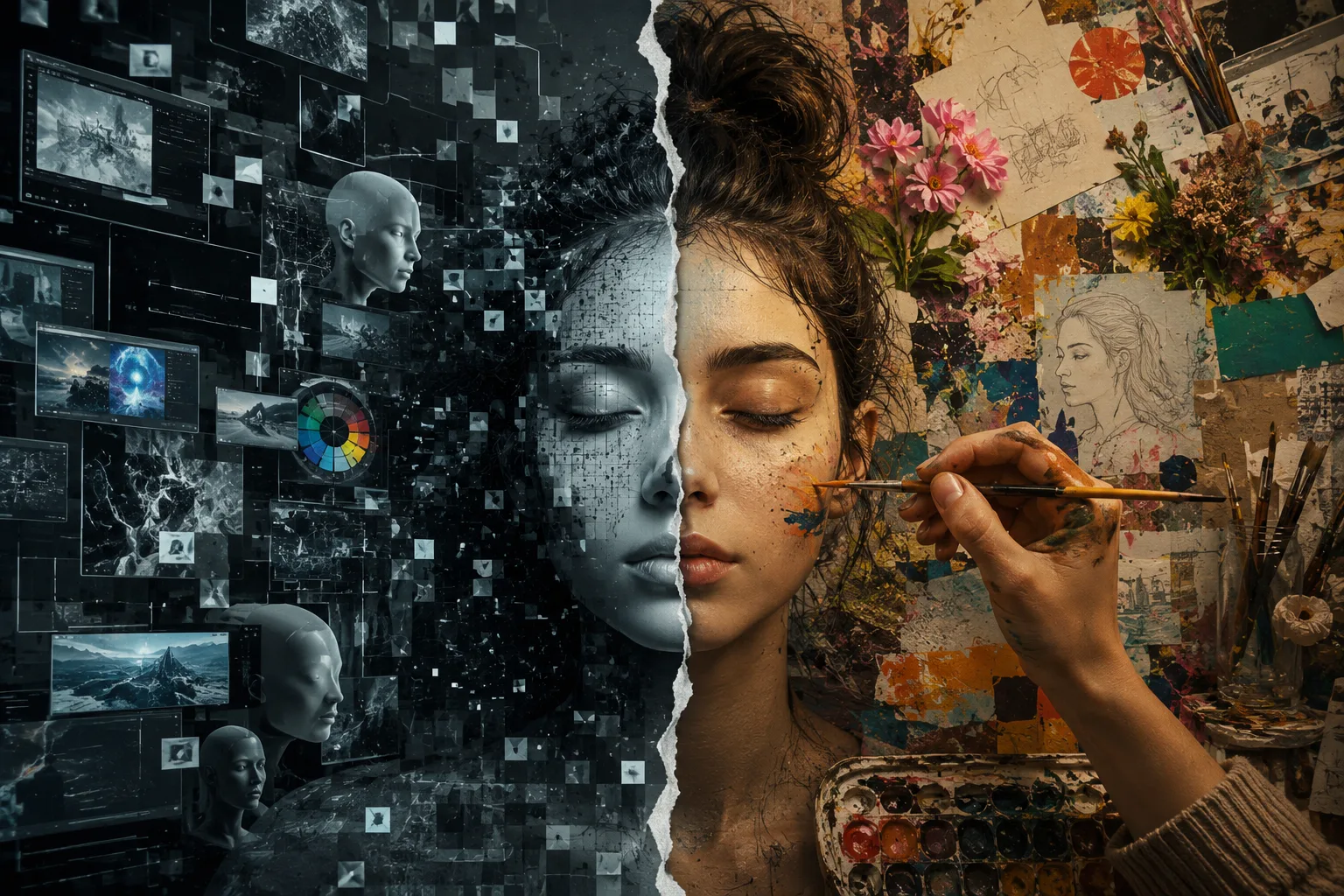
The internet has been flooded with polished, frictionless, hyper-produced images that look expensive at first glance and strangely empty by the second look. That fatigue is exactly where anti-slop art starts to feel less like a niche joke and more like a serious cultural signal. Across design feeds, animation circles, visual culture spaces, and creative studios, a growing number of artists are pushing back against the endless stream of AI-made visuals by leaning into the messy, handmade, imperfect, and unmistakably human. The movement is not simply about hating technology or rejecting every tool with a machine-learning label attached to it. It is about asking a sharper question: when everything can look finished instantly, what makes an image worth caring about?
For years, the promise of generative AI in visual culture sounded almost unbeatable. It could generate mood boards in seconds, imitate styles on demand, produce glossy fantasy worlds without a camera, and help brands move faster than traditional creative pipelines ever allowed. But speed has a cost, and the cost is now showing up in the way audiences react to images that feel too smooth, too familiar, and too disconnected from lived experience. The term “AI slop” has become a shorthand for that exhaustion, describing low-effort machine-generated content that fills feeds, search results, ads, and entertainment spaces with visual noise. In response, anti-slop art has become a creative counter-mood built around texture, authorship, intention, and visible human labor.
Why Anti-Slop Art Is Becoming a Visual Rebellion
Anti-slop art is not one single style, and that is part of why it is catching on. It can look like rough illustration, stop-motion animation, hand-cut collage, grainy photography, analog zines, expressive typography, puppet-based filmmaking, painted signage, or digital work that deliberately keeps traces of human imperfection. The common thread is not the medium but the attitude behind it. Artists are choosing methods that make the process visible instead of hiding every trace of labor behind a flawless output. In a visual economy increasingly shaped by synthetic abundance, the imperfect mark has started to feel rare again.
The rebellion also comes from a deeper frustration with how AI imagery has entered creative life. Many artists are not only annoyed by the look of generic AI visuals; they are worried about training data, copyright, consent, labor value, and the pressure to compete with machines that can imitate aesthetic surfaces without sharing the risks of making something personal. Designers who spent years developing a visual language now see similar-looking work appear instantly through prompts. Illustrators watch brands test AI campaigns while creative budgets get squeezed. Animators, photographers, art directors, and independent studios are realizing that the fight is not just about tools, but about who gets to define taste in the next era of visual culture.
That is why the word “slop” matters so much. It does not describe all AI-assisted work, and it does not mean every machine-made image is automatically worthless. Instead, it points to the feeling of being surrounded by content made without care, context, or consequence. Slop is the glossy fantasy portrait with no emotional weight, the fake product scene with impossible reflections, the generic motivational poster that looks like a thousand others, and the corporate animation that feels focus-grouped by a machine. Anti-slop art pushes against that sameness by making friction part of the visual experience again.
The New Value of the Handmade Look
Handmade visuals used to be described as slow, limited, or expensive compared with digital production. Now those same qualities are becoming their advantage. A hand-drawn line carries hesitation, pressure, rhythm, and personality in a way that a perfectly generated image often struggles to fake convincingly. A stop-motion frame carries the tiny evidence of physical objects being moved by real people under real lights. A collage edge, a paint texture, or a camera grain can remind viewers that an image came from a place, a hand, and a decision rather than from an infinite visual blender.
This does not mean audiences suddenly want everything to look unfinished. The shift is more subtle than that. People still respond to beauty, craft, clarity, and strong composition, but they are becoming more alert to visuals that feel emotionally blank. The handmade look works because it adds a layer of trust. When viewers can sense effort, limitation, and intention, they are more likely to feel that someone actually cared about the work before asking them to care too.
In design and digital art, this creates a fascinating reversal. For a long time, the most desirable look online was clean, polished, optimized, and seamless. Now, visual creators are rediscovering rough edges as a form of identity. A brand poster with a crooked hand-rendered title may stand out more than another perfect 3D gradient. A music video built from puppets and practical sets may feel fresher than a synthetic universe with flawless lighting but no physical soul.
How AI Slop Changed Audience Taste
The rise of anti-slop art makes more sense when you look at how quickly AI-generated visuals became ordinary. At first, audiences were amazed by the novelty. People shared surreal portraits, impossible architecture, cinematic fake worlds, and fantasy scenes that seemed to arrive from nowhere. The shock came from the speed and technical appearance of the images. But once every platform became filled with similar outputs, the novelty faded and the sameness became easier to spot.
AI slop often has a recognizable rhythm, even when the subject changes. It can be overly glossy, hyper-detailed in irrelevant places, emotionally vague, and strangely detached from the logic of real objects. Hands, typography, fabric, shadows, backgrounds, and facial expressions can look almost correct while still triggering a quiet sense that something is off. Even when newer tools fix the obvious errors, the deeper issue remains. An image can become technically stronger while still feeling culturally weak.
That weakness comes from repetition and missing intention. Human artists make strange choices because they have memories, biases, obsessions, constraints, mistakes, jokes, references, and emotional stakes. AI systems remix patterns at scale, which can be useful, but the result often feels like a summary of existing visual culture rather than a lived response to it. When users see too much of that summary, they start craving the unresolved and specific details that only human work tends to carry. This is why anti-slop visuals often do not need to be technically perfect to feel powerful.
The Trend Is Bigger Than Art Communities
What makes this moment important for a site like Visual Vortixel is that the trend is not limited to gallery artists or internet subcultures. It is spreading across advertising, entertainment, publishing, fashion, gaming, music visuals, social media branding, and creative software culture. The backlash is visible whenever audiences reject a campaign that feels automated or praise a project for being handcrafted. It shows up when studios publicly emphasize that their work was made by people. It also shows up when viewers reward visual projects that reveal their process instead of pretending to be effortless.
Brands should pay attention because the old shortcut is becoming riskier. A few years ago, using AI visuals could make a company look futuristic. Now, careless AI use can make a brand look cheap, disconnected, or disrespectful toward creative workers. Audiences have become better at detecting when a visual campaign is built from generic machine gloss rather than a strong creative concept. In some spaces, saying “handmade,” “shot practically,” “drawn frame by frame,” or “built without AI” has become a badge of credibility.
This creates a new kind of visual branding challenge. Companies do not only need images that look good; they need images that feel accountable. The question is no longer just whether a visual asset is eye-catching, but whether it carries enough human specificity to avoid being dismissed as content filler. Creative teams that understand this shift can build stronger campaigns by using human process as part of the story. Instead of hiding the making of an image, they can turn the making into the reason people trust it.
Anti-Slop Art and the Return of Creative Ownership
One reason anti-slop art feels emotionally charged is that it connects directly to creative ownership. Artists are not just defending a style; they are defending the right to have their work treated as more than raw material for automated systems. When a machine can imitate visual patterns scraped from countless creators, the boundary between inspiration and extraction becomes harder to ignore. The backlash is partly aesthetic, but it is also ethical. For many artists, refusing slop means refusing a creative economy that treats human imagination as an unpaid dataset.
This is where the movement becomes more than a trend board. The handmade image becomes a statement about authorship. A rough drawing says that a person made decisions and accepted responsibility for them. A stop-motion scene says that time was spent building a world rather than instantly generating one. A small studio choosing practical techniques is not only making a visual choice; it is taking a position on what creative labor should mean.
That does not mean every artist in this space is anti-technology. Many digital creators use tablets, 3D tools, editing software, compositing workflows, and code-based systems while still rejecting low-effort generative shortcuts. The issue is not whether a computer is involved. The issue is whether the final work reflects intention, skill, and a point of view. Digital creativity has always included tools, but the strongest work usually feels guided by a human mind rather than outsourced to visual probability.
Why Imperfection Now Feels Premium
Imperfection is becoming premium because it is harder to mass-produce convincingly. A generated texture can imitate dust, film grain, paint strokes, and paper fibers, but imitation is not the same as presence. Real imperfections are connected to process, and process gives an artwork a kind of memory. When viewers see a slightly uneven frame, a visible brush line, or a handmade object, they sense a chain of decisions behind the image. That chain creates depth, even when the visual itself is simple.
This is especially important in a culture trained by algorithms to scroll quickly. Smooth content is easy to pass because it demands little from the viewer. Rougher, stranger, more specific work can interrupt the scroll because it does not immediately behave like everything else. The human eye notices disturbance, and in a feed full of synthetic polish, analog texture becomes disturbance. That interruption gives anti-slop creators an advantage that pure speed cannot buy.
For designers, this does not mean every project should look messy. It means texture, process, and personality should be treated as strategic assets. A clean identity system can still carry human warmth through custom typography, original photography, hand-built layouts, or illustration with a recognizable voice. A digital campaign can still feel crafted if the concept is sharp and the visuals are not interchangeable. The lesson of anti-slop art is not “make everything ugly,” but “make everything intentional.”
The Impact on Digital Art and Creative Software
The anti-slop mood will likely influence how creative software evolves. Tools that only promise faster generation may start feeling less exciting than tools that help artists keep control over style, authorship, and process. Creators want speed, but they also want their work to remain recognizably theirs. This creates an opening for software that supports hybrid workflows, ethical asset management, transparent provenance, and better protection against unwanted style imitation. The next wave of creative tools may need to prove that they enhance human voice instead of flattening it.
For digital artists, the movement also offers a way to talk about value without sounding nostalgic. The point is not to return to a pre-digital past. The point is to build a future where digital work does not become disposable because machines can generate endless variations of it. Artists who combine digital precision with personal fingerprints may become more important, not less. Their advantage will come from the fact that audiences can recognize a viewpoint behind the work.
This matters for younger creators who are entering the field during the AI boom. They are learning in a world where anyone can generate a polished image instantly, which means technical beauty alone is no longer enough to stand out. Taste, concept, research, cultural awareness, and emotional honesty become more valuable. A creator who knows why an image should exist has an edge over a system that only knows what similar images usually look like. In that sense, anti-slop culture may push digital art education toward deeper creative thinking rather than pure output speed.
How Visual Entertainment Could Change
Visual entertainment is one of the biggest battlegrounds for this shift. Animation, games, music videos, short-form video, movie marketing, and streaming graphics all face pressure to produce more content with fewer resources. Generative AI looks tempting in that environment because it promises scale. But entertainment audiences are sensitive to emotional texture, and they often respond strongly when a project feels hollow. A world can be visually huge and still feel forgettable if it lacks human rhythm.
That is why practical effects, handcrafted animation, and distinctive art direction may gain new cultural value. Viewers who grew up online can often sense when something was made mainly to fill space. They notice when characters feel like content assets instead of expressive beings. They notice when backgrounds look impressive but meaningless. They also notice when a visual world has quirks that could only come from a team making specific creative choices under real constraints.
The strongest entertainment studios may not be the ones that reject AI entirely, but the ones that understand where AI does and does not belong. AI may help with planning, testing, cleanup, or technical tasks in some pipelines, but audiences will still judge the final work by feeling. If the work feels generic, the tool does not matter. If the work feels alive, viewers usually sense the human structure underneath it.
Practical Insights for Designers and Brands
For designers, the first practical lesson is to stop treating visual output as the whole product. The process behind the work now has communication value. Showing sketches, physical tests, behind-the-scenes footage, rejected versions, material experiments, and human decision-making can make a project feel more trustworthy. This does not mean exposing every messy detail. It means giving audiences enough proof that the work was shaped by people with a real point of view.
The second lesson is to build a stronger visual signature. Generic AI slop thrives where creative direction is weak, because it fills empty strategy with familiar aesthetics. A strong brand system should have recognizable choices in color, typography, composition, motion, photography, illustration, and tone. Those choices should be specific enough that they cannot be replaced by a random prompt without losing meaning. In a crowded visual market, identity is not decoration; it is defense.
The third lesson is to use AI carefully and honestly if it appears in the workflow. Audiences are not always against technology, but they are increasingly skeptical of visual work that hides automation while pretending to be handcrafted. Transparency can reduce backlash, especially when AI is used as support rather than replacement. Creative teams should define where human judgment enters the process and why the final image needed human direction. Without that clarity, even attractive work can become vulnerable to the slop label.
What Anti-Slop Art Means for Visual Innovation
At first, anti-slop art may sound like a rejection of visual innovation, but it may actually be one of the clearest signs of where innovation is heading. Real innovation is not only about producing faster images. It is about changing how people feel, think, interact, and remember. If a new technology creates more output but less meaning, culture eventually pushes back. The anti-slop movement is that pushback in visual form.
The future of visual innovation may be less about the cleanest synthetic image and more about the smartest relationship between tools and human intent. Artists may use AI in ways that are visible, critical, limited, or conceptually meaningful. Designers may combine analog textures with digital systems to create work that feels both contemporary and grounded. Studios may choose slower production methods for selected projects because slowness itself becomes part of the value. Innovation will not disappear, but the definition of innovation may become more human-centered.
This shift also challenges platforms. Social networks and search systems have rewarded volume for years, which made slop profitable. If platforms continue to amplify low-effort synthetic content, audience trust may keep eroding. If they develop better ways to highlight original human-made work, provenance, and creator identity, the visual ecosystem could become healthier. The anti-slop conversation is not only about artists; it is also about the systems that decide what gets seen.
The Cultural Mood Behind the Movement
The emotional power of anti-slop art comes from a broader cultural mood. People are tired of being surrounded by things that look optimized but feel empty. They are tired of feeds filled with fake interiors, fake models, fake product shots, fake travel scenes, fake nostalgia, and fake emotion. This exhaustion is not limited to art; it touches news, entertainment, shopping, education, and everyday digital life. When reality starts to feel buried under generated surfaces, authenticity becomes a form of relief.
That relief explains why handmade visuals can feel almost radical now. They remind people that time still matters. They show that limitation can create character. They prove that not every image needs to be frictionless to be valuable. In a culture obsessed with instant output, choosing to make something slowly can feel like choosing to stay human.
The movement also carries a Gen Z-coded skepticism toward corporate smoothness. Younger audiences grew up decoding ads, filters, influencer edits, algorithmic trends, and platform aesthetics. They often know when they are being sold a vibe without substance. Anti-slop visuals work because they resist that overly processed language. They feel closer to zines, indie animation, bedroom studios, local scenes, and creator-led culture than to automated brand filler.
A New Creative Standard Is Taking Shape
The anti-slop movement is still young, and it will probably evolve quickly. Like every visual trend, it could be copied, branded, and flattened into another aesthetic package. There is already a risk that “handmade” becomes a marketing filter rather than a meaningful practice. But the deeper demand behind the movement will be harder to fake. Audiences want evidence of human presence, and that desire will keep shaping how visual work is judged.
For creators, this is both a challenge and an opportunity. The challenge is that the bar for meaningful work is rising in a world where basic visual polish is easier to generate. The opportunity is that personal style, thoughtful process, and cultural awareness are becoming more valuable. Artists who can explain why they made something, not just how it looks, will have a stronger position. Designers who build visual systems with actual voice will stand out in a sea of automated sameness.
For brands and publishers in digital art, design, and visual entertainment, the lesson is clear. Do not treat audiences like they cannot tell the difference between presence and filler. They may not always identify the tool behind an image, but they can often feel when work lacks intention. The smartest creative strategies will not simply chase whatever looks futuristic. They will build trust through originality, transparency, and human detail.
Conclusion: Anti-Slop Art Is a Human Signal
Anti-slop art matters because it gives a name to something many people have been feeling but could not always explain. The problem is not that technology exists, and it is not that artists must avoid every new tool. The problem is a culture of endless visual production where images can look finished without feeling meaningful. Anti-slop creators are responding by making work that carries touch, tension, mistake, memory, and authorship. In a digital world overflowing with synthetic polish, those human signals are becoming impossible to ignore.
The movement also reminds the creative industry that visual value cannot be measured only by speed, scale, or surface quality. A powerful image is not just an arrangement of pixels; it is a trace of attention. It carries the choices of someone who cared enough to make it specific. That is why handmade, imperfect, and process-driven visuals are finding new relevance at the exact moment when machines can generate more images than anyone can consume. The future of visual culture will not belong only to the fastest output, but to the work that still feels alive after the scroll stops.