

Betye Saar Wearable Art Finds New Visual Power
 Vortixel
12 minutes read
Vortixel
12 minutes read
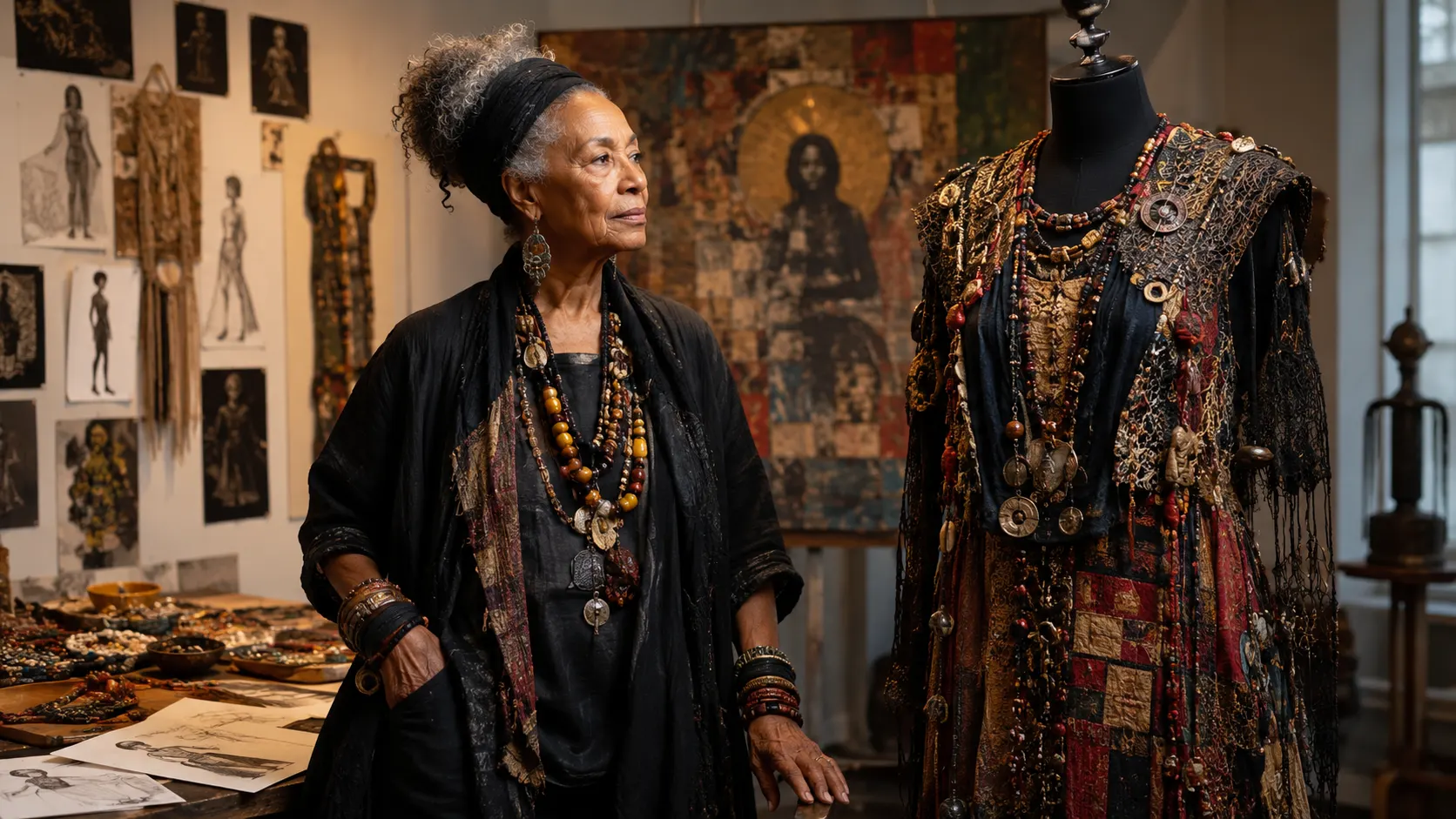
Betye Saar wearable art is getting a fresh spotlight at the exact moment contemporary visual culture is rethinking what an artwork can be, how it can move, and who gets to wear meaning on the body. The new attention around Saar’s costume sketches, theatrical garments, jewelry, and archival design work feels less like a side note and more like a correction in the story of modern American art. For decades, many people knew Saar through her powerful assemblages, symbolic objects, and fearless use of memory, race, spirituality, and found materials. Now, her early work in costume and wearable design is being read as part of the same visual language, not as a separate chapter parked outside the museum wall. That shift matters because it turns clothing into evidence, fabric into narrative, and performance design into a living extension of the artist’s imagination.
The best keyword for this story is Betye Saar wearable art, because it captures the heart of the moment while staying specific enough for art, design, and visual culture audiences. Saar’s wearable pieces were never just decorative objects made to fill a stage or complete a look. They were built from color, texture, symbolism, memory, and practical problem-solving, which is exactly what makes them feel so relevant now. In an era when fashion exhibitions, digital avatars, immersive theater, and character design are blending into one visual ecosystem, Saar’s work feels unexpectedly current. Her costumes remind us that visual innovation does not always begin with new software or futuristic screens; sometimes it begins with paper, scraps, thrifted fabric, and an artist who knows how to turn limitation into atmosphere.
Why Betye Saar Wearable Art Feels So Current
What makes Betye Saar wearable art feel so powerful today is the way it refuses to sit in one category. It belongs to costume design, but it also belongs to assemblage, theater, Black cultural history, feminist art, jewelry, performance, and visual storytelling. That kind of boundary-crossing is exactly what younger audiences now expect from creative work, especially online, where a single image can be read as fashion, identity, meme, archive, and political statement at the same time. Saar was already working in that layered mode long before the internet trained people to decode visual signals instantly. Her costume work shows that the body itself can become a gallery, a stage, and a message system all at once.
This new wave of attention also lands at a time when museums and galleries are expanding the definition of serious art. Once, costume design was often treated as a supporting craft, especially when compared with painting, sculpture, or monumental installation. Today, curators and viewers are increasingly interested in the labor behind visual worlds, including the sketch, the garment, the prop, the fabric sample, and the photograph that documents a performance after the curtain falls. Saar’s work fits perfectly into that wider shift because it proves that costumes can hold the same conceptual weight as objects placed on a pedestal. Her designs are not only things people wore; they are visual arguments about character, transformation, culture, and power.
From Stage Costume to Visual Language
Saar’s early costume designs show an artist thinking through movement, identity, and space in real time. A costume has to function differently from a static artwork because it must survive the body, the light, the stage, and the demands of performance. That pressure can limit an artist, but in Saar’s case it seems to have sharpened her visual instincts. She had to think about how fabric would read from a distance, how color would hold under stage lighting, and how a silhouette could tell an audience who a character was before the first line landed. Those decisions later echo through her better-known assemblage practice, where placement, contrast, texture, and symbolic charge become the engines of meaning.
The costume sketches are especially important because they show Saar treating design drawings as artworks in themselves. Instead of producing flat technical notes, she created images with atmosphere, mood, background, and emotional presence. Many of these sketches feel closer to collage than simple wardrobe planning, with patterned surfaces, dramatic poses, and rich color relationships that pull the eye across the page. That approach matters because it reveals a mind already building miniature worlds, even before the final costume reached the stage. For a visual culture site like Betye Saar wearable art, this is the key angle: Saar was not merely designing outfits, she was designing visual systems.
The Power of Materials, Memory, and Resourcefulness
One of the most compelling parts of Saar’s wearable practice is how much it depended on resourcefulness. Costumes for theater do not always come with big budgets, especially in community-based and experimental cultural spaces. That reality pushed Saar toward thrifted fabrics, repurposed garments, handmade details, and mixed materials that carried visible history. Instead of hiding those histories, she folded them into the visual life of the work. The result was a style that felt alive because it was built from objects and surfaces already touched by the world.
This is where Saar’s costume work connects deeply with her assemblages. Found materials are never neutral in her universe, because every object seems to arrive with memory attached. A scrap of leather, a piece of jewelry, a patterned textile, or a reused garment can become a symbol once it is placed inside the right frame. In wearable work, the frame is often the body, which gives the object even more emotional and social force. Clothing already tells people how to read identity, class, gender, ceremony, rebellion, and belonging, so Saar’s transformation of garments into art adds another layer to a language everyone already understands.
How Saar Turns Costume Into Character
Costume design is sometimes misunderstood as decoration, but Saar’s approach shows how deeply narrative it can be. A strong costume tells a story before a performer speaks, and Saar’s designs seem built around that immediate visual impact. She understood that clothing can make a body feel royal, vulnerable, comic, dangerous, mystical, seductive, or haunted within seconds. Her use of bold shapes, dramatic accessories, and expressive textures gave performers a visual identity that could hold the stage. In that sense, her costumes acted like portable environments, wrapping each character in a world of color, history, and feeling.
That character-building instinct is one reason her wearable work feels so relevant to Digital Art and contemporary visual entertainment. Today, character design drives games, film, animation, virtual influencers, music videos, and digital fashion. Audiences now recognize that a silhouette, accessory, color palette, or texture can define a character as strongly as dialogue. Saar was working with that same visual logic in physical form, using costumes to create instant recognition and deeper symbolic resonance. Her practice offers a reminder that the strongest visual worlds are not built from surface alone; they are built from emotional codes that viewers can feel before they fully explain them.
A Trend Bigger Than One Exhibition
The renewed attention around Betye Saar wearable art is part of a larger cultural trend that is reshaping how audiences value design archives. Sketches, garments, mock-ups, notes, and production photographs are no longer treated only as background material for researchers. They are becoming central objects in exhibitions because they reveal how ideas are made, tested, revised, and embodied. Viewers want to see process now, not just the polished final result. Saar’s wearable archive offers exactly that kind of access because it shows the bridge between imagination and performance.
This trend also reflects a broader hunger for art that feels tactile in an increasingly digital world. People spend so much of their visual life scrolling images on glass that handmade surfaces now carry a different kind of charge. Saar’s feathers, fabrics, leather pieces, jewelry, costume drawings, and archival photographs offer texture that cannot be reduced to a clean digital thumbnail. They remind viewers that visual culture has weight, friction, age, and material presence. That does not make the work anti-digital; it makes it more valuable inside a digital era because it gives creators a physical vocabulary to study and reinterpret.
Why This Matters for Visual Innovation
For anyone working in design, digital creativity, or visual entertainment, Saar’s wearable work offers a practical lesson in how to build meaning through layers. Her costumes do not rely on a single trick or one obvious symbol. They build impact through combinations of color, silhouette, texture, material history, body movement, and cultural memory. That layered structure is exactly what strong visual branding, character design, and immersive storytelling require today. The more visual media becomes fast, crowded, and algorithm-driven, the more important it becomes to create images that reward a second look.
Saar’s practice also challenges the idea that innovation must always look futuristic. In her work, innovation often comes from recombination, which means taking existing materials and placing them in a charged new relationship. That mindset is useful for artists and designers facing creative fatigue, tight budgets, or pressure to produce something “new” at high speed. Saar proves that originality can come from attention rather than excess. A found object, an old garment, or a familiar symbol can become visually radical when the artist understands its emotional weight and changes the context around it.
The Gen Z Connection to Saar’s Visual World
Part of why this moment lands so well now is that younger audiences are fluent in identity as visual language. Gen Z grew up reading outfits, avatars, profile images, filters, edits, mood boards, and digital aesthetics as expressions of self. Saar’s wearable art speaks directly to that mindset, even though it comes from an earlier cultural moment. Her work treats style as a serious form of communication, not a shallow layer added after the real art is finished. That makes her costume archive feel less like a historical detour and more like a blueprint for how personal and political visuals can merge.
There is also something very current about Saar’s refusal to separate beauty from critique. Her work can be glamorous, strange, spiritual, theatrical, handmade, and politically charged all at once. That complexity fits a generation that distrusts clean boxes and prefers hybrid forms. A costume can be beautiful and still carry social meaning, just as a digital artwork can be stylish and still ask difficult questions. Saar’s visual world gives permission for art to be layered without becoming cold, and expressive without becoming empty.
Practical Insights for Artists and Designers
For creators, the most useful lesson from Betye Saar wearable art is that every material choice should carry narrative pressure. Fabric is not only fabric when it suggests history, class, ceremony, intimacy, or survival. Color is not only color when it changes the emotional temperature of a character or scene. Jewelry is not only ornament when it acts like a charm, shield, memory object, or sign of status. Saar’s work encourages artists to ask what each visual decision is doing beyond looking good.
- Start with material meaning: Choose textures, objects, and surfaces because they carry emotional or cultural weight, not just because they match a trend.
- Think in silhouettes: A strong outline can communicate power, softness, tension, mystery, or movement before details are visible.
- Build visual layers: Combine color, pattern, symbol, and scale so the viewer discovers more after the first glance.
- Use limitation creatively: A small budget or limited material pool can lead to stronger, more personal visual solutions.
- Treat process as content: Sketches, references, tests, and archival fragments can become part of the story, not just steps hidden behind the final work.
These insights matter across multiple creative fields because Saar’s work sits at the intersection of art and applied design. A graphic designer can learn from her sense of symbolic composition. A digital artist can learn from her layering of identity, object, and atmosphere. A filmmaker or game designer can learn from the way her costumes create character before dialogue begins. Even a creative director building a campaign can learn from her ability to turn material constraint into a distinctive visual voice.
The Impact on Museums and Creative Archives
The renewed focus on Saar’s wearable work also affects how institutions may treat creative archives moving forward. Museums have often centered finished masterpieces while placing sketches, garments, photographs, and design notes in secondary roles. Saar’s archive shows why that hierarchy can be misleading. Sometimes the supporting material is not secondary at all; it is the place where the artist’s thinking becomes most visible. When institutions show these objects with care, they help audiences understand art as a living process rather than a set of isolated icons.
This approach can also change how audiences understand artists whose practices moved across craft, domestic life, theater, community spaces, and formal galleries. Saar’s career reminds us that important visual work does not always emerge inside traditional art-world pipelines. It can be made in homes, backstage rooms, cultural centers, classrooms, and small studios where artists are solving real problems with available materials. By honoring wearable art as part of Saar’s larger practice, the conversation becomes more honest about how creativity actually develops. It also expands the kinds of labor that get recognized as historically important.
Why Saar’s Wearable Work Still Feels Alive
The reason Betye Saar wearable art still feels alive is that it was never only about fashion or theater. It was about transformation, and transformation never goes out of style in visual culture. A costume changes how a performer stands, how an audience reads the body, and how a story enters the room. Saar understood that deeply, and she used design to give characters a visual charge that could survive beyond the stage. The archive now allows viewers to see those choices not as temporary theater solutions, but as lasting artworks with their own force.
Her wearable pieces also carry the energy of touch, which is something many contemporary images lack. You can feel the hand behind the sketch, the decision behind the material, and the imagination behind the accessory. That sense of touch gives the work intimacy, even when the visual effect is bold or theatrical. It makes the pieces feel less like historical artifacts and more like creative signals still transmitting. For artists working today, that is a powerful reminder that technology can amplify vision, but it cannot replace the emotional intelligence of making.
Conclusion: Betye Saar Wearable Art Redefines the Frame
Betye Saar wearable art matters because it changes the frame around one of America’s most important visual artists. It shows that her costume designs, jewelry, sketches, and theatrical materials are not minor side projects, but essential parts of a practice built on transformation, memory, and symbolic power. The work connects the stage to the gallery, the body to the archive, and handmade design to the future of visual storytelling. It also gives today’s creators a sharp lesson in how to make images that carry history without losing immediacy. In a culture obsessed with what looks new, Saar reminds us that the deepest visual innovation often comes from seeing overlooked materials, overlooked labor, and overlooked histories with fresh eyes.