

Rothko in Florence Redraws Renaissance Light
 Vortixel
16 minutes read
Vortixel
16 minutes read
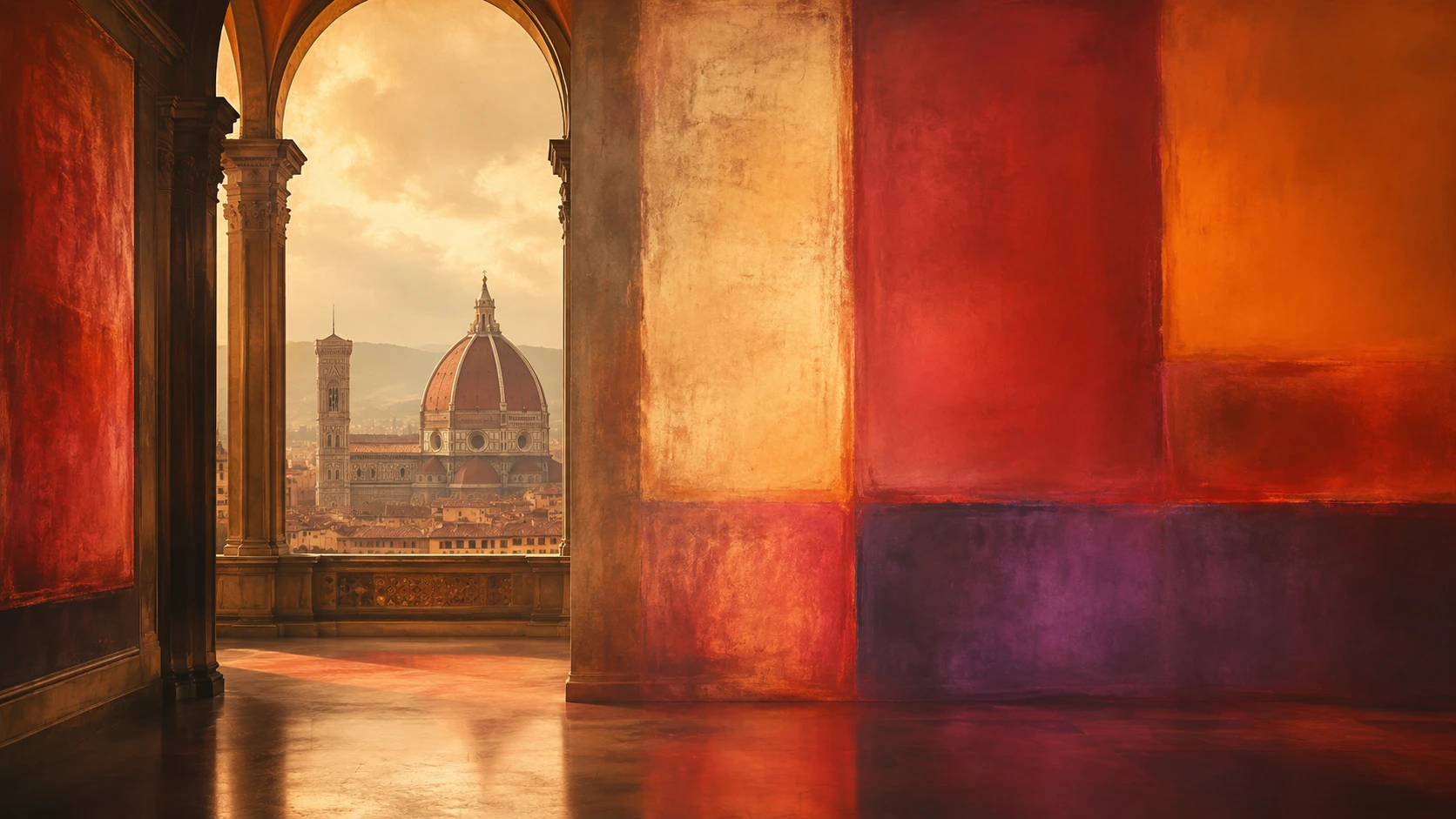
Rothko in Florence feels less like a traditional museum event and more like a visual collision between two eras that were never supposed to stand this close. On one side, there is Florence, the city that turned sacred walls, measured architecture, and Renaissance light into a language of human emotion. On the other, there is Mark Rothko, the American modernist who made vast fields of color feel like rooms, wounds, prayers, and private weather systems. The meeting point is not simply a gallery wall filled with famous paintings, but a deeper question about how images can hold silence, pressure, belief, and intensity without explaining themselves. That is why this exhibition lands with such a strong cultural pulse: it shows that abstraction was never a clean break from art history, but a continuation of older visual instincts translated into modern form.
The hook is simple but powerful: Rothko’s glowing rectangles are being read again through Florence, a city better known for frescoes, chapels, stone geometry, and Renaissance masters than for postwar American abstraction. Yet the pairing makes immediate sense once the emotional rhythm becomes clear. Rothko was not just painting color; he was building experiences that asked viewers to slow down, stand still, and feel scale in the body before the mind could turn it into language. Florence has been doing that for centuries through architecture, devotional painting, and carefully controlled space. In this context, Rothko in Florence becomes more than an exhibition title; it becomes a fresh way to understand how modern visual culture keeps borrowing from the past even when it looks radically new.
Why Rothko in Florence Feels So Timely
The timing of Rothko in Florence matters because global art audiences are increasingly looking for exhibitions that do more than assemble masterpieces in a room. They want context, atmosphere, emotional architecture, and a reason to look again at names they already think they understand. Rothko has long been treated as a giant of Abstract Expressionism, but the usual story often places him inside a New York-centered narrative of postwar experimentation, psychological intensity, and color-field painting. Florence shifts that frame by placing him in dialogue with Renaissance space, especially the kind of sacred and contemplative environments that shaped his sense of what painting could do. The result is a show that feels built for the current cultural moment, where audiences are hungry for slower visual experiences in a world dominated by fast scrolling, instant images, and algorithmic overload.
That relevance is not only historical; it is also deeply emotional. Contemporary viewers live inside an image economy where visuals are often designed to grab attention within seconds, compete for engagement, and disappear into a feed. Rothko’s paintings resist that behavior by demanding duration, distance, and vulnerability. Florence adds another layer because its Renaissance heritage reminds viewers that visual power has never only been about novelty or spectacle. Sometimes the strongest image is the one that rearranges the viewer’s breathing, and that is exactly where Rothko and the Renaissance unexpectedly meet.
From Renaissance Space to Modern Abstraction
At first glance, Renaissance art and Rothko’s abstraction may seem almost opposite. Renaissance painting often carries figures, stories, saints, architecture, perspective, and carefully modeled bodies. Rothko’s mature canvases strip all of that away, leaving hovering blocks of color, soft edges, and layered surfaces that appear simple until they start pressing back. But the relationship becomes clearer when the focus moves from subject matter to experience. Both Renaissance masters and Rothko understood that images could organize attention, shape silence, and create a zone where the viewer becomes aware of their own inner state.
Florence is essential to this reading because the city is not just a backdrop; it is a visual system. Its churches, cloisters, libraries, and chapels train the eye to understand proportion, sequence, and spiritual atmosphere. Rothko’s paintings, especially the large works from the 1950s and 1960s, function in a similar way even though they use a completely different vocabulary. They do not illustrate religious stories, but they often create an encounter that feels ritualistic. Their scale surrounds the viewer, their color seems to breathe, and their quietness turns looking into something closer to meditation than consumption.
The Power of Color as Emotional Architecture
The strongest reason Rothko in Florence works as a visual event is that it treats color not as decoration, but as architecture. In Rothko’s mature paintings, color does not sit politely on the surface; it creates depth, pressure, heat, gravity, and atmosphere. A red field can feel like a curtain, a wound, a chamber, or a sunset that refuses to end. A dark maroon can feel heavy enough to alter the emotional temperature of a room. This is why Rothko remains so important for Digital Art and contemporary visual culture, because his work proves that even the simplest visual structure can become immersive when scale, rhythm, and emotional tension are handled with precision.
In Florence, that idea becomes even richer because Renaissance artists also treated color as a spatial and emotional force. Frescoes were not merely images placed on walls; they were part of built environments designed to move bodies, guide attention, and create meaning through placement. Rothko’s canvases carry a similar environmental ambition, especially when installed in settings that allow viewers to feel their size and silence. The connection is not about copying the Renaissance, but about sharing an understanding of visual presence. Both worlds show that color can become a place the viewer enters, not just something the viewer sees.
How Florence Reframes Rothko’s Legacy
Rothko is often discussed through the language of American modernism, but Florence opens a wider map. It reminds viewers that modern artists were not floating outside history, even when they were trying to invent new forms. Rothko’s abstraction was shaped by literature, philosophy, myth, music, tragedy, architecture, and the long memory of European painting. Seeing his work through Florence makes his canvases feel less like isolated modern icons and more like part of a larger conversation about how humans build images for grief, awe, and reflection. That shift matters because it gives his paintings more depth without reducing their mystery.
The city also reframes Rothko by emphasizing his relationship with sacred space rather than only his role in the New York art scene. His paintings are not religious in a narrow doctrinal sense, but they often aim for a level of seriousness usually associated with chapels, murals, and places of contemplation. Florence helps viewers recognize that ambition because the city itself is filled with art created for silence, ritual, and emotional transformation. In that setting, Rothko’s rectangles no longer feel like pure formal experiments. They feel like modern altarpieces for an age that lost many old certainties but still needed places to stand with difficult feelings.
The Exhibition as a Visual Journey
A major strength of Rothko in Florence is the way it encourages viewers to think about evolution rather than only arrival. Many people know Rothko through the famous late canvases, where stacked rectangles float in deep red, orange, black, blue, brown, or maroon. But the path toward those paintings was not instant, and it did not happen in a vacuum. Rothko moved through figuration, mythic imagery, Surrealist influence, and experimental forms before arriving at the visual language that made him one of the defining artists of the twentieth century. Seeing that journey matters because it breaks the myth that abstraction is simply a rejection of representation.
Instead, Rothko’s development shows abstraction as a process of compression. Figures disappear, but emotion remains. Narrative fades, but drama becomes stronger. Architectural references dissolve into blocks of color, yet the feeling of built space becomes even more intense. This is why the Florence context feels so productive: it helps explain how Rothko could remove so much from painting while still making the final image feel monumental, human, and charged with history.
Why Gen Z Audiences Can Connect With Rothko
For younger audiences raised inside a flood of visual platforms, Rothko may seem slow at first. There is no obvious narrative, no dramatic figure, no quick caption, and no instantly shareable punchline. But that slowness is exactly what makes him newly compelling. Gen Z viewers are often fluent in visual culture, but they are also increasingly aware of burnout, overstimulation, and the emotional cost of constant digital noise. Rothko offers a different kind of visual encounter, one where the image does not demand a reaction but waits until the viewer becomes available.
That waiting is powerful because it feels almost rebellious in the current media climate. A Rothko painting does not behave like content. It does not explain itself, optimize itself, or chase attention through novelty. Instead, it holds space, which may be one of the rarest visual experiences today. In Florence, surrounded by centuries of art built for devotion, memory, and public meaning, that sense of held space becomes even sharper and more relevant.
The Trend: Museums Are Becoming Context Machines
Rothko in Florence also reflects a wider trend in global museum culture: exhibitions are increasingly being designed as context machines. The old model of lining up famous works and expecting reputation to do all the heavy lifting is no longer enough for many audiences. Visitors want to understand why works matter now, how they connect to place, and what new angle makes the experience worth leaving the screen for. This is why exhibitions that link modern masters with historical cities, architectural sites, and cross-era dialogues are gaining traction. They give audiences more than objects; they give them a story to inhabit.
For Visual Vortixel readers, this trend is especially important because it speaks to the future of visual storytelling. Museums are no longer just preserving objects; they are producing layered experiences that combine scholarship, atmosphere, design, tourism, branding, and emotional pacing. A strong exhibition today behaves almost like a spatial essay, guiding visitors through a sequence of ideas without turning the experience into a lecture. Rothko in Florence fits this shift because it treats the city as part of the artwork’s meaning. The exhibition becomes not only a retrospective, but also a study of how place can change the way images are seen.
The Impact on Visual Culture
The cultural impact of Rothko in Florence reaches beyond art history because it challenges how people think about minimal visuals. In commercial design, branding, digital interfaces, and entertainment, minimalism is often treated as clean, efficient, and stylish. Rothko reminds us that reduction can also be intense, unstable, and emotionally overwhelming. His paintings do not simplify in order to become neutral; they simplify in order to become deeper. That distinction is crucial for designers and visual creators who want to understand why some simple images feel empty while others feel unforgettable.
This matters in digital creativity because modern audiences encounter thousands of simplified visuals every day. App icons, streaming thumbnails, brand gradients, AI-generated backdrops, and social templates all use color and shape to create instant recognition. But Rothko’s example shows that color only becomes powerful when it carries tension, proportion, and emotional intent. Florence strengthens that lesson by connecting modern abstraction to older systems of sacred composition and spatial drama. The impact is practical: creators can learn that visual restraint is not about doing less randomly, but about making every remaining element matter more.
What Designers Can Learn From Rothko
Designers can take several useful lessons from Rothko in Florence, especially if they work with color, atmosphere, layout, or immersive environments. The first lesson is that negative space is never empty when it is handled with intention. Rothko’s fields of color feel alive because the edges, proportions, and relationships between forms create quiet movement. The second lesson is that scale changes meaning, because a color block on a small screen behaves very differently from a field large enough to confront the body. The third lesson is that mood can be built through restraint, not only through detail.
- Use color as atmosphere, not just as a decorative layer or brand accent.
- Think about scale because visual impact changes when the body feels surrounded by an image.
- Let simplicity carry tension by making proportion, contrast, and spacing feel deliberate.
- Build emotional pacing so the viewer moves through a visual experience instead of only scanning it.
- Respect silence in design because not every powerful visual needs to shout for attention.
These lessons apply far beyond fine art. They can shape editorial design, website hero sections, album covers, exhibition graphics, film posters, digital installations, and AI-assisted image workflows. In a world where generative tools can produce endless visual complexity in seconds, Rothko’s discipline feels newly valuable. He shows that visual power does not depend on how much an image contains. It depends on whether the image knows what kind of emotional room it wants to create.
Rothko, AI Visuals, and the New Meaning of Human Touch
The rise of artificial intelligence in visual production makes Rothko’s relevance even sharper. AI systems can now generate painterly surfaces, glowing gradients, simulated canvases, and museum-like compositions with impressive speed. But Rothko in Florence reminds us that visual meaning is not only about appearance. Rothko’s work carries the slow pressure of decision, revision, memory, philosophy, and human vulnerability. That is difficult to replicate because the emotional weight of the work comes from more than its visible structure.
This does not mean AI visuals are automatically shallow, but it does mean creators need to think more deeply about intention. A Rothko-like gradient is not the same as a Rothko painting, just as a digitally generated chapel is not the same as a sacred space shaped by centuries of use. The lesson for AI-era creativity is not to reject new tools, but to understand what makes an image resonate beyond surface style. Human touch may increasingly mean the ability to choose, frame, edit, contextualize, and give emotional direction to visual systems. Rothko’s Florence dialogue makes that point without needing to mention technology directly, because it shows how much history and feeling can live inside a seemingly simple image.
Florence as More Than a Backdrop
One of the smartest aspects of Rothko in Florence is that Florence is not treated like a glamorous postcard attached to a famous artist. The city becomes an active interpretive tool. Its Renaissance architecture, sacred interiors, and long tradition of visual experimentation help viewers read Rothko in a more expansive way. The exhibition asks people to consider how a modern painting can echo the emotional logic of a fresco, a chapel, or a library vestibule without looking like any of them. That kind of place-based interpretation gives the show a depth that a standard white-cube presentation might struggle to achieve.
Florence also carries a specific kind of visual authority. It is a city where proportion, light, and spiritual drama have shaped the global imagination for centuries. Bringing Rothko into that environment gives his work a different kind of pressure, almost as if the paintings have to speak across time. They do not lose their modernity in the process. Instead, they become more complex because the viewer starts to see the old questions inside the new forms: how does art hold grief, how does color create presence, and how does space make emotion visible?
The Emotional Grammar of Abstraction
Rothko’s abstraction works because it has an emotional grammar, even when it refuses literal storytelling. The stacked forms often feel like thresholds, windows, bodies, doors, or suspended weights, but they never settle into one stable meaning. Their edges blur just enough to make the image feel alive, as if the painting is still forming while the viewer looks. This instability is part of the emotional charge. It creates a sense that something is being revealed and withheld at the same time.
In Florence, that emotional grammar becomes easier to read because Renaissance art also depends on controlled revelation. Frescoes use framing, gesture, light, and placement to guide viewers toward moments of recognition. Rothko removes the figures but keeps the drama of encounter. His paintings are not scenes, yet they still feel staged. They do not show sacred figures, yet they often create a sacred mood through scale, silence, and color.
Why This Matters for Visual Entertainment
The influence of Rothko in Florence can also be felt in visual entertainment, especially in how filmmakers, game designers, and installation artists think about mood. Many of today’s strongest visual worlds are not memorable because of detail alone; they are memorable because they control atmosphere. A film frame dominated by a single color can communicate dread, romance, isolation, or transcendence before a character says anything. A game environment can use light and spatial emptiness to create emotional tension without constant action. Rothko’s work offers a masterclass in this kind of atmospheric storytelling.
Florence adds the historical layer that makes this lesson even stronger. Renaissance artists understood staging long before cinema existed, using architecture, perspective, and painted space to direct emotional attention. Rothko translates that impulse into modern abstraction, and contemporary entertainment continues translating it into screens, immersive rooms, and digital worlds. The chain is not linear, but the connection is real. Visual culture keeps returning to the same core problem: how to make an audience feel something through space, light, and composition.
A Practical Insight for Content Creators
For content creators, the practical insight from Rothko in Florence is that visual storytelling becomes stronger when it has a conceptual frame. A beautiful image may attract attention, but a beautiful image connected to a bigger idea can build memory. Rothko’s paintings are visually magnetic, but the Florence context gives audiences a new path into them. It turns the viewing experience into a story about influence, place, spirituality, modernity, and the persistence of older visual languages. That kind of framing is exactly what separates disposable content from durable cultural content.
This is useful for websites, social media editors, video creators, and digital publishers. When covering visual culture, the strongest angle is rarely just “this looks beautiful.” The stronger question is why it looks the way it does, what history it activates, and why it matters now. Rothko in Florence offers a perfect case study because it connects a famous artist to a famous city while still opening fresh interpretation. The story is not only about an exhibition; it is about how visual meaning changes when artworks are placed in the right conversation.
The Deeper Appeal of Slow Looking
One reason Rothko in Florence feels so meaningful today is that it promotes slow looking at a time when attention is constantly fragmented. Slow looking is not passive. It is an active choice to let an image unfold beyond the first impression. Rothko’s paintings reward that kind of attention because they change with time, distance, and mood. What first appears simple can begin to feel unstable, warm, heavy, luminous, or quietly devastating after several minutes.
Florence has always invited slow looking because its visual culture is layered into streets, walls, ceilings, and sacred interiors. Visitors do not only see artworks there; they move through visual history as a physical environment. Rothko’s paintings, when understood through that environment, become part of a longer tradition of images that ask for patience. This is a valuable reminder for contemporary culture, where speed often gets mistaken for relevance. Sometimes the most current experience is the one that gives people permission to slow down.
Conclusion: Rothko in Florence Makes Abstraction Human Again
Rothko in Florence succeeds because it makes abstraction feel human, historical, and alive rather than distant or purely intellectual. It shows that Rothko’s color fields are not isolated modernist icons, but emotional spaces connected to older traditions of light, architecture, silence, and spiritual intensity. Florence does not soften Rothko’s modernity; it deepens it by revealing the Renaissance echoes inside his pursuit of presence. The exhibition also speaks strongly to today’s visual culture, where designers, artists, creators, and audiences are searching for images that can last longer than a scroll. In the end, the power of Rothko in Florence is not only that abstraction meets the Renaissance, but that both remind us why looking can still feel transformative.