

London Homelessness Exhibition Reframes the City
 Vortixel
15 minutes read
Vortixel
15 minutes read
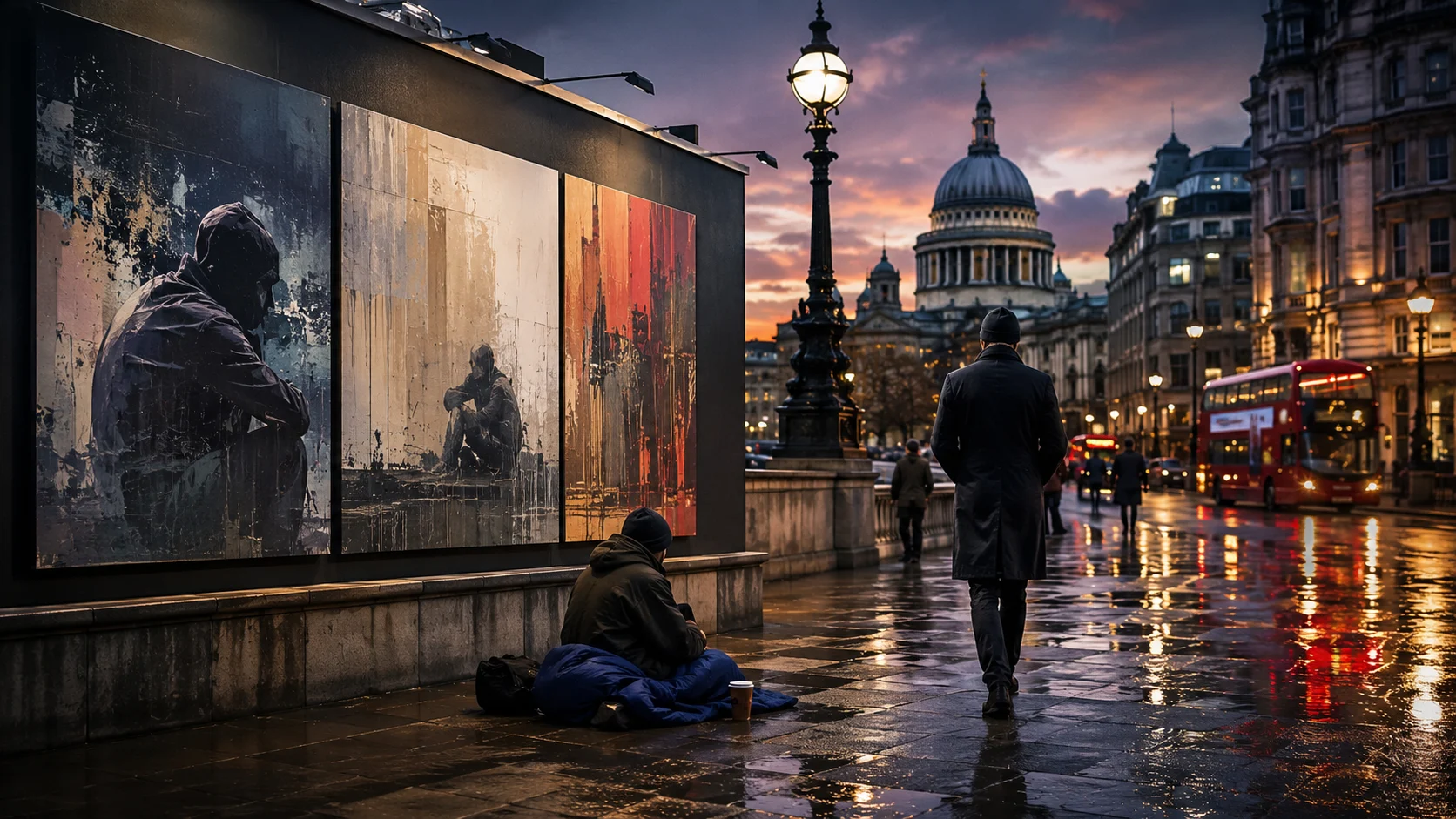
A new London homelessness exhibition is turning one of the city’s most overlooked realities into a visual conversation about power, memory, and public space. Instead of treating homelessness as a background issue that appears only in policy debates or passing street encounters, the exhibition frames it as a long story written into the city’s land, laws, walls, and everyday design. It asks viewers to look at London not only as a global capital of culture, finance, and architecture, but also as a place where visibility has always been political. For a visual culture audience, that shift matters because the show is not simply about people without housing; it is about how cities teach us what to notice, what to ignore, and who gets pushed out of the picture. That is why the exhibition feels less like a standard gallery stop and more like a public mirror, reflecting the uneasy relationship between urban beauty and urban exclusion.
The strongest hook of this story is that the exhibition does not present homelessness as a sudden modern crisis detached from history. It looks backward, tracing how social attitudes, land ownership, policing, and economic systems helped shape the way unhoused people have been seen and treated over centuries. That historical approach gives the visual work a deeper charge because every artwork becomes more than an image; it becomes a record of how society has drawn borders around belonging. In London, where luxury towers, heritage buildings, transport hubs, parks, and hidden sleeping spots often exist within the same visual frame, that context lands hard. The exhibition invites audiences to follow this bigger story through art, activism, design, and lived experience, making London homelessness exhibition a natural anchor for anyone trying to understand how visual storytelling can challenge civic amnesia.
Why This London Homelessness Exhibition Matters
The importance of this London homelessness exhibition lies in the way it refuses to flatten homelessness into one familiar image of rough sleeping. Mainstream visual culture often reduces homelessness to a person in a doorway, a tent near a station, or a blurred figure on the edge of a busy street scene. Those images may feel recognizable, but they can also become visual shortcuts that make viewers feel informed without asking them to understand the systems behind the situation. This exhibition pushes against that pattern by widening the frame and showing homelessness as a condition shaped by history, criminalization, displacement, labor, class, and public perception. In doing so, it gives the subject visual depth and emotional weight without turning hardship into spectacle.
For Visual Vortixel readers, the show also matters because it proves that visual storytelling is not limited to beauty, aesthetics, or trend cycles. Design, photography, street art, installation, archival material, and performance can all function as tools for public memory. When used with intention, they can expose the systems that ordinary city branding often hides behind polished skylines and lifestyle imagery. London has long marketed itself through images of heritage, creativity, and cosmopolitan energy, yet the exhibition asks what happens when the city’s most vulnerable residents are placed at the center of that visual field. That is a powerful editorial angle because it connects art with the politics of attention, which is one of the most important cultural questions of the digital age.
From Street Visibility to Historical Memory
One of the most compelling parts of the exhibition is its insistence that homelessness has a long visual and legal history. It does not allow visitors to treat the issue as a temporary failure of the present moment or as an unfortunate side effect of contemporary housing markets alone. Instead, the show reaches into older patterns of land enclosure, poverty control, movement restriction, and punishment, revealing how the idea of the “undesirable” person was built over time. That wider timeline makes the artworks feel like fragments of a much larger civic archive. It also helps viewers understand why homelessness is so often managed through visibility, because being seen in the “wrong” place has historically been treated as a problem to remove rather than a signal to understand.
This connection between street visibility and historical memory is especially relevant in a city like London, where public space is constantly being redesigned, privatized, guarded, and photographed. Benches, underpasses, transport entrances, parks, and plazas are not neutral backdrops; they are designed environments that can welcome some bodies while discouraging others. A person sleeping in public can be treated as a social emergency, a legal issue, an aesthetic disruption, or a moral challenge, depending on who is looking and what story they have been taught. The exhibition uses visual culture to slow down that reflex and ask why certain lives are read as visual disorder. That question makes the show feel urgent because it moves beyond sympathy and asks viewers to examine the visual rules of the city itself.
Art, Activism, and the Politics of Looking
The artists and activists involved in the exhibition bring different forms of visual language into the same conversation. Street art offers immediacy, graphic design delivers sharp public messaging, poetry and performance bring voice into the room, and installation can turn abstract history into something physically felt. This mix is important because homelessness is not a single-genre subject, and it cannot be fully represented through one artistic method. A poster can speak like a protest, a wall piece can feel like a city scar, and a performance can make the audience aware of their own position as witnesses. Together, these forms create a layered visual experience that feels closer to a public inquiry than a decorative exhibition.
The politics of looking sits at the center of the show because homelessness is often visible but not truly seen. People may pass rough sleepers every day while mentally editing them out of the urban image, especially in fast-moving cities where attention is treated like a luxury. The exhibition interrupts that habit by asking audiences to stay with uncomfortable images, histories, and stories long enough for them to become legible. That act of staying matters because visual culture can either normalize distance or create a new kind of proximity. When the viewer is no longer allowed to look away quickly, the city begins to feel different, and the people pushed to its margins become part of its central narrative.
How the Exhibition Changes the Urban Frame
Urban imagery usually celebrates growth, speed, and transformation, but this exhibition asks what gets lost when those words dominate the city’s visual identity. London’s architectural image is often built from glass towers, renovated neighborhoods, cultural districts, historic streets, and luxury developments. Those images are not false, but they are incomplete when they exclude the people displaced or disciplined by the same urban forces. The London homelessness exhibition changes the frame by placing homelessness not outside the story of the city, but inside the story of how the city became what it is. That reframing is subtle but powerful because it challenges the viewer to see homelessness as structurally connected to urban life rather than visually separate from it.
This approach also speaks to a larger trend in contemporary exhibitions, where museums and cultural spaces are increasingly being pushed to address social realities instead of staying neutral. Audiences, especially younger ones, often expect art spaces to do more than display objects under clean lighting. They want context, accountability, lived experience, and a sense that cultural institutions are willing to take risks with difficult subjects. A homelessness-focused exhibition in London fits that shift because it treats the museum as a site of civic conversation rather than an escape from public life. For visual culture, this signals a move away from passive viewing and toward exhibitions that ask visitors to think about their own role in the systems being shown.
The Visual Language of Criminalization
One of the exhibition’s most serious themes is the criminalization of homelessness, a subject that has deep visual consequences. Laws and policies may look abstract on paper, but they shape the way bodies move through streets, parks, stations, and shelters. They also influence which people are watched, moved along, documented, fined, judged, or made invisible through urban management. When art takes on this issue, it can reveal how criminalization is not only a legal process but also a visual system. It teaches the public to see unhoused people as problems in the landscape instead of people carrying histories, relationships, and rights.
The exhibition’s use of historical material gives this theme more force because it shows that the visual suspicion placed on homelessness did not appear overnight. Over time, society developed images of the vagrant, the wanderer, the trespasser, and the person considered out of place. Those images became part of public imagination, feeding policies that turned poverty into something to police. By unpacking those old visual codes, the show helps audiences recognize how modern cities still inherit them in updated forms. A security sign, a hostile bench design, a redevelopment image, or a cleaned-up tourism campaign can all carry traces of that older desire to control who belongs in public view.
A Gen Z Lens on Housing, Space, and Visibility
The exhibition also connects strongly with Gen Z because younger audiences are entering adulthood during an era of housing anxiety, cost-of-living pressure, insecure work, and intense urban inequality. For many young people, homelessness is not an abstract social issue that belongs to someone else’s world; it sits uncomfortably close to conversations about rent, debt, wages, mental health, and the shrinking idea of stability. That does not mean every viewer experiences the same risk, but it does mean the emotional distance between housed and unhoused lives can feel thinner than older narratives suggest. A visual culture exhibition that explores homelessness through history and public space therefore speaks to a generation already questioning the promises attached to city life. It gives that anxiety a visual and historical structure, which can make the issue feel clearer without making it simpler.
Gen Z audiences are also fluent in images, often encountering social issues through photography, short videos, protest graphics, online archives, and viral street documentation. That visual fluency can make them more responsive to exhibitions that blend art, activism, and urban critique. At the same time, it raises the bar because younger viewers can quickly sense when a social issue is being used as aesthetic content without meaningful depth. This exhibition appears to answer that challenge by grounding its visual language in research, history, and community-centered storytelling. That combination matters because it avoids the shallow trap of turning homelessness into a mood board of urban sadness.
Trend Impact: Social Exhibitions Are Getting Sharper
The wider trend behind this exhibition is the rise of socially engaged shows that treat art as a public tool rather than a closed cultural product. Across major cities, audiences are seeing more exhibitions about migration, climate, disability, race, labor, housing, and memory. These shows often combine archival research with contemporary artistic practice, creating spaces where history feels active instead of settled. The London homelessness exhibition belongs to this sharper wave because it does not only ask viewers to care; it asks them to understand the systems that made care necessary. That difference is important because empathy without analysis can fade quickly, while empathy connected to history can change how people interpret the world after they leave the exhibition.
For cultural websites, this trend also changes how exhibitions should be covered. A simple “what to see this weekend” format is no longer enough for shows that engage with heavy social themes. Writers need to explain the visual strategies, the historical context, the emotional stakes, and the broader impact on public conversation. That is why this topic works well for visual culture, because it sits at the intersection of art, urbanism, ethics, and media. It gives readers more than event information; it helps them understand why an exhibition can become part of a larger debate about how cities represent the people they fail to protect.
Why the Setting Makes the Message Stronger
The setting of the exhibition adds another layer to the story because a homelessness-focused show gains power when it is not isolated from the public environment it critiques. When an exhibition about housing, exclusion, and criminalization is placed in relation to real urban space, the visitor cannot easily separate the gallery experience from the streets outside. That connection changes the walk to and from the exhibition into part of the viewing experience. The city becomes both subject and evidence, especially when the themes inside the show echo in the architecture, public transport routes, and everyday street encounters nearby. This is where the exhibition’s visual impact becomes bigger than individual artworks, because it changes how visitors may read the city after leaving.
There is also a symbolic strength in staging work about homelessness in a way that resists the clean distance of traditional cultural consumption. Many exhibitions are designed to make viewers feel safe, calm, and removed from the friction of the outside world. This one seems to move in the opposite direction, bringing that friction closer and refusing to let the subject become comfortably abstract. That does not mean the show has to shock audiences at every turn, but it does mean its atmosphere likely depends on tension, memory, and confrontation. For a visual audience, that tension is part of the design, because the show’s message lives in the space between what is displayed and what the city usually hides.
Practical Insights for Visual Storytellers
For photographers, designers, curators, and digital editors, the exhibition offers practical lessons about how to approach sensitive social subjects with more care. The first lesson is that context matters as much as the image itself. A powerful photograph or graphic can attract attention, but without historical grounding it can also simplify the issue or place too much emotional labor on the subject being shown. The second lesson is that collaboration matters, especially when a subject involves people whose lives are often spoken about by others. Visual storytellers should think carefully about who gets to frame the narrative, who benefits from the attention, and whether the work creates understanding or simply extracts emotion.
Another practical insight is that urban stories need layers. A strong visual project about homelessness should not only capture visible hardship, because the most important forces behind homelessness are often invisible. Rent systems, land ownership, policing, bureaucracy, public design, stigma, and historical memory are difficult to photograph directly, but they can be represented through objects, maps, archives, typography, testimony, and spatial installation. The exhibition’s value lies in showing that complex topics can be made visually accessible without being reduced to easy symbols. For creators working in urban visual storytelling, that is a useful reminder that the best work often comes from connecting the human face of an issue with the structures that shape it.
The Ethics of Turning Crisis Into Culture
Any exhibition about homelessness has to face a difficult ethical question: how can art represent crisis without turning it into cultural content for comfortable audiences? This question is not a reason to avoid the subject, but it is a reason to handle it with seriousness. The difference often lies in whether the exhibition centers agency, history, and lived experience, or whether it simply uses suffering as a dramatic visual theme. A thoughtful London homelessness exhibition can open public understanding by showing how homelessness is produced, narrated, and resisted. A careless one would risk repeating the same visual hierarchies it claims to criticize.
The most promising element here is the role of artists and activists whose work appears connected to resistance rather than passive representation. That matters because homelessness is not only a story of vulnerability; it is also a story of survival, organization, creativity, and refusal. When exhibitions include those dimensions, they give audiences a fuller picture of people who are too often reduced to crisis alone. They also challenge the idea that museums and galleries should only preserve objects from the past, because they can also preserve ignored histories and amplify living struggles. In that sense, the exhibition becomes a cultural space where memory and action meet.
How This Exhibition Fits London’s Visual Identity
London’s visual identity has always been built from contrast. It is royal and rebellious, historic and hyper-modern, polished and chaotic, expensive and deeply unequal. That contrast gives the city its visual energy, but it can also make inequality feel like part of the scenery instead of a condition that demands attention. The exhibition challenges this by refusing to let homelessness remain a background detail in the image of London. It asks viewers to understand that the city’s visual identity is incomplete without the people pushed to its edges.
This is especially relevant because London is one of the most photographed and branded cities in the world. Every year, countless images sell the city as a destination, a market, a creative hub, and a symbol of global culture. Yet those images often depend on careful framing, where poverty is cropped out or softened into atmosphere. The London homelessness exhibition pushes back by making the cropped-out subject impossible to ignore. It suggests that a more honest visual identity for the city would include not only monuments and museums, but also the histories of displacement and survival that run beneath them.
What Audiences Can Take Away
Audiences who encounter this exhibition can take away more than awareness. They can leave with a changed way of reading public space, which may be the show’s most lasting impact. A doorway, a bench, a police notice, a luxury development render, or a redevelopment campaign may no longer look like isolated urban details. Instead, these things can start to appear as parts of a larger visual system that shapes who is welcomed, who is watched, and who is removed. That shift in perception is one of the strongest things art can do, because it changes not only what people see but how they interpret what has always been in front of them.
The exhibition also encourages a more careful form of attention. Instead of asking viewers to react quickly with pity or outrage, it asks them to stay with complexity. Homelessness becomes a story of policy, land, labor, law, stigma, creativity, and resistance, not just a single moment of visible hardship. That deeper attention is valuable in an online culture where social issues often become fast-moving content cycles. A show like this slows the topic down and gives it enough space to become historical, visual, and human at the same time.
Conclusion: A City Seen From Its Margins
The London homelessness exhibition stands out because it looks at the city from the margins and reveals how central those margins really are. By connecting homelessness with history, criminalization, land, public space, and visual storytelling, the show challenges the clean image of London as a city defined only by culture, wealth, and architectural spectacle. It reminds audiences that every city is also built from the people it chooses to recognize and the people it trains itself not to see. For Visual Vortixel, the exhibition is a strong example of how contemporary art can move beyond aesthetics and become a tool for civic understanding. Its message is clear without being simple: to see the city honestly, we have to look at the lives and histories that have been pushed out of frame.