
Giant Balloon Art Turns The Hague Into a Gallery
 Vortixel
14 minutes read
Vortixel
14 minutes read
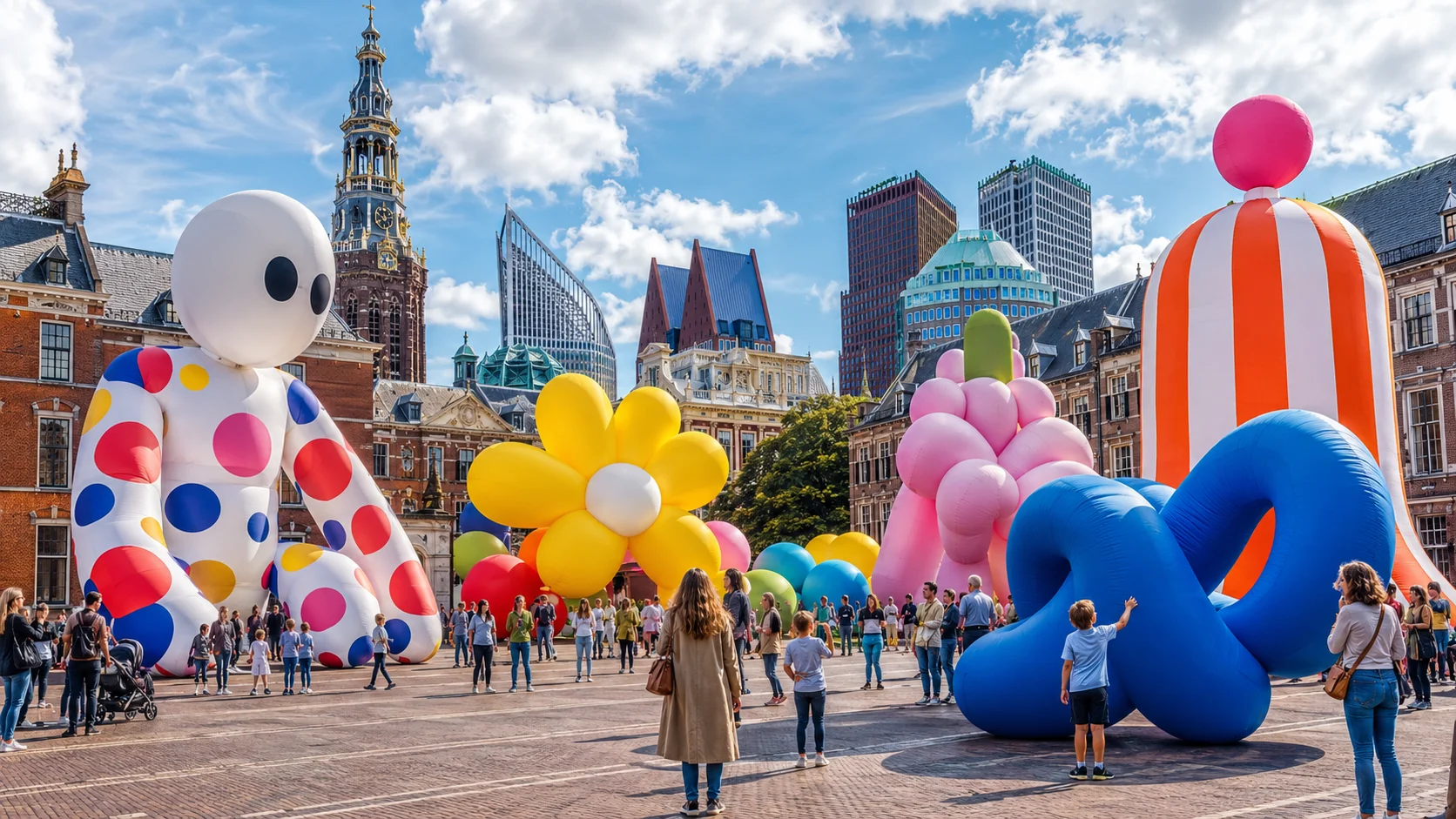
The Hague is usually framed through diplomacy, courts, coastal wind, and grand civic buildings, but this season the city is being seen through something much softer and more surreal: giant balloon art. Across public spaces, oversized inflatable forms are changing the rhythm of the streets and making familiar urban corners feel like open-air exhibition rooms. The idea feels simple at first glance, because balloons are objects people associate with birthdays, fairs, and childhood memories. Yet when they become monumental, carefully placed, and visually dominant, they stop being party props and start acting like architecture, sculpture, and social commentary at the same time. That shift is what makes The Hague’s transformation into a public gallery feel timely, photogenic, and deeply connected to how cities now compete for attention in a hyper-visual world.
What makes this moment interesting is not only the size of the balloons, but the way they interrupt the everyday cityscape without feeling hostile or heavy. A giant inflatable object can tower over a square, sit near a historic facade, or hover beside a pedestrian route, and somehow it still keeps a sense of play. That playful quality matters because public art often struggles with distance, especially when it feels too academic or locked behind institutional language. Here, the visual invitation is instant, and people do not need an art degree to understand that something unusual is happening in front of them. The city becomes easier to approach, easier to photograph, and easier to remember because the artwork meets people where they already are.
Why Giant Balloon Art Fits The Hague Now
The timing of giant balloon art in The Hague feels especially sharp because modern cities are no longer experienced only through walking, commuting, or tourism brochures. They are experienced through phone cameras, shared clips, travel reels, and quick visual impressions that move across social platforms faster than traditional cultural marketing ever could. The Hague already has strong visual assets, from its architecture to its museums and seaside atmosphere, but inflatable public art adds a different layer of accessibility. It gives the city a softer visual identity, one that can sit beside its serious international reputation without weakening it. In a way, the balloons work because they create contrast, and contrast is one of the strongest tools in contemporary visual storytelling.
The Hague has long been associated with governance, diplomacy, and legal institutions, which gives the city a certain formal weight. That image is valuable, but it can also make the city feel distant to people who are looking for spontaneous culture or visually playful urban experiences. Large-scale balloon installations break that mood in a useful way because they make public space feel lighter, more experimental, and more welcoming. The effect is not about replacing the city’s identity, but about expanding how people can read it. A place known for seriousness can still host joy, and a city shaped by institutions can still become a living canvas for temporary visual imagination.
This is why inflatable art has become such an effective tool in the wider world of public art. It can be installed with a visual force that feels monumental, yet it often avoids the permanence and expense of traditional sculpture. It can respond to a location without demanding that the location be permanently altered. It can create spectacle while still feeling approachable, which is not always easy for large-scale contemporary art. Most importantly, it gives viewers a reason to pause in places they may normally cross without noticing.
From Street Corners to Open-Air Gallery Rooms
The most powerful part of this kind of installation is the way it changes movement. A normal street corner becomes a viewing point, a square becomes a stage, and a passing crowd becomes part of the artwork’s atmosphere. Unlike a traditional gallery, where people enter a controlled space and move according to a quiet cultural script, the city version is louder, messier, and more democratic. People stop while carrying groceries, walking dogs, meeting friends, or rushing between appointments. That collision between ordinary routines and extraordinary forms is exactly what gives giant balloon art its emotional pull.
There is also a strong visual logic behind the use of balloons in urban space. Their rounded shapes soften hard architectural lines, while their scale creates a strange conversation with buildings, statues, benches, and trees. When an inflatable sculpture appears beside stone, glass, brick, or concrete, the city suddenly feels less fixed. The object may be temporary, but while it exists, it changes how people read the entire scene around it. That is why these installations often feel larger than themselves, because they do not only occupy space; they reframe everything nearby.
For a website focused on visual culture, this is the kind of urban event that shows how public attention now works. People are drawn to forms that are easy to recognize, easy to share, and open enough to invite personal interpretation. Some viewers may see the balloons as joyful, while others may read them as surreal disruptions in a carefully ordered city. Some may treat them as family-friendly attractions, while others may see a serious conversation about scale, spectacle, and access to art. The strength of the installation is that it can hold all of those readings at once without becoming too narrow.
The Visual Trend Behind Inflatable Public Art
The rise of inflatable public art is not random. It fits a broader trend in which cultural institutions, cities, and artists are searching for formats that can compete with digital distraction while still creating real-world presence. People are constantly surrounded by screens, so physical art has to work harder to earn attention in public life. Inflatable installations do this by using scale, color, softness, and surprise in ways that feel instantly legible. They are not subtle in the traditional sense, but their boldness is part of their cultural function.
In recent years, immersive exhibitions and public installations have become major drivers of cultural tourism. Cities understand that visitors are not only looking for monuments anymore; they are looking for moments. A giant balloon in a civic space delivers that moment quickly because it turns the city into a backdrop and the visitor into an active participant. People do not simply look at the artwork; they position themselves around it, photograph it, walk under it, and use it to tell their own version of the city. This makes the installation part of a larger experience economy where visual memory becomes almost as important as the artwork itself.
There is a risk in that, of course, because art made for public attention can be dismissed as spectacle. But spectacle is not automatically shallow, especially when it opens cultural space to people who might never step inside a gallery. The best public installations understand that visibility can be a doorway rather than an endpoint. A person may first approach the balloons because they look strange or fun, but they may leave thinking about the relationship between art, architecture, city planning, and public emotion. That movement from curiosity to reflection is one of the strongest arguments for why giant balloon art matters.
A Softer Kind of Monumentality
Traditional monuments often speak through permanence, weight, and authority. They are usually made of stone, metal, or bronze, and they tend to tell viewers that history has already decided what deserves attention. Balloon art works differently because it is monumental without pretending to last forever. Its temporary nature makes the encounter feel more urgent, because people know the artwork will disappear and the city will return to its usual rhythm. That limited lifespan gives the installation a kind of emotional glow that permanent objects do not always have.
This softness is not only physical; it is cultural. Inflatable art has a way of reducing the intimidation that sometimes surrounds contemporary sculpture. A massive balloon can be serious in its concept while still feeling open and friendly on the surface. That balance is difficult, and it is one reason the format keeps appearing in festivals, public programs, and urban cultural events. It allows artists and organizers to create something visually powerful without making the public feel like they are being tested.
The Hague’s use of this format shows how cities can experiment with monumentality without relying only on permanent landmarks. A temporary inflatable can still become a landmark for a day, a week, or a season. It can still guide foot traffic, shape conversations, and enter the visual memory of residents and tourists. In many ways, that temporary impact is perfectly matched to the speed of contemporary culture. Not everything has to last for decades to matter deeply in the moment.
How The Hague Becomes More Photographic
One of the strongest effects of these installations is how they make The Hague more photographic. The city already has visual depth, but giant balloon art adds a focal point that instantly changes composition. A street scene that might have looked ordinary now has scale, humor, color, and tension. Photographers can frame the balloons against historic buildings, open skies, passing cyclists, or groups of curious viewers. The result is a layered image where public art and city life become inseparable.
This matters because photography has become one of the main ways people understand urban culture. A city can have incredible cultural programming, but if that programming does not translate visually, it may struggle to travel beyond local audiences. Inflatable public art is highly transmissible because it works in wide shots, close-ups, street photography, and social video. It gives editors, visitors, and local creators material that is immediately recognizable. That recognition helps the city extend its cultural presence beyond the physical location of the installation.
Still, the photographic appeal is not only about online visibility. It also changes how people behave in person. When visitors take photos, they slow down, look more carefully, and become more aware of the space around them. They notice angles, reflections, crowds, and background details that they might otherwise ignore. In that sense, the balloons encourage a more active form of seeing, and that is one of the quiet wins of public visual art.
The Impact on Local Streets and Public Mood
Public art can change a city’s mood in ways that are difficult to measure but easy to feel. A giant inflatable sculpture does not solve urban problems, but it can create moments of shared attention in a society where people often move through public space separately. Strangers may stop at the same time, point at the same object, smile at the same unexpected view, or start casual conversations about what they are seeing. These small interactions are part of what makes public culture valuable. They remind people that the city is not only a system of roads and buildings, but also a shared emotional environment.
For local businesses, installations like this can also create softer forms of economic movement. People who come to see the artwork may spend more time in nearby areas, visit cafes, explore streets, and bring attention to neighborhoods that might not usually appear in travel guides. The effect depends on placement, promotion, weather, and accessibility, but the potential is real. Cultural events often work best when they do not feel isolated from everyday urban life. The Hague’s gallery-like transformation shows how art can become part of the street economy without losing its creative identity.
There is also a civic benefit in giving residents something new to talk about. Cities can feel repetitive when people move through the same spaces every day, especially when urban design becomes too predictable. Temporary installations interrupt that repetition and invite people to rediscover familiar areas with fresh eyes. A square is not just a square when a huge balloon sculpture suddenly changes its scale and mood. That feeling of rediscovery is one reason public art remains important even in a digital-first cultural landscape.
Practical Insights for Cities and Creators
The Hague’s balloon-driven public gallery effect offers useful lessons for other cities, curators, and creative teams. First, scale matters, but scale alone is not enough. A large object gets attention, but the strongest installations are those that create a meaningful relationship with the place around them. The object should not feel randomly dropped into the city; it should feel like it is having a conversation with the architecture, the flow of pedestrians, and the emotional tone of the neighborhood. That relationship is what turns an eye-catching object into a memorable public artwork.
Second, accessibility should be treated as part of the design, not as an afterthought. Public art works best when people can approach it comfortably, see it from multiple angles, and understand enough of its presence without needing a long explanation. This does not mean the art has to be simplistic. It means the first layer should be open enough for anyone to enter, while deeper layers can reward people who want to think more critically. Giant balloon art succeeds when it balances instant visual pleasure with broader cultural questions about space, scale, and shared experience.
Third, temporary visual events need good documentation. Because inflatable installations are not permanent, their afterlife depends heavily on photography, video, editorial storytelling, and local memory. Cities and creators should think carefully about lighting, visitor pathways, signage, and vantage points before the public arrives. The best images often happen naturally, but thoughtful planning can make those natural images more likely. In a media environment where visuals travel quickly, documentation is not a bonus; it is part of the artwork’s cultural reach.
Why This Story Matters Beyond The Hague
The story of giant balloons turning The Hague into a public gallery matters because it reflects a larger change in how people expect to meet art. The old model placed art inside special buildings and asked the public to come in. The newer model often sends art outward, into streets, parks, plazas, stations, and waterfronts. This does not make museums less important, but it does expand the cultural map. It says that a city itself can become an exhibition space when artists and organizers treat public areas as places of imagination rather than empty gaps between destinations.
This shift is especially relevant for younger audiences who often discover culture through movement, social media, and hybrid experiences. They may visit a museum, but they also want culture to appear in unexpected places and feel connected to real life. A balloon installation does that with unusual clarity because it is easy to encounter, easy to photograph, and hard to ignore. It transforms passive urban space into a stage for curiosity. It also makes the city feel less controlled and more alive, which is one of the most important qualities public art can offer.
There is also a deeper symbolic layer in the use of balloons. Balloons are fragile, filled with air, and associated with celebration, yet here they become huge enough to dominate the built environment. That contrast creates a quiet tension between lightness and power. It asks viewers to take something playful seriously, which is a very contemporary artistic move. In an era often shaped by anxiety, speed, and hard-edged public debate, a soft monumental object can feel surprisingly radical.
The Future of Public Visual Experiences
The success of installations like this points toward a future where public visual experiences become more flexible, temporary, and emotionally direct. Cities will likely continue looking for projects that can activate streets without requiring permanent construction. Artists will keep experimenting with materials that are lightweight, responsive, and able to create maximum visual impact with limited physical intervention. Audiences will keep expecting art to be not only seen, but experienced, photographed, discussed, and remembered. In that context, giant balloon art feels less like a novelty and more like a sign of where urban culture is heading.
However, the future of this format will depend on whether creators can keep it meaningful. If every city simply places oversized inflatables in public space without a strong concept, the trend could become predictable. The challenge is to use spectacle as a starting point, not as the whole message. The best installations will be those that understand local context, invite public participation, and leave people with more than a photo. The Hague’s current visual transformation works because it gives the city a new mood while still letting the city remain itself.
For creative industries, this is a reminder that the most effective visual ideas often sit between categories. These balloons are not only sculpture, not only design, not only festival decoration, and not only urban branding. They are a hybrid form that borrows from all of those worlds while creating something accessible in public space. That hybridity is exactly what makes them relevant for today’s visual culture. People are no longer interested in strict boundaries between art, design, tourism, and everyday life, because their actual experiences already blend those things together.
Conclusion: A City Lifted by Visual Imagination
The Hague’s transformation through giant balloon art shows how a city can become a gallery without walls, tickets, or silent rooms. By placing oversized inflatable works in public space, the city invites people to look again at streets they may have thought they already knew. The balloons create humor, scale, softness, and surprise, but they also reveal something serious about the future of cultural engagement. Art that meets people in everyday life can lower barriers, create shared attention, and make urban space feel more emotionally alive. That is why this story is bigger than a temporary installation; it is a glimpse of how visual imagination can lift a city into a new conversation.
At its best, giant balloon art does more than decorate The Hague. It changes how the city is photographed, walked, discussed, and remembered. It proves that public art does not always need to be heavy to have weight, and it does not need to be permanent to leave an impression. In a world where attention is fragmented and cities are constantly trying to define their cultural identity, soft spectacle can become a surprisingly powerful language. The Hague’s open-air gallery moment shows that sometimes the most memorable urban landmark is the one that floats, glows, and disappears before the city becomes ordinary again.