

Elizabeth Blackadder Exhibition Returns Quietly
 Vortixel
11 minutes read
Vortixel
11 minutes read
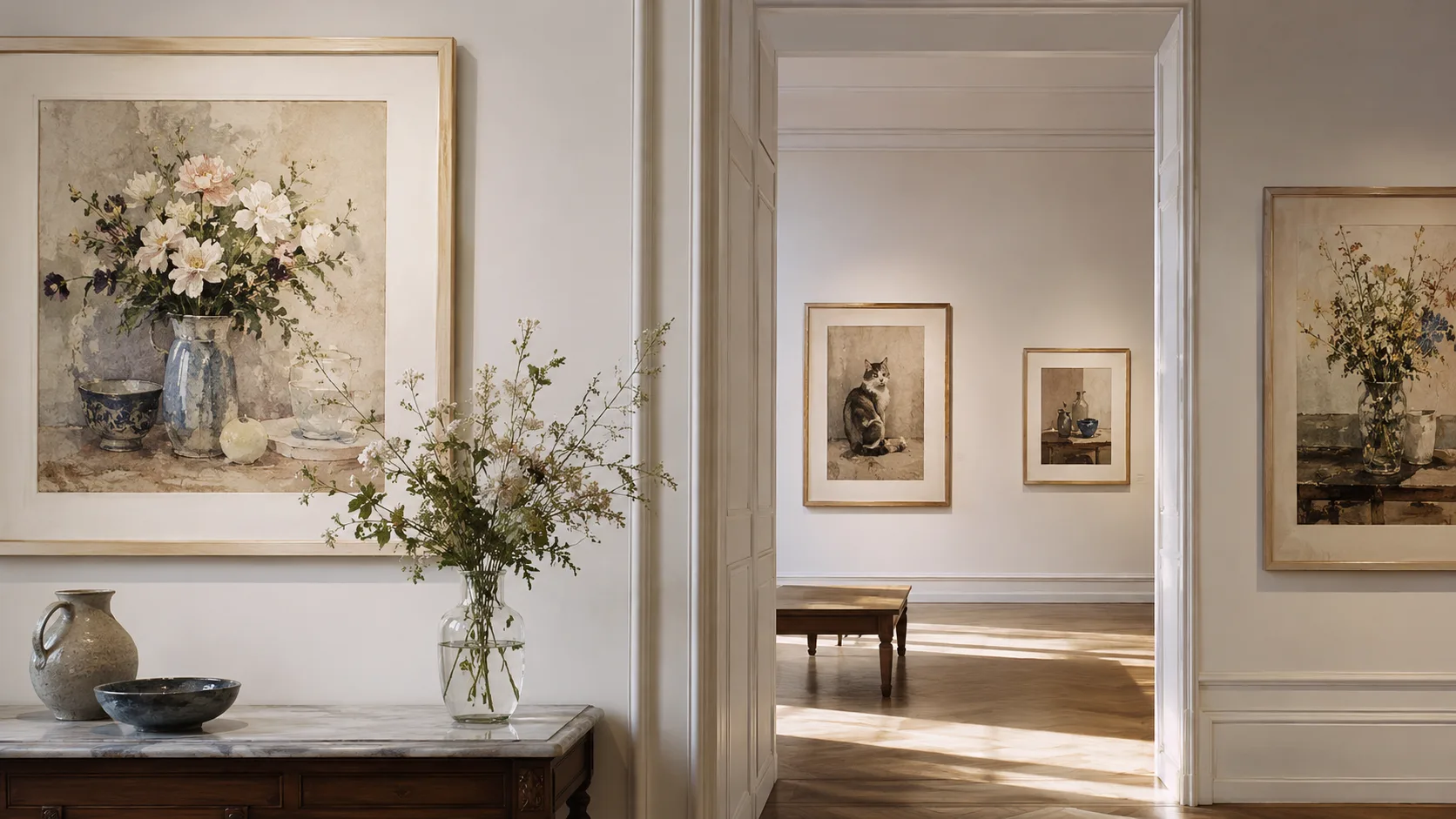
The reopening conversation around the Elizabeth Blackadder exhibition feels unusually quiet in the best possible way, especially in a visual culture that often rewards spectacle over stillness. Blackadder’s work does not shout for attention, yet it keeps pulling viewers closer through flowers, cats, windows, interiors, travel fragments, and carefully held silence. For a new generation raised on fast images, endless feeds, and loud visual branding, her art offers a different rhythm that feels almost radical. The renewed interest in her paintings and prints shows how softness can still feel powerful when the world is visually overloaded. That is why the return of this Elizabeth Blackadder exhibition matters not only as an art event, but as a reminder that quiet images can shape memory just as strongly as dramatic ones.
Why the Elizabeth Blackadder Exhibition Feels Timely
The timing of the Elizabeth Blackadder exhibition feels bigger than a simple gallery reopening because the current art mood is shifting toward intimacy, craft, and emotional detail. In recent years, audiences have been surrounded by digital saturation, algorithmic aesthetics, and large-scale immersive experiences that turn art into something closer to entertainment architecture. Those formats can be exciting, but they also leave many viewers craving images that slow the body down and let the eye breathe. Blackadder’s paintings arrive inside that cultural moment with a calm confidence that does not need noise to feel contemporary. Her art gives viewers permission to spend time with composition, negative space, color balance, and the small visual decisions that make an image unforgettable.
Blackadder’s reputation was built through a career that moved between painting, printmaking, watercolor, still life, landscape, and carefully observed domestic scenes. She had a way of making ordinary objects appear suspended between reality and memory, as if a vase, a flower stem, or a cat crossing a room could become part of a private visual language. That language now feels fresh again because contemporary audiences are becoming more aware of how much attention has been stolen by speed. The exhibition’s quiet tone does not make it less relevant; it makes it more necessary. In a period when visual culture is constantly trying to go bigger, Blackadder’s work proves that smallness can still hold deep emotional scale.
A Visual Language Built on Stillness
One of the strongest reasons the Elizabeth Blackadder exhibition stands out is the artist’s rare ability to turn stillness into movement. Her compositions often seem simple at first glance, but the longer a viewer looks, the more the picture begins to open. Objects are spaced with unusual care, colors hold their own atmosphere, and empty areas become active parts of the work instead of background filler. This is where Blackadder’s visual intelligence becomes clear, because she understood that silence in an image is not the absence of meaning. It is a structure that allows meaning to arrive slowly, almost like a thought forming in real time.
Her art often features flowers, fabrics, animals, ceramics, and interiors, yet it avoids the decorative trap that can make still life feel passive. A Blackadder image can look delicate without becoming fragile, because the composition is usually sharper than it first appears. The placement of a line, a petal, or a pattern can shift the entire emotional weight of the work. That balance between gentleness and precision is part of what makes her art especially interesting for today’s designers, illustrators, and digital creatives. In a culture where visuals are often optimized for instant reaction, Blackadder’s work asks the viewer to notice how an image can unfold through patience.
Color, Space, and the Power of Restraint
Color plays a central role in the renewed conversation around the Elizabeth Blackadder exhibition, but her use of color is rarely about visual volume alone. She often allowed colors to sit beside each other with a measured calm, creating relationships that felt thoughtful rather than forced. This sense of restraint gives the paintings a distinctive mood, where color becomes atmosphere instead of decoration. The result is a body of work that can feel both grounded and dreamlike, especially when familiar objects appear slightly detached from everyday logic. For modern viewers used to hyper-edited images, her color choices feel like a lesson in how subtle contrast can produce lasting visual impact.
Space is just as important as color in Blackadder’s art because she often treats blank areas as living parts of the composition. The empty space around a flower, a table edge, or an animal is not wasted; it creates tension, breath, and emotional distance. That approach connects naturally with contemporary conversations in Digital Art, where creators are rethinking how minimal layouts, clean interfaces, and negative space can affect feeling. Blackadder’s work reminds digital artists that restraint can be a design strategy, not a lack of ambition. Her quiet surfaces show that an image does not need to be overloaded to feel complete.
The Return of Quiet Art in a Loud Visual Era
The renewed attention around Blackadder also fits a wider visual trend: the return of quiet art in a loud visual era. Across galleries, design studios, and online creative communities, there is growing interest in work that values texture, handcraft, softness, and emotional clarity. This does not mean audiences are rejecting technology or digital culture entirely, but many are becoming more selective about what kind of images deserve their time. The Elizabeth Blackadder exhibition reflects that shift by offering a slower kind of visual experience that feels almost restorative. Instead of asking viewers to consume quickly, it invites them to stay with an image long enough for its details to become personal.
This trend matters because visual fatigue is now a real cultural condition, not just a casual complaint. People scroll through hundreds of images every day, from ads and reels to product shots and news graphics, often without remembering most of them afterward. Blackadder’s work challenges that pattern because it does not behave like disposable content. A single composition can linger because it feels emotionally specific, even when the subject is simple. That staying power is exactly what many contemporary artists and designers are trying to recover in a creative economy dominated by speed.
How Blackadder’s Art Speaks to Gen Z Viewers
At first, Elizabeth Blackadder might not seem like an obvious Gen Z art reference, but her work connects with younger viewers in ways that feel surprisingly current. Many younger audiences are drawn to visual worlds that feel sincere, personal, and less aggressively polished. They are also deeply familiar with the emotional pressure of being constantly online, where every image is competing for attention and identity is often performed through aesthetics. Against that backdrop, Blackadder’s art feels refreshingly unforced. Her paintings do not beg to be turned into content, and that makes them feel strangely modern.
There is also a strong connection between Blackadder’s visual world and the current love for intimate objects, personal spaces, and quiet domestic details. Online culture has made room for aesthetics around rooms, bookshelves, plants, pets, stationery, soft color palettes, and slow living, even when those trends are filtered through digital platforms. Blackadder worked with similar subjects long before they became lifestyle language, but she treated them with more depth and less branding. Her cats are not props, her flowers are not mood-board accessories, and her interiors are not staged for social approval. They feel lived with, observed, and remembered, which gives them emotional credibility.
The Exhibition as a Design Lesson
For designers, the Elizabeth Blackadder exhibition is more than an art-history moment because it offers practical lessons in visual decision-making. Her work demonstrates how composition can guide attention without needing obvious drama. She knew how to let objects breathe, how to create hierarchy through placement, and how to use emptiness as a form of emphasis. These are the same principles that matter in editorial layouts, branding systems, user interfaces, packaging, and digital storytelling. The difference is that Blackadder explored them through painting and printmaking, giving those ideas a slower and more tactile emotional charge.
One practical insight from Blackadder’s work is that visual clarity often comes from subtraction rather than addition. Many digital projects fail because they try to communicate too much at once, filling every surface with icons, gradients, buttons, captions, and competing focal points. Blackadder’s compositions show that a strong image can depend on knowing what to leave out. Another lesson is that softness does not have to mean weakness, because a gentle palette can still carry strong structure. For contemporary creative software users, her art becomes a reminder that tools are only powerful when the person using them understands attention, rhythm, and restraint.
Nature, Memory, and Emotional Detail
Nature appears throughout Blackadder’s work, but it rarely feels like a simple record of what she saw. Flowers, plants, and animals often become emotional markers, carrying a sense of time, place, and personal memory. This gives the Elizabeth Blackadder exhibition a layered quality because viewers are not only looking at botanical or domestic subjects. They are also entering a world where observation becomes a form of feeling. The quietness of the work allows those feelings to stay open instead of being explained too quickly.
Her use of natural forms is especially relevant now because many artists and audiences are rethinking their relationship with the nonhuman world. Climate anxiety, urban life, and digital isolation have all changed the way people look at plants, animals, landscapes, and domestic spaces. Blackadder’s art does not turn nature into a slogan, but it does encourage a more attentive relationship with living forms. That attention feels meaningful in a time when nature is often presented through crisis imagery or commercial wellness aesthetics. Her work offers another path, where looking carefully becomes a quiet act of respect.
Why the Exhibition Matters for Visual Innovation
It might sound unexpected to connect Elizabeth Blackadder with Visual Innovation, but the link becomes clear when innovation is understood as more than technology. True visual innovation is not only about new software, faster rendering, or immersive hardware. It is also about finding new ways to make viewers feel, pause, notice, and remember. Blackadder’s work does this through composition, color, silence, and the emotional charge of ordinary things. The Elizabeth Blackadder exhibition matters because it expands the idea of what innovation can look like in a culture obsessed with novelty.
Her relevance also challenges the assumption that the future of visual culture must always look futuristic. Sometimes the most forward-looking image is the one that reminds people how to see again. Artists working with artificial intelligence, generative systems, motion graphics, and interactive media can still learn from Blackadder’s sense of placement and restraint. A machine can generate endless visual options, but it cannot automatically understand why a small gap between objects might change the mood of an image. That kind of judgment remains deeply human, and Blackadder’s work is full of it.
The Impact on Contemporary Art Conversations
The renewed visibility of Blackadder’s work may also influence how contemporary art conversations frame legacy, gender, and quiet achievement. Art history has often favored dramatic biographies, aggressive movements, and personalities that fit the myth of the disruptive genius. Blackadder’s career offers a different model, one built on consistency, observation, craft, and visual intelligence across decades. That model is important because it helps widen the definition of artistic importance. The Elizabeth Blackadder exhibition gives audiences a chance to reconsider how many powerful artists have shaped visual culture without needing to perform loudness.
This impact is especially meaningful for younger artists who may feel pressured to build a personal brand before they have built a visual language. Blackadder’s work suggests that artistic identity can emerge from attention rather than performance. Her paintings and prints do not feel designed around a viral signature, yet they remain recognizable because the eye behind them is so distinct. That kind of slow recognition is valuable in a creative economy that often rewards instant legibility. The exhibition reminds artists that depth can still outlast visibility, even when visibility feels like the main currency of the moment.
Practical Insights for Digital Creators
Digital creators can take several practical insights from Blackadder’s approach without copying her style directly. The first is to treat negative space as an active design element instead of empty background. The second is to build images around emotional pacing, not just visual density. The third is to use color with intention, allowing quiet combinations to carry mood rather than relying only on high contrast. These ideas are useful for artists, illustrators, web designers, motion designers, and anyone building visual stories for screens.
Another useful lesson is the value of looking before making. In digital workflows, creators often begin by opening software, testing effects, and generating variations before fully understanding the visual problem. Blackadder’s work feels rooted in sustained observation, which is something digital creators can bring back into their process. Before choosing a filter, palette, layout, or animation, it helps to ask what the image needs emotionally. That question can prevent a project from becoming stylish but empty.
A Quiet Exhibition With a Lasting Signal
The Elizabeth Blackadder exhibition is not the kind of event that depends on shock value, and that may be its greatest strength. Its power comes from the way it reintroduces viewers to a slower form of attention. It asks people to look at flowers, cats, interiors, and fragments of travel not as small subjects, but as complete visual worlds. That shift feels important because contemporary culture often treats quietness as something secondary. Blackadder’s art shows that quietness can be the main event when it is handled with intelligence and care.
In the end, Blackadder’s return to public conversation is about more than nostalgia. It is about the future of how people look, design, create, and remember images. Her work speaks to painters and printmakers, but it also speaks to digital artists, designers, creative software users, and visual storytellers trying to make meaningful work in a crowded field. The exhibition proves that an image can be gentle and still unforgettable, restrained and still emotionally rich, modest and still culturally important. For Visual Vortixel’s audience, the lesson is clear: the next big visual shift may not be louder, brighter, or faster, but quieter, sharper, and more deeply seen.