

AI Lamp-Post Surveillance Is Changing Cities
 Vortixel
27 minutes read
Vortixel
27 minutes read
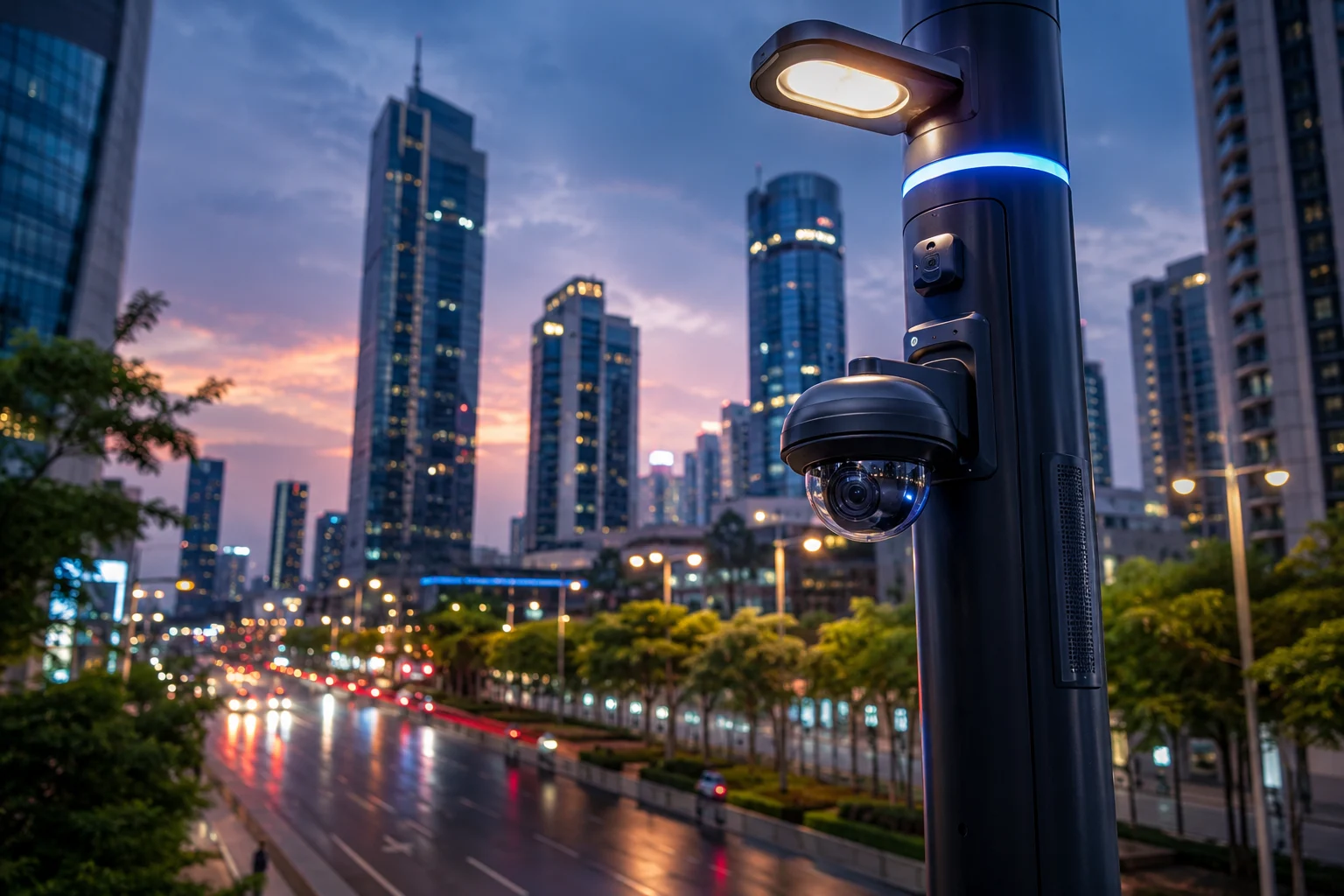
The city used to watch us through obvious cameras, mounted high on poles, tucked into corners, or staring from the ceiling of a train station. Now the next version of urban visibility is starting to look much quieter, more ordinary, and harder to notice. A streetlight can brighten a sidewalk, measure air quality, count traffic, detect movement, and feed data into systems that interpret what is happening in real time. That is why AI lamp-post surveillance is becoming one of the most important visual technology debates of the smart city era. It is not only about better lighting anymore; it is about what happens when everyday infrastructure becomes a network of intelligent eyes.
At first, the idea sounds almost harmless because lamp-posts are already part of the city’s background. Nobody walks down the street and feels surprised by a pole with a light attached to it. But when that same pole begins carrying cameras, microphones, environmental sensors, connectivity hardware, and artificial intelligence, the mood changes fast. A piece of street furniture becomes a data platform, and a public square becomes a live visual feed. The future of cities may depend on whether people see this as progress, protection, or a slow redesign of public life without public consent.
Why AI Lamp-Post Surveillance Is Suddenly Everywhere
The rise of AI lamp-post surveillance is not happening in isolation. Cities are under pressure to manage congestion, crime concerns, climate risk, emergency response, public transit, and aging infrastructure with budgets that rarely feel big enough. Smart poles promise a convenient answer because they use something cities already have: lighting networks spread across streets, sidewalks, parks, and business districts. Instead of installing separate systems for traffic monitoring, public safety, wireless connectivity, and environmental sensing, officials can bundle several technologies into one vertical structure. From a procurement perspective, that makes the lamp-post look less like a light and more like a compact operating system for the street.
The shift also reflects a broader movement in visual technology, where cameras are no longer just recording devices. Modern cameras can pair with computer vision models that detect objects, classify movement, identify patterns, and flag events automatically. This means the value is no longer only in the footage itself, but in what software can infer from the footage. A road crossing can become data about pedestrian behavior, a crowd can become a density map, and a parking lane can become a live availability signal. The visual layer of the city is being translated into machine-readable information, and lamp-posts are one of the easiest places to put the hardware.
There is also a branding advantage behind the word “smart.” Smart lighting sounds cleaner than surveillance, and smart infrastructure sounds more innovative than constant monitoring. Cities can describe these systems as tools for safety, energy efficiency, mobility, and environmental intelligence, all of which are real and useful goals. The problem is that the same sensor network that helps detect a traffic hazard can also be used to track movement at scale. That double use is what makes AI-powered visual technology so powerful and so politically sensitive.
The Lamp-Post Is Becoming a Visual Platform
For decades, a streetlight had one obvious job: make public space visible after dark. The new generation of smart lamp-posts treats light as only one feature inside a larger device. Some can support high-resolution cameras, motion sensors, acoustic detection, air quality tools, Wi-Fi equipment, electric vehicle charging, emergency call buttons, and digital signage. When artificial intelligence is added, the lamp-post stops being passive infrastructure and starts acting like a visual platform. It can observe, process, prioritize, and send alerts without waiting for a human operator to watch every frame.
This is where the story becomes bigger than surveillance cameras. Traditional CCTV depends heavily on storage and review, with humans searching through footage after something happens. AI-assisted systems are designed to surface what matters before, during, or immediately after an event. They can notice a stalled vehicle, unusual crowding, a blocked intersection, or a person entering a restricted zone. The promise is speed, but the trade-off is that public space becomes continuously interpreted by software that most residents never see, audit, or understand.
For visual technology companies, smart lamp-posts are attractive because they provide stable height, electricity, and urban coverage. A device mounted on a pole has a better view than one placed at ground level, and it can monitor the same area every day. When many poles are connected, the city gains a kind of distributed visual nervous system. That network can be trained to understand patterns over time, from traffic flow during rush hour to foot traffic around nightlife districts. The technical achievement is impressive, but the social question is whether every useful pattern should automatically be captured.
The Safety Argument Is Real, but Not Simple
Supporters of AI lamp-post surveillance usually begin with safety, and the argument is not fake. Better lighting can reduce fear, improve visibility, and make public spaces more accessible at night. Cameras can help emergency teams understand what is happening before they arrive. Sensors can detect traffic incidents, crowd pressure, flooding, smoke, or infrastructure problems faster than traditional reporting channels. In a city where seconds matter, a connected lamp-post can act like a first layer of awareness.
The strongest case appears in situations where the system is focused on events, not identities. For example, detecting a vehicle collision is different from tracking every individual who walks past a store. Measuring whether a sidewalk is overcrowded is different from building a movement profile of specific people. A city can use visual AI to understand risk without turning every resident into a target. The difference depends on policy, system design, data retention, and whether privacy protections are built in from the beginning.
However, safety can become a very flexible word. Once a city installs a sensor network, new uses often appear after the original public conversation has already ended. A system approved for traffic management can later support law enforcement analytics, commercial footfall measurement, or behavioral monitoring. This is known as function creep, and it is one of the biggest risks in smart city technology. The lamp-post may begin as a safety tool, but without clear limits, it can become a general-purpose surveillance layer.
The Privacy Problem Hides in Plain Sight
The privacy issue with smart lamp-posts is not only that cameras exist. People already live around cameras in stores, offices, buses, airports, apartment buildings, and busy intersections. The difference is scale, automation, and invisibility. A visible CCTV camera still feels like a camera, while a sensor-packed lamp-post can blend into the street and become almost emotionally invisible. That quietness makes AI surveillance harder to challenge because people may not even realize when a public space has changed.
Computer vision also changes the meaning of being seen. A human looking at a street sees a messy public scene with context, ambiguity, and social judgment. A machine vision system may convert the same scene into coordinates, classifications, risk scores, object labels, and alerts. That translation can be useful, but it can also flatten human behavior into data points that look more certain than they really are. When a system flags “suspicious” movement, the key question is who defined suspicion and how the model learned to recognize it.
Bias is another concern because visual AI does not enter the city as a neutral observer. Models can perform unevenly across lighting conditions, clothing styles, skin tones, mobility aids, age groups, and crowded environments. Even when a system does not identify faces, it can still create unequal outcomes if certain neighborhoods are monitored more heavily than others. A wealthy shopping district may get “smart safety,” while a lower-income neighborhood gets constant suspicion. The technology may be the same, but the lived experience can be completely different.
Smart Cities Need Smart Consent
One of the biggest gaps in the smart city conversation is consent. People can choose whether to install a smart doorbell at home, use a fitness tracker, or enable location services on a phone. But they cannot realistically opt out of walking under a lamp-post on the way to work, school, or the grocery store. Public space works because it belongs to everyone, including people who do not want to be analyzed by a camera network. That is why visual infrastructure needs a higher standard than consumer tech.
Consent in this context does not mean every passerby signs a digital form before crossing the street. It means communities should know what is installed, what data is collected, how long it is stored, who can access it, and what uses are forbidden. It also means residents should have a way to challenge deployments before they become permanent. Public signage should be clear, not hidden behind vague smart city language. A city that wants trust cannot treat visual monitoring as a technical upgrade only engineers and vendors need to understand.
Good governance also requires independent oversight. A dashboard controlled only by the vendor or the city department using the system is not enough. Residents, civil liberties groups, urban planners, privacy experts, and technical auditors should all have a seat at the table. The rules should be written before deployment, not after controversy. Once the poles are installed and the data pipelines are active, reversing the system becomes much harder politically, financially, and operationally.
The Design Challenge: Making Tech Visible
Visual technology usually wants to become seamless, but public infrastructure should not always disappear. A beautifully designed smart pole may look sleek, minimal, and futuristic, yet that same design can make surveillance feel less noticeable. This creates a design ethics problem for cities and hardware makers. Should a sensor be hidden for aesthetics, or should it be obvious because people deserve to know they are being observed? In the age of AI-powered urban design, visibility is not just a visual choice; it is a civic value.
Designers can help by making smart infrastructure legible. A lamp-post could include clear visual indicators showing what functions are active, such as camera monitoring, environmental sensing, or emergency communication. Public maps could show where AI-enabled poles are located and what each one does. Cities could use open design standards so residents are not forced to decode a confusing mix of private hardware brands. If a streetlight is part of a data network, its design should communicate that honestly.
This is especially important for creative and visual communities because the street is not only a transport corridor. It is a place for protest, performance, fashion, photography, nightlife, murals, skate culture, and everyday self-expression. If people feel constantly watched, they may behave differently in ways that are difficult to measure. The city can become more controlled but less alive. For a publication focused on Artificial Intelligence and visual innovation, that tension is the real story behind the hardware.
What This Means for Digital Creativity
The lamp-post debate may seem far away from digital art, design tools, and visual entertainment, but it is directly connected. The same advances that help artists generate scenes, restore footage, build 3D worlds, and automate editing also help cities interpret real streets. Computer vision, image recognition, spatial mapping, and generative AI all sit inside the same wider shift toward machine-readable visuals. Creative software makes images easier to produce, while urban AI makes public life easier to analyze. Both are reshaping how humans relate to images, spaces, and reality.
For creators, this opens a strange new frontier. Urban data could inspire immersive installations, real-time city visualizations, responsive public art, and more adaptive design systems. Imagine a public artwork that changes based on pedestrian movement, weather conditions, air quality, or neighborhood sound levels. That kind of creative use can make the city feel more alive and participatory. But if the same sensors are also feeding opaque surveillance systems, the artwork may become a friendly face on top of a more complicated data machine.
This is why digital creativity needs ethics as much as aesthetics. Artists and designers working with public data should ask where that data comes from and whether people had any meaningful say in its collection. Agencies building smart city campaigns should avoid turning surveillance into lifestyle branding. Product teams should understand that “frictionless” is not always the same as good. In public space, a little friction can remind everyone that technology is making choices, not simply improving the background.
The Business of Watching the Street
Behind every smart lamp-post is also a market. Hardware companies, AI startups, telecom providers, cloud platforms, analytics vendors, and security contractors all see opportunity in urban visual infrastructure. A city full of connected poles can generate recurring revenue through maintenance, software subscriptions, data services, and system upgrades. That business model matters because it can influence how aggressively systems are sold and expanded. When surveillance becomes a product category, growth incentives do not always match public interest.
The sales pitch often focuses on efficiency because efficiency is easy for city leaders to defend. Smart lights can reduce energy use, remote diagnostics can lower maintenance costs, and traffic insights can support better planning. Those are meaningful benefits, especially for cities trying to modernize without rebuilding everything from scratch. But efficiency can become a narrow lens if it ignores democratic accountability. A city may become easier to manage while becoming harder for residents to question.
There is also the issue of data ownership. If a private vendor operates the platform, who controls the visual data collected from public streets? Can it be shared with third parties, used for product development, or combined with other datasets? Are there strict deletion policies, or does the city keep data because storage is cheap and future uses might appear? These questions sound technical, but they decide whether smart city infrastructure serves the public or quietly turns public life into an asset class.
Practical Questions Every City Should Ask
Before installing AI-enabled lamp-posts, city leaders should slow down and ask practical questions in public. What problem is the system supposed to solve, and is visual monitoring actually the least invasive way to solve it? What data is collected, what data is ignored, and what data is processed directly on the device instead of being sent to the cloud? Who can access the footage or analytics, and under what legal process? If the answers are vague, the project is not ready for public deployment.
- Purpose: Define the exact use case before installation, not after the system is live.
- Transparency: Tell residents where sensors are located and what they do.
- Data limits: Collect only what is necessary and delete it quickly when possible.
- Auditability: Allow independent experts to test performance, bias, and security.
- Accountability: Create clear consequences when the system is misused.
These questions are not anti-technology. They are pro-trust, and trust is the real infrastructure smart cities need most. A community may accept visual AI for traffic safety if it understands the boundaries. It may reject the same system if officials hide behind vague promises and private contracts. The difference is not only the hardware; it is the relationship between the city and the people who live inside it. When technology enters public space, legitimacy matters as much as capability.
Why the Future Should Not Be Camera First
The easiest smart city solution is often to add a camera, but the easiest solution is not always the best one. Many urban problems come from design failures, not information gaps. A dangerous crossing may need a safer street layout, not more automated monitoring. A poorly lit park may need better maintenance, community programming, and inclusive design, not a sensor network that makes visitors feel watched. AI can help cities understand problems, but it should not become a shortcut around deeper urban care.
A camera-first city risks treating symptoms while leaving root causes untouched. If traffic violations are constant, the road may be designed for speed rather than safety. If public spaces feel unsafe, the answer may involve housing, lighting, transit access, mental health services, and community presence. AI analytics can produce beautiful dashboards, but dashboards do not automatically create justice, comfort, or belonging. The danger is that cities may mistake visibility for understanding.
The better future is one where visual AI is selective, accountable, and clearly connected to public benefit. Some use cases will make sense, especially when they protect people without identifying them. Others should be rejected because they normalize constant observation for problems that could be solved in less invasive ways. The smartest city is not the one that sees everything. It is the one that knows when not to look.
Conclusion: The Streetlight Is No Longer Neutral
The rise of AI lamp-post surveillance shows how fast ordinary objects can become powerful visual technologies. A streetlight that once symbolized safety, warmth, and public access can now become a camera node, a sensor hub, and a data gateway. That does not make every smart pole dangerous, but it does mean every deployment deserves serious public attention. Cities need better tools, but they also need better rules, clearer design, and deeper respect for the people moving through public space. The future of urban technology should not be built only around what machines can see, but around what communities are willing to become.The city used to watch us through obvious cameras, mounted high on poles, tucked into corners, or staring from the ceiling of a train station. Now the next version of urban visibility is starting to look much quieter, more ordinary, and harder to notice. A streetlight can brighten a sidewalk, measure air quality, count traffic, detect movement, and feed data into systems that interpret what is happening in real time. That is why AI lamp-post surveillance is becoming one of the most important visual technology debates of the smart city era. It is not only about better lighting anymore; it is about what happens when everyday infrastructure becomes a network of intelligent eyes.
At first, the idea sounds almost harmless because lamp-posts are already part of the city’s background. Nobody walks down the street and feels surprised by a pole with a light attached to it. But when that same pole begins carrying cameras, microphones, environmental sensors, connectivity hardware, and artificial intelligence, the mood changes fast. A piece of street furniture becomes a data platform, and a public square becomes a live visual feed. The future of cities may depend on whether people see this as progress, protection, or a slow redesign of public life without public consent.
Why AI Lamp-Post Surveillance Is Suddenly Everywhere
The rise of AI lamp-post surveillance is not happening in isolation. Cities are under pressure to manage congestion, crime concerns, climate risk, emergency response, public transit, and aging infrastructure with budgets that rarely feel big enough. Smart poles promise a convenient answer because they use something cities already have: lighting networks spread across streets, sidewalks, parks, and business districts. Instead of installing separate systems for traffic monitoring, public safety, wireless connectivity, and environmental sensing, officials can bundle several technologies into one vertical structure. From a procurement perspective, that makes the lamp-post look less like a light and more like a compact operating system for the street.
The shift also reflects a broader movement in visual technology, where cameras are no longer just recording devices. Modern cameras can pair with computer vision models that detect objects, classify movement, identify patterns, and flag events automatically. This means the value is no longer only in the footage itself, but in what software can infer from the footage. A road crossing can become data about pedestrian behavior, a crowd can become a density map, and a parking lane can become a live availability signal. The visual layer of the city is being translated into machine-readable information, and lamp-posts are one of the easiest places to put the hardware.
There is also a branding advantage behind the word “smart.” Smart lighting sounds cleaner than surveillance, and smart infrastructure sounds more innovative than constant monitoring. Cities can describe these systems as tools for safety, energy efficiency, mobility, and environmental intelligence, all of which are real and useful goals. The problem is that the same sensor network that helps detect a traffic hazard can also be used to track movement at scale. That double use is what makes AI-powered visual technology so powerful and so politically sensitive.
The Lamp-Post Is Becoming a Visual Platform
For decades, a streetlight had one obvious job: make public space visible after dark. The new generation of smart lamp-posts treats light as only one feature inside a larger device. Some can support high-resolution cameras, motion sensors, acoustic detection, air quality tools, Wi-Fi equipment, electric vehicle charging, emergency call buttons, and digital signage. When artificial intelligence is added, the lamp-post stops being passive infrastructure and starts acting like a visual platform. It can observe, process, prioritize, and send alerts without waiting for a human operator to watch every frame.
This is where the story becomes bigger than surveillance cameras. Traditional CCTV depends heavily on storage and review, with humans searching through footage after something happens. AI-assisted systems are designed to surface what matters before, during, or immediately after an event. They can notice a stalled vehicle, unusual crowding, a blocked intersection, or a person entering a restricted zone. The promise is speed, but the trade-off is that public space becomes continuously interpreted by software that most residents never see, audit, or understand.
For visual technology companies, smart lamp-posts are attractive because they provide stable height, electricity, and urban coverage. A device mounted on a pole has a better view than one placed at ground level, and it can monitor the same area every day. When many poles are connected, the city gains a kind of distributed visual nervous system. That network can be trained to understand patterns over time, from traffic flow during rush hour to foot traffic around nightlife districts. The technical achievement is impressive, but the social question is whether every useful pattern should automatically be captured.
The Safety Argument Is Real, but Not Simple
Supporters of AI lamp-post surveillance usually begin with safety, and the argument is not fake. Better lighting can reduce fear, improve visibility, and make public spaces more accessible at night. Cameras can help emergency teams understand what is happening before they arrive. Sensors can detect traffic incidents, crowd pressure, flooding, smoke, or infrastructure problems faster than traditional reporting channels. In a city where seconds matter, a connected lamp-post can act like a first layer of awareness.
The strongest case appears in situations where the system is focused on events, not identities. For example, detecting a vehicle collision is different from tracking every individual who walks past a store. Measuring whether a sidewalk is overcrowded is different from building a movement profile of specific people. A city can use visual AI to understand risk without turning every resident into a target. The difference depends on policy, system design, data retention, and whether privacy protections are built in from the beginning.
However, safety can become a very flexible word. Once a city installs a sensor network, new uses often appear after the original public conversation has already ended. A system approved for traffic management can later support law enforcement analytics, commercial footfall measurement, or behavioral monitoring. This is known as function creep, and it is one of the biggest risks in smart city technology. The lamp-post may begin as a safety tool, but without clear limits, it can become a general-purpose surveillance layer.
The Privacy Problem Hides in Plain Sight
The privacy issue with smart lamp-posts is not only that cameras exist. People already live around cameras in stores, offices, buses, airports, apartment buildings, and busy intersections. The difference is scale, automation, and invisibility. A visible CCTV camera still feels like a camera, while a sensor-packed lamp-post can blend into the street and become almost emotionally invisible. That quietness makes AI surveillance harder to challenge because people may not even realize when a public space has changed.
Computer vision also changes the meaning of being seen. A human looking at a street sees a messy public scene with context, ambiguity, and social judgment. A machine vision system may convert the same scene into coordinates, classifications, risk scores, object labels, and alerts. That translation can be useful, but it can also flatten human behavior into data points that look more certain than they really are. When a system flags “suspicious” movement, the key question is who defined suspicion and how the model learned to recognize it.
Bias is another concern because visual AI does not enter the city as a neutral observer. Models can perform unevenly across lighting conditions, clothing styles, skin tones, mobility aids, age groups, and crowded environments. Even when a system does not identify faces, it can still create unequal outcomes if certain neighborhoods are monitored more heavily than others. A wealthy shopping district may get “smart safety,” while a lower-income neighborhood gets constant suspicion. The technology may be the same, but the lived experience can be completely different.
Smart Cities Need Smart Consent
One of the biggest gaps in the smart city conversation is consent. People can choose whether to install a smart doorbell at home, use a fitness tracker, or enable location services on a phone. But they cannot realistically opt out of walking under a lamp-post on the way to work, school, or the grocery store. Public space works because it belongs to everyone, including people who do not want to be analyzed by a camera network. That is why visual infrastructure needs a higher standard than consumer tech.
Consent in this context does not mean every passerby signs a digital form before crossing the street. It means communities should know what is installed, what data is collected, how long it is stored, who can access it, and what uses are forbidden. It also means residents should have a way to challenge deployments before they become permanent. Public signage should be clear, not hidden behind vague smart city language. A city that wants trust cannot treat visual monitoring as a technical upgrade only engineers and vendors need to understand.
Good governance also requires independent oversight. A dashboard controlled only by the vendor or the city department using the system is not enough. Residents, civil liberties groups, urban planners, privacy experts, and technical auditors should all have a seat at the table. The rules should be written before deployment, not after controversy. Once the poles are installed and the data pipelines are active, reversing the system becomes much harder politically, financially, and operationally.
The Design Challenge: Making Tech Visible
Visual technology usually wants to become seamless, but public infrastructure should not always disappear. A beautifully designed smart pole may look sleek, minimal, and futuristic, yet that same design can make surveillance feel less noticeable. This creates a design ethics problem for cities and hardware makers. Should a sensor be hidden for aesthetics, or should it be obvious because people deserve to know they are being observed? In the age of AI-powered urban design, visibility is not just a visual choice; it is a civic value.
Designers can help by making smart infrastructure legible. A lamp-post could include clear visual indicators showing what functions are active, such as camera monitoring, environmental sensing, or emergency communication. Public maps could show where AI-enabled poles are located and what each one does. Cities could use open design standards so residents are not forced to decode a confusing mix of private hardware brands. If a streetlight is part of a data network, its design should communicate that honestly.
This is especially important for creative and visual communities because the street is not only a transport corridor. It is a place for protest, performance, fashion, photography, nightlife, murals, skate culture, and everyday self-expression. If people feel constantly watched, they may behave differently in ways that are difficult to measure. The city can become more controlled but less alive. For a publication focused on Artificial Intelligence and visual innovation, that tension is the real story behind the hardware.
What This Means for Digital Creativity
The lamp-post debate may seem far away from digital art, design tools, and visual entertainment, but it is directly connected. The same advances that help artists generate scenes, restore footage, build 3D worlds, and automate editing also help cities interpret real streets. Computer vision, image recognition, spatial mapping, and generative AI all sit inside the same wider shift toward machine-readable visuals. Creative software makes images easier to produce, while urban AI makes public life easier to analyze. Both are reshaping how humans relate to images, spaces, and reality.
For creators, this opens a strange new frontier. Urban data could inspire immersive installations, real-time city visualizations, responsive public art, and more adaptive design systems. Imagine a public artwork that changes based on pedestrian movement, weather conditions, air quality, or neighborhood sound levels. That kind of creative use can make the city feel more alive and participatory. But if the same sensors are also feeding opaque surveillance systems, the artwork may become a friendly face on top of a more complicated data machine.
This is why digital creativity needs ethics as much as aesthetics. Artists and designers working with public data should ask where that data comes from and whether people had any meaningful say in its collection. Agencies building smart city campaigns should avoid turning surveillance into lifestyle branding. Product teams should understand that “frictionless” is not always the same as good. In public space, a little friction can remind everyone that technology is making choices, not simply improving the background.
The Business of Watching the Street
Behind every smart lamp-post is also a market. Hardware companies, AI startups, telecom providers, cloud platforms, analytics vendors, and security contractors all see opportunity in urban visual infrastructure. A city full of connected poles can generate recurring revenue through maintenance, software subscriptions, data services, and system upgrades. That business model matters because it can influence how aggressively systems are sold and expanded. When surveillance becomes a product category, growth incentives do not always match public interest.
The sales pitch often focuses on efficiency because efficiency is easy for city leaders to defend. Smart lights can reduce energy use, remote diagnostics can lower maintenance costs, and traffic insights can support better planning. Those are meaningful benefits, especially for cities trying to modernize without rebuilding everything from scratch. But efficiency can become a narrow lens if it ignores democratic accountability. A city may become easier to manage while becoming harder for residents to question.
There is also the issue of data ownership. If a private vendor operates the platform, who controls the visual data collected from public streets? Can it be shared with third parties, used for product development, or combined with other datasets? Are there strict deletion policies, or does the city keep data because storage is cheap and future uses might appear? These questions sound technical, but they decide whether smart city infrastructure serves the public or quietly turns public life into an asset class.
Practical Questions Every City Should Ask
Before installing AI-enabled lamp-posts, city leaders should slow down and ask practical questions in public. What problem is the system supposed to solve, and is visual monitoring actually the least invasive way to solve it? What data is collected, what data is ignored, and what data is processed directly on the device instead of being sent to the cloud? Who can access the footage or analytics, and under what legal process? If the answers are vague, the project is not ready for public deployment.
- Purpose: Define the exact use case before installation, not after the system is live.
- Transparency: Tell residents where sensors are located and what they do.
- Data limits: Collect only what is necessary and delete it quickly when possible.
- Auditability: Allow independent experts to test performance, bias, and security.
- Accountability: Create clear consequences when the system is misused.
These questions are not anti-technology. They are pro-trust, and trust is the real infrastructure smart cities need most. A community may accept visual AI for traffic safety if it understands the boundaries. It may reject the same system if officials hide behind vague promises and private contracts. The difference is not only the hardware; it is the relationship between the city and the people who live inside it. When technology enters public space, legitimacy matters as much as capability.
Why the Future Should Not Be Camera First
The easiest smart city solution is often to add a camera, but the easiest solution is not always the best one. Many urban problems come from design failures, not information gaps. A dangerous crossing may need a safer street layout, not more automated monitoring. A poorly lit park may need better maintenance, community programming, and inclusive design, not a sensor network that makes visitors feel watched. AI can help cities understand problems, but it should not become a shortcut around deeper urban care.
A camera-first city risks treating symptoms while leaving root causes untouched. If traffic violations are constant, the road may be designed for speed rather than safety. If public spaces feel unsafe, the answer may involve housing, lighting, transit access, mental health services, and community presence. AI analytics can produce beautiful dashboards, but dashboards do not automatically create justice, comfort, or belonging. The danger is that cities may mistake visibility for understanding.
The better future is one where visual AI is selective, accountable, and clearly connected to public benefit. Some use cases will make sense, especially when they protect people without identifying them. Others should be rejected because they normalize constant observation for problems that could be solved in less invasive ways. The smartest city is not the one that sees everything. It is the one that knows when not to look.
Conclusion: The Streetlight Is No Longer Neutral
The rise of AI lamp-post surveillance shows how fast ordinary objects can become powerful visual technologies. A streetlight that once symbolized safety, warmth, and public access can now become a camera node, a sensor hub, and a data gateway. That does not make every smart pole dangerous, but it does mean every deployment deserves serious public attention. Cities need better tools, but they also need better rules, clearer design, and deeper respect for the people moving through public space. The future of urban technology should not be built only around what machines can see, but around what communities are willing to become.