
Anish Kapoor London Exhibition Goes Monumental
 Vortixel
15 minutes read
Vortixel
15 minutes read
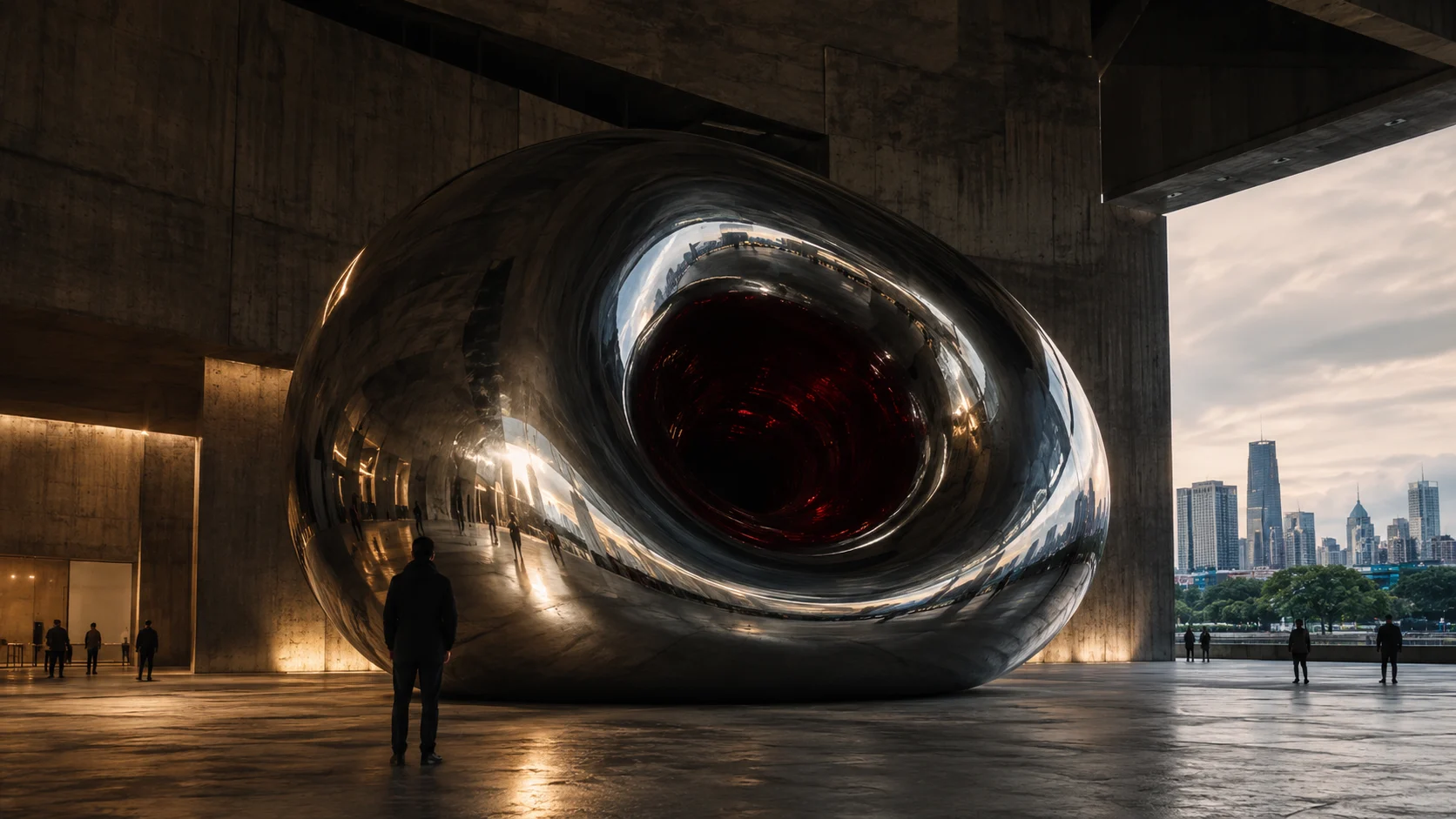
The Anish Kapoor London exhibition arrives like a pressure change in the middle of the city, the kind of cultural moment that makes a familiar building feel suddenly unstable, alive, and almost too big for its own walls. At the Hayward Gallery, Kapoor is not simply bringing sculptures into rooms; he is turning the entire exhibition space into a field of optical tension, psychological drama, and physical scale. The show runs from June 16 to October 18, 2026, and it marks his major return to the Southbank venue after decades of shaping how audiences think about voids, mirrors, pigment, darkness, and the body. For Visual Vortixel, this is exactly the kind of story that sits at the edge of art, architecture, spectacle, and sensory design. It is not only about a famous artist getting another big show, but about how monumental visual culture keeps pulling people back into real spaces in an era overloaded with screens.
Kapoor’s name carries a specific visual charge because his work often looks simple at first and then refuses to stay still. A mirrored curve can turn a crowd into liquid. A black recess can feel less like a surface and more like an opening into another temperature of space. A red, fleshy form can appear somewhere between sculpture, wound, landscape, and ritual object. That instability is why the Anish Kapoor London exhibition feels bigger than a regular museum calendar entry. It offers a chance to see how one of contemporary art’s most recognizable makers continues to build experiences that do not behave like static images.
Why the Anish Kapoor London Exhibition Matters Now
The timing of this exhibition matters because the art world is living through a strange double movement. On one side, audiences are flooded with immersive entertainment, projection rooms, AI visuals, and social-media-friendly installations designed to look good in a five-second video. On the other side, there is a growing hunger for encounters that feel physically difficult to flatten into content. Kapoor sits right in the middle of that tension, but he does not arrive from the world of digital spectacle. His work uses material, scale, reflection, and absence to create an experience that feels immersive without needing to become a tech demo.
The Hayward Gallery is also a strong match for Kapoor because the building itself has a blunt architectural personality. Its Brutalist structure, concrete weight, terraces, and angular circulation can easily fight with an artist who wants a neutral white cube. Kapoor’s practice benefits from that friction because his objects often seem to bend, swallow, or disturb the architecture around them. When a major artist occupies the whole building, including outdoor sculpture terraces, the gallery becomes less like a container and more like an active participant. That makes this London show feel like a spatial event, not just a retrospective.
There is also a deeper generational reason this show lands with impact in 2026. Younger audiences have grown up reading images quickly, zooming into details, capturing reflections, and moving between physical and digital perception without thinking too hard about the border. Kapoor’s art plays with that exact border, but it does so through sculpture rather than software. His mirrors distort the self before any filter touches it. His voids create depth before any screen simulates it. His pigment-heavy and body-like forms remind viewers that visual innovation still begins with a human body standing in front of something it cannot fully control.
A Giant Spectacle Built From Space, Color, and Doubt
The phrase “giant spectacle” can sound like marketing language, but with Kapoor it has a more complicated meaning. His spectacle is not only about size, even though scale has always been part of his vocabulary. It is about making viewers doubt what they are seeing, where their bodies are located, and whether the object in front of them is truly solid. This is why his most memorable works often create a feeling of being pulled into a zone rather than simply standing before a finished thing. A Kapoor exhibition can feel like a visual event that happens to the viewer, not a lineup of objects waiting to be admired.
At the center of the London exhibition is the promise of new and major works alongside pieces that have already shaped Kapoor’s reputation. Works such as Descent into Limbo belong to his long exploration of the void, where darkness is not treated as a color but as a space with emotional force. Newer pieces, including works discussed around the exhibition such as All of Nothing and Ritual Expiation, suggest that Kapoor is still pushing toward forms that feel ceremonial, strange, and physically charged. The show is expected to move between mirror, darkness, pigment, bodily materiality, and architectural confrontation. That mix gives the exhibition its power because it refuses one clean mood.
Kapoor’s use of color is especially important because it is never just decorative. His reds can feel raw, ancient, surgical, or mythic depending on the context. His blacks are not simply dark surfaces but perceptual traps that make viewers question where matter ends. His reflective surfaces turn the surrounding world into unstable visual material, bringing the audience, the building, and the city into the artwork itself. In this way, the Anish Kapoor London exhibition becomes a study of how color can behave as atmosphere, psychology, and architecture at the same time.
The Hayward Gallery Becomes Part of the Artwork
One of the most interesting parts of this show is that Kapoor is not entering a quiet, invisible gallery. The Hayward Gallery has a strong identity, and that identity matters. Its concrete forms, terraces, and Southbank setting carry the energy of postwar cultural ambition, urban roughness, and public experimentation. Kapoor’s exhibition arrives as part of a wider anniversary moment for the Southbank Centre, which adds another layer of institutional weight. The building is not just hosting a famous artist; it is being activated as a visual stage for one of London’s biggest contemporary art moments of the year.
This kind of total-gallery occupation changes how visitors experience time inside an exhibition. Instead of moving through disconnected rooms, they are invited to follow a sequence of spatial shocks, pauses, openings, and disorientations. Outdoor terraces can extend that experience into the city, letting Kapoor’s forms talk to the skyline, the river, the weather, and the shifting light of London. That matters because his work often depends on the conditions around it. A mirror is never only a mirror when the city, the viewer, and the sky are all changing inside its surface.
The Hayward also brings historical resonance because Kapoor’s earlier relationship with the gallery helped define his place in British contemporary art. Returning to the same venue after a long arc of global fame turns the show into a kind of visual conversation between past and present. The early survey framed him as a major force; this new exhibition positions him as an artist still capable of disturbing expectations. That distinction is important because retrospectives can sometimes feel like monuments to completed careers. Kapoor’s London return seems more restless, as if the work still wants to argue with the room.
From Monumental Sculpture to Visual Innovation
Kapoor’s practice fits naturally into conversations about Digital Art, even when the works themselves are materially physical. That might sound surprising at first, but the connection is not about medium alone. Digital culture has trained audiences to think about perception as something editable, unstable, mirrored, warped, and rendered in real time. Kapoor has been exploring those questions through sculpture for decades, often with a directness that feels more intense because it happens without a screen. His work reminds us that visual innovation does not always require new software; sometimes it requires a more radical understanding of space.
In a world where many immersive installations rely on projection and synchronized media, Kapoor’s approach feels almost stubbornly physical. He uses metal, pigment, wax, void, reflection, and architectural scale to produce effects that many digital artists are still trying to simulate. This does not make his work anti-technology, because it often shares technology’s obsession with perception and transformation. Instead, it places him in a longer lineage of artists who understand that the viewer’s body is the original interface. The room becomes the platform, the artwork becomes the system, and perception becomes the output.
This is why the exhibition can speak to designers, visual technologists, creative directors, and digital creators as much as traditional art audiences. Kapoor’s best-known works are case studies in how to build a strong visual identity from simple but extreme principles. Reflect deeply. Darken completely. Scale beyond comfort. Remove the center. Turn the viewer into part of the image. Those principles are just as relevant to experience design, stage design, brand worlds, game environments, and cinematic visual language as they are to sculpture.
The Psychology of the Void Still Feels Fresh
The void is one of Kapoor’s most famous visual ideas, but it is also one of the easiest to misunderstand. It is not just a hole, a dark circle, or a dramatic shape. In his work, the void often becomes a psychological event that makes the viewer unsure whether they are looking at a surface, a depth, or an absence. That uncertainty creates the charge. The viewer is not simply observing emptiness but negotiating with it.
This matters in 2026 because contemporary audiences are surrounded by images that explain themselves too quickly. Social feeds reward clarity, instant recognition, and immediate emotional coding. Kapoor’s voids resist that speed. They slow the eye down by making it fail. When the eye cannot solve the image immediately, the body becomes more aware of its own position, and that is where the work begins to feel intimate despite its monumental scale.
The psychological force of the void also connects with broader cultural feelings. People are living through an era of information overload, political instability, technological acceleration, and environmental anxiety. A dark opening in a gallery can become a metaphor for many things without being reduced to any single message. Kapoor’s work does not need to explain the age directly to feel connected to it. Its uncertainty is the point, and that uncertainty gives viewers space to project fear, wonder, humor, discomfort, or awe into the same form.
Why Kapoor’s Spectacle Is Not Just Instagram Bait
It would be easy to frame the exhibition as a perfect social-media event because Kapoor’s work is visually striking and highly photographable. Mirrors, large forms, dramatic darkness, and saturated color all translate well into digital circulation. Yet reducing the show to that level misses what makes his work powerful. Kapoor’s strongest pieces often behave differently in person than they do in images. A photograph can capture the look, but it struggles to capture the bodily uncertainty, the scale shift, and the strange feeling of being visually absorbed.
This distinction is useful for anyone thinking about the future of exhibitions. Museums and galleries now have to compete with entertainment venues, online content, and immersive commercial experiences. The temptation is to design everything as a shareable backdrop. Kapoor shows another model, where the image may be shareable but the real value remains tied to physical presence. The visitor can take a picture, but the work still withholds something that only the body can understand.
That does not mean social visibility is irrelevant. In fact, Kapoor’s exhibition will almost certainly move across feeds, newsletters, travel lists, and culture pages because it has the visual force to travel. The key difference is that the work does not seem built only for that circulation. It has enough formal and psychological density to survive beyond the post. That balance is what many contemporary art events are trying to achieve but do not always reach.
A Practical Insight for Creators and Designers
For creators, the most practical lesson from Kapoor’s London show is that scale is not only about making something large. Scale is about changing the relationship between the viewer and the work. A small object can feel monumental if it disrupts perception, while a massive object can feel empty if it has no tension. Kapoor’s practice shows that strong visual experiences are built from contrast, not just size. Light against darkness, surface against depth, reflection against body, and control against uncertainty all create the conditions for impact.
Designers can also learn from the way Kapoor uses restraint. Many of his most powerful visual ideas begin with simple forms, but those forms are pushed until they become emotionally unstable. That is a useful reminder in a creative culture that often confuses complexity with depth. A clean shape can become unforgettable when material, placement, scale, and context are handled with precision. For digital creators, this is especially relevant because the strongest visual systems are often built from a small number of rules applied with confidence.
Another practical takeaway is the importance of atmosphere. Kapoor does not treat an artwork as an isolated asset, and that is a major reason his installations feel so complete. The surrounding architecture, the viewer’s movement, the lighting, the entry point, and the exit all shape the final experience. This approach is useful far beyond contemporary art. Whether someone is building a website, a product launch, a visual campaign, a stage environment, or a digital world, the lesson is the same: the frame around the object can be as important as the object itself.
The Bigger Trend Behind Monumental Art in 2026
The rise of large-scale exhibitions reflects a larger shift in culture. Audiences increasingly want experiences that feel worth leaving the house for, especially when so much visual material is available instantly online. Museums are responding by programming shows that offer physical intensity, architectural drama, and the promise of something that cannot be fully replaced by a screen. Kapoor’s London exhibition fits this shift, but it also complicates it. He is not just offering spectacle; he is asking what spectacle does to perception, memory, and power.
This trend also points to the changing role of the museum. The museum is no longer only a place for preservation, scholarship, or quiet contemplation, although those roles still matter. It is becoming a live environment where design, crowd movement, media visibility, and emotional pacing all shape the cultural value of a show. Major exhibitions now function as city events, tourism anchors, social media moments, and critical conversations at the same time. Kapoor’s show has the ingredients to operate on all those levels without losing its artistic core.
For London, the exhibition adds another high-profile moment to a visual culture scene that has always thrived on contrast. The city can hold historic collections, experimental galleries, design fairs, fashion weeks, public art, and architectural debate inside the same cultural weather system. Kapoor’s return to the Hayward plugs directly into that energy. His work has enough global recognition to attract broad attention, but enough difficulty to keep the conversation from becoming too easy. That combination is rare and valuable in a crowded cultural season.
Kapoor’s Public Image and the Art of Disobedience
Kapoor has never been a neutral figure in contemporary art, and that is part of why his exhibitions carry tension before visitors even enter the room. His career has included celebrated public works, fierce debates, strong political views, and moments of controversy around materials, ownership, and artistic authority. For some viewers, that complexity makes the work more compelling. For others, it raises questions about power, ego, and the scale of the contemporary art system. Either way, the Anish Kapoor London exhibition does not arrive as a quiet decorative event.
This matters because monumental art always carries a power dynamic. Large objects take up space, require resources, shape movement, and command attention. Kapoor understands that dynamic and often leans into it, creating works that feel seductive and aggressive at the same time. The viewer can be amazed, unsettled, annoyed, fascinated, and physically drawn in during the same visit. That emotional contradiction is one reason his work continues to feel alive rather than settled into safe prestige.
His long-standing interest in disobedience also gives the exhibition a sharper edge. Kapoor’s art often refuses the polite role of sculpture as something beautiful to walk around and appreciate from a respectful distance. Instead, it interferes with vision, distorts the viewer, and sometimes makes the body feel small, unstable, or implicated. This is not spectacle as comfort. It is spectacle as challenge, and that difference is what gives the London show its cultural electricity.
What Visitors Should Watch For
Visitors should pay attention to how their own bodies become part of the exhibition. Kapoor’s reflective works often turn the audience into moving material, which means the artwork changes as people enter, pause, photograph, and pass through. This creates a social dimension that is easy to overlook. The crowd is not just looking at the work; the crowd is also inside the visual system. That makes every visit slightly different and gives the exhibition a living rhythm.
It is also worth watching how the exhibition handles transitions between spaces. Kapoor’s strongest environments are not only about individual objects but about the psychological pacing between them. A bright reflective moment can make a dark void feel more intense. A bodily red form can shift the mood after a clean geometric encounter. A terrace work can reset the eye after the density of the interior. These transitions create the emotional architecture of the show.
Finally, visitors should resist the urge to understand everything immediately. Kapoor’s work rewards uncertainty, and the first impression is not always the deepest one. Some pieces may feel theatrical, some may feel almost empty, and some may become more unsettling after a few minutes of looking. That slow reaction is part of the experience. In a culture addicted to instant takes, this exhibition asks for a different kind of attention.
Conclusion: A London Art Moment Built to Linger
The Anish Kapoor London exhibition is positioned to become one of the major visual art events of 2026 because it brings together scale, history, architecture, and psychological intensity in one public setting. It is not just a display of famous works or a celebration of an established name. It is a reminder that contemporary art can still create physical uncertainty in a world where so many images feel instantly consumable. Kapoor’s return to the Hayward Gallery matters because it treats the exhibition as an encounter, not a playlist. The result is likely to be a show that people discuss not only for what it looks like, but for how strangely it makes them feel.
For Visual Vortixel readers, the deeper story is about the future of visual experience itself. Kapoor’s work proves that innovation does not always move in a straight line from analog to digital, or from object to screen. Sometimes the most futuristic experience is a body standing in a room, facing a form that refuses to behave. Sometimes the most powerful interface is a void, a reflection, or a field of color that changes the way space feels. That is why this London spectacle is more than an art-world headline; it is a living case study in how images become environments, and how environments become memory.