
David Hockney Legacy Recolors Modern Pop Art
 Vortixel
16 minutes read
Vortixel
16 minutes read
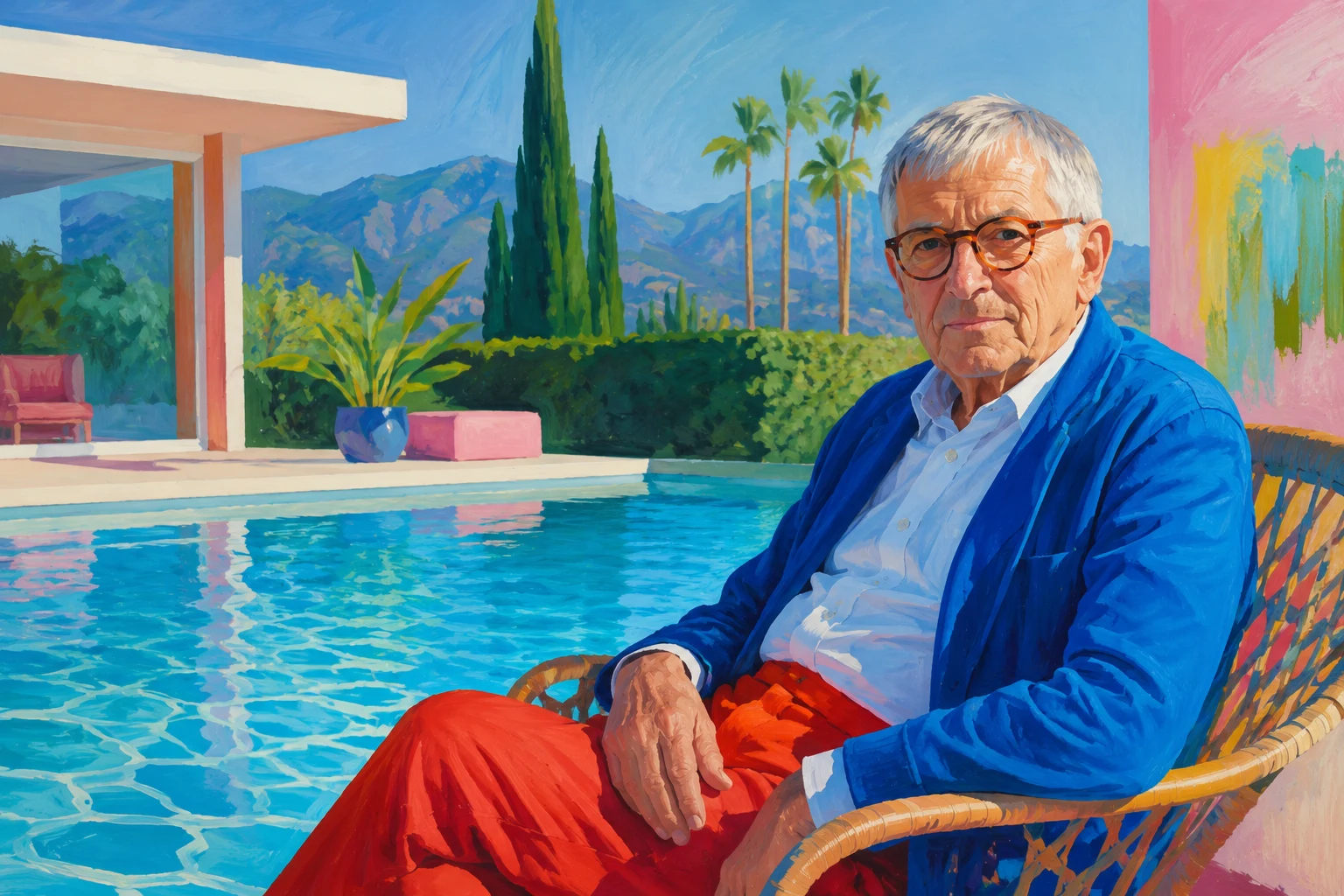
David Hockney legacy now feels less like a chapter closing and more like a color switch being flipped across modern visual culture. After the British artist’s death at 88, the art world is not only remembering a painter, but also recalculating what it means to look, frame, crop, draw, photograph, and digitally remix ordinary life. Hockney died peacefully at home on June 11, 2026, after a seven-decade career that moved through painting, photography, collage, theater design, digital drawing, and immersive visual experiments. His public image was often playful, sharp, and stubbornly alive, yet his deeper impact came from something simpler: he made people look longer at things they thought they already understood. That is why his passing changes the emotional temperature around Pop Art, not because color disappears, but because one of its most restless interpreters is no longer here to keep pushing it forward. :contentReference[oaicite:0]{index=0}
For a site like David Hockney legacy, the story is not just about mourning a famous name. It is about how a visual language born in the 1960s keeps echoing through screens, galleries, design studios, AI image tools, fashion campaigns, and digital entertainment. Hockney helped turn pools, rooms, windows, friends, lovers, flowers, roads, and landscapes into scenes that felt both personal and cinematic. His images were bright without being shallow, stylish without being cold, and accessible without being simple. That tension is why younger creators still read his work as a cheat code for making everyday visuals feel iconic.
David Hockney Legacy and the New Mood of Pop Art
David Hockney legacy matters because he never treated Pop Art as a frozen historical category. He moved through it, bent it, and kept repainting its borders until it could hold intimacy, technology, queer visibility, domestic space, landscape, and digital experimentation. While many artists connected to Pop Art became linked to the commercial image, Hockney became linked to the act of seeing itself. He was fascinated by how a person looks at a room, how memory rearranges a place, and how color can make reality feel more truthful than realism. That is why his death lands differently from the loss of a celebrity painter; it feels like losing a visual thinker who kept proving that modern life still had new angles.
His reputation was built across multiple eras, not one clean movement. Born in Bradford in 1937, Hockney became one of the most influential British artists of the twentieth and twenty-first centuries, with works held in major museum collections and exhibitions that continued into his final years. He was associated with the rise of Pop Art, but he never stayed obedient to the movement’s usual expectations. He painted Los Angeles swimming pools with the coolness of a magazine spread and the emotional tension of a private diary. He also made portraits that felt tender, landscapes that felt huge, and digital drawings that made tablets look less like gadgets and more like portable studios. :contentReference[oaicite:1]{index=1}
The emotional reaction to his death also shows how rare his position had become. Hockney was both critically respected and widely loved, which is not always an easy combination in contemporary art. People who never studied painting could still recognize the feeling of his pools, the charge of his blues, and the strange calm of his interiors. Serious art audiences could still trace his experiments with perspective, photography, and composition across decades. That overlap gave his work a democratic pulse, making him feel less like an artist locked inside institutions and more like someone who smuggled visual intelligence into everyday culture.
Why Hockney’s Color Still Feels So Current
Color was never just decoration in Hockney’s world. It was structure, attitude, memory, and emotional weather. His blues did not merely describe water or sky; they created a psychological climate where leisure, desire, distance, and loneliness could sit in the same frame. His pinks, yellows, greens, and oranges often felt almost too clean for real life, yet that artificial clarity made the scenes more memorable. This is one reason his images travel so easily through digital culture, because his palette already understood the logic of attention before social media made attention the main currency.
When people say the color of Pop Art changes after Hockney, they are really talking about inheritance. His use of saturated color helped separate modern beauty from old rules of seriousness. He showed that a painting could be bright and still carry emotional complexity. He proved that visual pleasure did not have to apologize for itself. In an era where creators often choose between conceptual heaviness and scroll-stopping immediacy, Hockney’s work reminds them that strong images can do both at once.
That lesson now feels especially relevant for digital artists and designers. The current visual internet is packed with high-contrast palettes, artificial lighting, nostalgia filters, surreal interiors, dreamy pool scenes, and carefully staged lifestyle compositions. Many of those trends do not directly copy Hockney, but they move through a world he helped normalize. He made flatness feel stylish, made staged space feel emotionally believable, and made color feel like a viewpoint rather than a surface effect. His death may push more creators to revisit color as a serious storytelling device, not just a branding choice.
The Los Angeles Dream That Became a Visual Template
Hockney’s Los Angeles paintings remain some of the clearest examples of how a city can become an image system. He arrived in California in the 1960s and transformed pools, glass walls, sunlight, lawns, and modern houses into a visual mythology. Works connected to that period helped define how global audiences imagined L.A. as a place of heat, openness, wealth, isolation, and cinematic calm. The swimming pool became more than architecture or lifestyle; it became a stage for modern desire. Even today, advertising, music videos, film posters, hotel branding, and fashion editorials still recycle echoes of that Hockney-like California dream. :contentReference[oaicite:2]{index=2}
What made those works so powerful was not only their glamour. Under the clean surfaces, there was often a strange stillness that kept the scenes from turning into simple luxury images. A pool could feel inviting and empty at the same time. A house could look open while still suggesting emotional distance. A figure could appear relaxed while the composition around them felt carefully controlled. That layered mood is why Hockney’s California did not become dated like a travel poster; it became a visual grammar.
For modern visual entertainment, this grammar is everywhere. Streaming series use color-coded interiors to tell viewers how a character feels before anyone speaks. Music videos turn pools and glass houses into symbols of fame, alienation, and fantasy. Digital creators use sunlit spaces and carefully arranged bodies to produce a sense of effortless cool. Hockney’s influence sits behind these choices because he made the modern environment feel theatrical without making it feel fake.
From Painting to iPad, He Never Feared the Tool
One of the most practical parts of Hockney’s legacy is his refusal to treat technology like an enemy of art. He explored photography, photocollage, fax machines, digital drawing, video walls, and iPad works with the curiosity of someone who cared more about seeing than protecting tradition. His later iPad landscapes, especially those connected to Normandy, showed that a digital screen could become a serious sketchbook and a serious visual language. Some critics questioned whether these works had the same force as his paintings, but Hockney’s larger point was bigger than medium loyalty. For him, the tool mattered only if it helped the eye discover something fresh. :contentReference[oaicite:3]{index=3}
This attitude feels almost built for the current age of Digital Art. Artists today move between Procreate, Blender, AI-assisted workflows, motion graphics, generative tools, photography, scanned textures, and traditional media without seeing those borders as fixed. Hockney modeled that flexibility before it became normal. He did not approach new tools as shortcuts, but as new ways to measure attention. That distinction matters because technology can either flatten creativity into effects or expand the ways artists notice the world.
His tech openness also offers a useful warning for the AI era. Hockney’s digital work still looked like Hockney because the device did not replace his eye. The hand, the rhythm, the color judgment, and the obsession with looking remained visible. That is the lesson many creators need now as visual software becomes more powerful and more automated. A tool can generate polish, but a point of view still has to come from someone willing to see differently.
How His Death Changes the Conversation Around Visual Culture
Hockney’s passing arrives at a moment when visual culture is both more abundant and more unstable than ever. Images move faster, trends burn shorter, and style is often optimized for immediate recognition. Against that backdrop, his career feels almost rebellious because it was long, patient, and deeply committed to returning to the same questions. How do we see space. How do we remember a face. How does time change a landscape. How can color make the world feel more awake.
His death will likely trigger a wave of reassessment across museums, schools, design studios, and digital platforms. Major institutions already preserve and exhibit his work, and his exhibition history shows how active his presence remained across global art spaces. As audiences revisit his paintings, drawings, photo works, and digital pieces, the conversation may shift from nostalgia to usefulness. People will not only ask what Hockney meant in the past. They will ask what his methods can still teach creators who are working inside a much faster visual economy. :contentReference[oaicite:4]{index=4}
The biggest change may be emotional. While many twentieth-century art figures are discussed through theory, Hockney is often discussed through affection. Viewers remember how his images made them feel before they remember the academic label attached to them. That affection gives his legacy unusual power in a culture where art can seem distant from everyday life. His work invites people back to the basic pleasure of looking, and that invitation may become more valuable as screens become noisier.
Pop Art After Hockney Is Not Less Bright
It would be too easy to say that Pop Art becomes dimmer after Hockney. A better way to understand the shift is that Pop Art becomes more reflective. His death reminds viewers that the movement was never only about consumer culture, comic-book sharpness, celebrity, and mass reproduction. Through Hockney, it also became a way to explore private life, queer identity, domestic architecture, friendship, pleasure, and the mechanics of vision. That expanded version of Pop Art is the one that still feels alive now.
Hockney’s openly personal imagery helped broaden what modern art could show. His early work included same-sex desire at a time when that visibility carried cultural weight, and his later career continued to treat intimacy as a serious visual subject. He did not separate style from identity, but he also did not reduce identity to message. Instead, he made personal experience part of the image’s structure. That approach feels deeply current because younger artists often want work that can hold politics, emotion, beauty, and experimentation without being trapped by any single label.
This is where his influence connects strongly with Digital Art and contemporary visual innovation. Online culture has made identity, aesthetics, and self-presentation inseparable. The way someone frames a room, edits a photo, chooses a color palette, or builds a virtual scene can carry social meaning. Hockney understood that long before the feed existed. He knew that style is never just style when it changes how people become visible.
The Practical Lessons Creators Can Take From Hockney
For designers, artists, editors, and creative software users, Hockney’s career offers more than inspiration. It offers a working method. He observed intensely, repeated subjects without becoming stale, changed tools without losing identity, and treated pleasure as a serious form of intelligence. He also understood that a recognizable style does not come from repeating a preset. It comes from returning to a personal question until the world starts to recognize the shape of that question.
- Use color as meaning, not decoration. Hockney’s palette shows that color can carry mood, rhythm, memory, and point of view.
- Let tools evolve without surrendering the eye. His digital work mattered because it still carried his decisions, not because it used a new device.
- Make ordinary spaces feel cinematic. Rooms, roads, pools, gardens, and windows can become powerful if the framing is intentional.
- Build a visual language over time. Hockney’s influence came from decades of looking, not from one viral image.
- Keep pleasure in the work. Beauty, humor, and brightness can be serious when they reveal how people experience life.
Those lessons are especially useful now because creative industries are under pressure to move fast. Brands want instant visuals, platforms reward recognizable aesthetics, and software makes it easy to produce polished images quickly. Hockney’s example pushes against empty speed. He reminds creators that the strongest images often come from sustained attention rather than constant novelty. In a world full of templates, his work argues for the slow development of a real eye.
Why Younger Audiences Still Connect With Him
Hockney’s work connects with younger audiences because it feels visually fluent in ways that predate the internet. His compositions often have the clarity of a strong screen image, even when they were made decades before smartphones. His colors feel optimized for memory without feeling engineered by an algorithm. His scenes are clean enough to be instantly readable but strange enough to reward a second look. That combination makes his work feel native to the current visual moment, even when its roots are analog.
There is also a lifestyle dimension that younger audiences recognize. Hockney’s art often makes looking feel like living, not like studying. A chair, a pool edge, a window view, or a patch of garden can become the center of attention. That sensibility fits a generation that documents everyday life constantly but also feels exhausted by overproduction. Hockney offers a different kind of visual mindfulness, one built from attention, color, and the belief that the ordinary scene is never truly ordinary.
His personality also helped keep the work approachable. He was known for wit, stubbornness, curiosity, and a refusal to perform solemnity just because the art world sometimes rewards it. His lifelong smoking became part of his public mythology, and even late tributes have described that habit as tangled with his larger defense of personal freedom. Whether one agrees with him or not, the image of Hockney as fiercely himself reinforces why his work never felt manufactured. He turned independence into a visual ethic. :contentReference[oaicite:5]{index=5}
The Market, Museums, and the Afterlife of an Image
After a major artist dies, the art market usually responds with renewed attention, but Hockney’s case goes beyond prices and auction records. His work already occupied a rare space between museum scholarship, public affection, design influence, and pop-cultural recognition. That means the afterlife of his images will unfold across many layers at once. Museums will revisit his formal experiments, collectors will reassess key periods, and younger artists will keep remixing his visual strategies. His influence will not sit quietly in retrospectives; it will keep leaking into the way contemporary images are built.
This afterlife is important because Hockney’s images are unusually adaptable. A pool painting can speak to art history, architecture, queer culture, luxury branding, cinema, and digital composition all at once. A portrait can be read as personal memory, social document, design study, and color experiment. An iPad landscape can become a conversation about aging, technology, nature, and the future of drawing. Few artists leave behind a body of work that can be entered from so many doors without losing its core identity.
For visual media platforms, that adaptability is the real story. Hockney’s work teaches that an image becomes powerful when it can move across contexts while still remaining unmistakably itself. That is the dream of modern branding, entertainment, digital art, and creative software culture. Everyone wants a visual language strong enough to survive translation. Hockney built one by staying loyal to looking, and that loyalty may be the most durable part of his legacy.
Hockney’s Final Years Proved Curiosity Can Age Well
One reason Hockney’s death feels so striking is that he did not spend his final years as a distant historical figure. He remained active, visible, and creatively curious, with late exhibitions and digital works that continued to attract attention. His Normandy works and large-scale presentations showed an artist still testing how time, seasons, screens, and walls could change the experience of looking. That ongoing activity made him feel present rather than archived. It also made his passing feel like an interruption instead of a quiet fadeout.
Late-career creativity is often discussed through decline or legacy management, but Hockney complicated that narrative. He showed that an artist could age without becoming visually cautious. He kept using technology, kept returning to nature, kept making images, and kept defending the simple act of noticing beauty. That matters because creative culture often worships youth while quietly fearing age. Hockney offered another model, where curiosity becomes the thing that keeps an artist contemporary.
His late work also makes the relationship between nature and technology feel less oppositional. Drawing spring on an iPad does not destroy the experience of spring if the looking is sincere. Using screens to study trees, skies, flowers, or fields can become a way of slowing attention rather than speeding it up. That idea is deeply relevant for artists working between physical and digital worlds today. Hockney’s final years suggest that technology becomes most human when it helps people notice what they might otherwise rush past.
The Future of Pop Color After Hockney
The future of Pop color after Hockney will probably be more hybrid, more digital, and more emotionally layered. Artists will keep borrowing the brightness, but the best ones will also borrow the patience underneath it. Designers will keep using saturated palettes, but the strongest work will understand that color needs a reason to stay memorable. Digital creators will keep building glossy worlds, but Hockney’s influence will remind them that surfaces become interesting when they suggest deeper ways of seeing. His death may therefore push Pop-inspired visual culture toward reflection rather than simple nostalgia.
This shift matters because audiences are getting smarter about images. People can feel when a visual is only chasing a trend. They can also feel when an image has been built from genuine attention. Hockney’s work survives because it carries that attention in every line, color field, and compositional decision. The lesson for the next generation is not to imitate his pools, glasses, rooms, or landscapes, but to imitate his refusal to stop looking.
In that sense, Hockney’s passing does not drain Pop Art of color. It changes the responsibility of the people inheriting that color. The bright image now has to prove it can think. The stylish composition has to prove it can feel. The digital artwork has to prove that a tool has not replaced a vision.
Conclusion: The Color Has Changed, Not Gone
David Hockney legacy will continue because his art never depended on one era, one medium, or one audience. He helped shape Pop Art, but he also stretched it into portraiture, landscape, photography, digital drawing, theater, and immersive visual experience. His death at 88 marks the end of a living voice that kept telling people to look harder, brighter, and more freely. Yet the visual world he influenced is still moving through his lessons every time a creator treats color as emotion, a screen as a studio, or an ordinary scene as something worth framing. The color of Pop Art has changed after Hockney, but it has not faded; it has become a challenge for the next generation to see with more courage.