

Serpentine Pavilion 2026 Redefines Quiet Design
 Vortixel
12 minutes read
Vortixel
12 minutes read
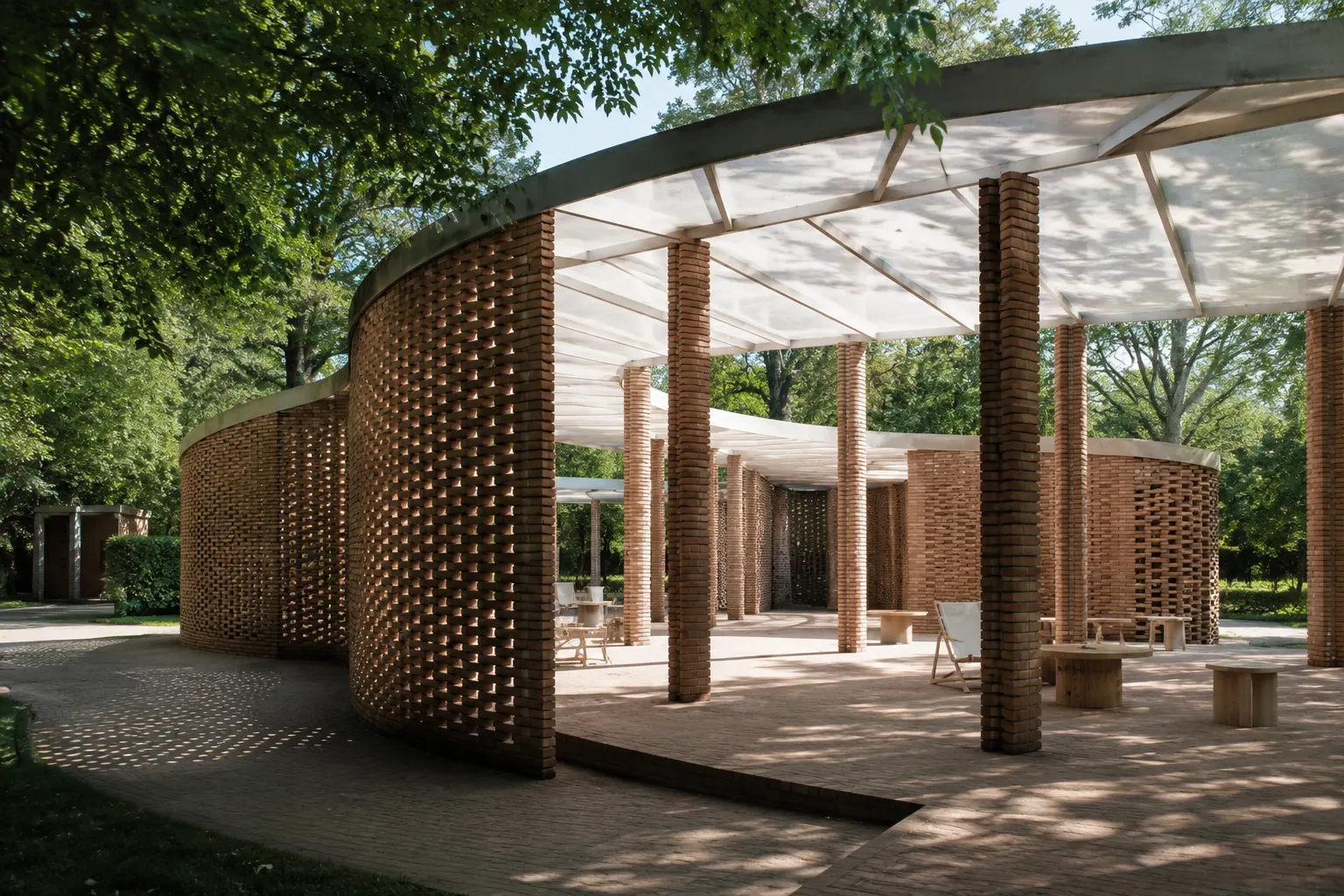
The Serpentine Pavilion 2026 arrives with a mood that feels almost rebellious in a visual culture obsessed with noise, scale, spectacle, and instant virality. Instead of chasing a futuristic shell or a high-gloss landmark moment, the pavilion leans into quietness, slowness, brick, air, shadow, and the simple act of moving through space with attention. Designed by LANZA atelier, the Mexico City practice led by Isabel Abascal and Alessandro Arienzo, the project turns a familiar architectural element into something strangely fresh: a winding brick wall that does not simply divide, but listens, frames, shelters, and guides. For Visual Vortixel readers, this is where the story gets interesting, because the Serpentine Pavilion 2026 is not just another temporary summer structure in London. It is a timely visual statement about how architecture can feel powerful without shouting, how craft can look contemporary without becoming cold, and how public space can create presence through restraint.
Why the Serpentine Pavilion 2026 Matters Now
Every year, the Serpentine Pavilion becomes a kind of architectural weather report, showing where design culture is drifting before the trend becomes fully mainstream. The 2026 edition feels especially important because it comes at a time when cities, galleries, brands, and public institutions are rethinking how people actually want to experience space after years of hyper-digital saturation. The pavilion does not answer that question with screens, spectacle, or a dramatic object meant only to be photographed from a distance. It answers with movement, texture, light, and a form that invites people to slow down, sit, pass through, look again, and notice how a wall can become a social device rather than a hard border. That is why the Serpentine Pavilion 2026 belongs naturally within the larger conversation around design, public creativity, and the future of visual environments.
The pavilion is titled “a serpentine,” and the name works on more than one level because it refers to both the Serpentine institution and the historic serpentine, or crinkle-crankle, wall. This old wall type uses curves to create stability, meaning its shape is not ornamental decoration but a structural idea with deep practical roots. LANZA atelier reinterprets that tradition through a contemporary lens, using brick not as nostalgia but as a material that can carry memory, weight, warmth, and civic intimacy. The result is a pavilion that feels less like an isolated architectural object and more like a sequence of thresholds placed inside the landscape. It is temporary, but its visual language feels grounded in something older than the seasonal calendar that usually defines pavilion culture.
A Quiet Architecture Built From Brick and Air
The most striking thing about the Serpentine Pavilion 2026 is how much it does with so little. Two primary brick walls organize the experience, curving through the site and responding to the trees, views, paths, and atmosphere around Serpentine South. A translucent roof filters daylight into the sheltered zone, while slender brick columns create a rhythm that feels somewhere between a grove, a colonnade, and a half-remembered garden structure. The walls move between solid and porous conditions, allowing glimpses, openings, shadows, and cross-breezes to become part of the design. In a world where many temporary installations compete to become an image first and a place second, this pavilion makes the experience of being there the main event.
Brick is a surprisingly loaded choice here because it carries associations of permanence, labor, domesticity, tradition, and human scale. In the context of a temporary pavilion, that material tension becomes visually meaningful, because the structure looks grounded even though it is designed to exist for a limited period. The brick also speaks to the neighboring Serpentine South Gallery, creating a dialogue between the pavilion and the existing architecture rather than pretending the site is a blank canvas. This is a different kind of innovation, one that does not depend on looking aggressively new. It suggests that the future of visual innovation may not always be about inventing unfamiliar forms, but about re-reading familiar materials with sharper cultural awareness.
LANZA atelier and the Power of Gentle Geometry
LANZA atelier’s design language often works through modest gestures that become emotionally complex when placed in the right setting. For the Serpentine Pavilion 2026, the studio uses geometry as a social tool rather than a purely formal performance. The curved wall does not just look elegant from above; it shapes how bodies move, how groups gather, how people pause, and how the landscape reveals itself in fragments. This gentle geometry matters because it resists the hard straight line as the default language of order. Instead, the pavilion creates a softer sequence of encounters, where architecture becomes less about command and more about invitation.
The idea of quiet architecture can sound passive, but this project proves that quietness can be active, intentional, and even radical. A loud building often announces itself immediately, while a quiet one asks for time and attention before it fully opens up. The Serpentine Pavilion 2026 seems built around that slower rhythm, encouraging visitors to understand it through walking rather than through one perfect image. Its curved brick forms create an experience that changes depending on where someone stands, how the light hits, and whether the visitor approaches from the park, the gallery, or the interior path. This makes the pavilion feel alive without needing kinetic technology or digital animation.
The Visual Language of Silence
Silence in architecture is never truly empty, because it is made of surfaces, proportions, shadows, acoustics, temperature, and the emotional expectations people bring into a place. The Serpentine Pavilion 2026 uses silence as a visual language by refusing to over-explain itself through excessive form. Its muted material palette allows the brick, roof, trees, and human presence to carry the composition. The pavilion does not need a dramatic facade moment because the drama comes from the changing relationship between enclosure and openness. That makes it especially relevant for today’s design scene, where audiences are becoming more sensitive to spaces that feel restorative rather than overstimulating.
This quietness also connects to a broader shift in visual culture, especially across architecture, interiors, digital art, and exhibition design. After years of maximalist feeds, immersive rooms, algorithm-friendly color explosions, and branded installations, there is growing interest in spaces that feel slower, more tactile, and less performative. The Serpentine Pavilion 2026 fits that shift without becoming minimalist in a cold or empty way. It is warm, physical, and grounded, which separates it from the sterile version of silence that can sometimes dominate luxury design. Its restraint feels less like aesthetic withdrawal and more like a carefully edited invitation to pay attention.
A Pavilion That Turns Walls Into Social Space
Walls usually carry complicated meanings because they can protect, exclude, frame, separate, guide, or conceal. The Serpentine Pavilion 2026 understands that tension and uses it as the core of the design. Its brick walls are not blank barriers but porous spatial instruments that let air, light, sightlines, and people move through and around them. This is important because the pavilion arrives in a cultural moment when the idea of the wall is politically and socially charged across the world. By transforming a wall into a place of gathering, the project reframes architecture as something that can soften boundaries rather than simply enforce them.
The pavilion’s relationship to public life is also shaped by the fact that it sits in a park rather than a sealed museum interior. Visitors do not encounter it in isolation; they approach it while walking through greenery, crossing paths with strangers, hearing the city, and feeling the weather. That outdoor condition makes the structure feel open-ended, because its meaning changes with crowd density, season, daylight, and use. A child might read it as a maze, a designer might read it as a material study, and a casual visitor might simply see it as a calm place to rest. This flexibility is one reason the Serpentine Pavilion 2026 feels visually quiet but socially generous.
Trend Analysis: From Spectacle to Sensory Restraint
The biggest design trend reflected by the Serpentine Pavilion 2026 is the move from spectacle toward sensory restraint. This does not mean spectacle is disappearing, because large-scale visual entertainment and immersive environments still dominate many cultural venues. However, the most forward-looking projects are increasingly asking whether intensity alone can still move people in meaningful ways. LANZA atelier’s pavilion suggests another path, where the emotional impact comes from tactility, atmosphere, proportion, and spatial sequencing. For architects, curators, artists, and creative directors, that shift is worth watching closely because it changes how visual experiences may be designed in the next few years.
The pavilion also points toward a renewed respect for craft in contemporary architecture. Bricklaying, masonry logic, timber furniture, and site-responsive construction all push against the idea that innovation must look frictionless or machine-perfect. In the age of artificial intelligence, generative imagery, and rapid digital prototyping, there is something especially compelling about a project that foregrounds simple clay brick and human-scaled assembly. The Serpentine Pavilion 2026 does not reject technology by choosing craft, but it reminds the design world that intelligence can also live in old material systems. That message feels sharp because the future of creativity will likely depend on balancing digital speed with physical depth.
Impact on Public Architecture and Visual Culture
The influence of the Serpentine Pavilion 2026 may extend far beyond its temporary life in London. Pavilions often operate as test sites for ideas that later appear in cultural buildings, retail spaces, museums, hotels, campuses, and public installations. This project’s emphasis on curved thresholds, material warmth, filtered light, and social porosity could inspire designers who want to create spaces that feel open without becoming shapeless. It also gives institutions a model for commissioning architecture that is visually memorable without needing to dominate its surroundings. In that sense, the pavilion’s impact may be strongest not as an icon, but as a quiet reference point for how public design can become more humane.
For visual culture, the pavilion also challenges the way architecture is consumed online. A structure like this may not reveal its full value in a single dramatic image because its experience depends on walking, turning, pausing, and noticing small shifts in perception. That makes it slightly resistant to the flat logic of the feed, where buildings are often reduced to one shareable angle. Yet that resistance is exactly what makes it interesting for a site like Visual Vortixel, because the most important visual stories are not always the loudest ones. The Serpentine Pavilion 2026 invites a deeper kind of looking, where the viewer becomes aware of time, material, and movement as part of the image.
Why Designers Should Pay Attention
Designers can take several practical insights from the Serpentine Pavilion 2026, especially when thinking about how to create environments that feel emotionally durable. The first lesson is that a simple form can become rich when it responds carefully to context. The second is that material choice should not be treated as a surface decision, because materials carry cultural memory, climate behavior, and emotional tone. The third is that public space benefits from ambiguity, because people often use generous spaces in ways designers cannot fully predict. Together, these lessons make the pavilion relevant not only to architecture, but also to exhibition design, installation art, interior concepts, and digital spatial storytelling.
For digital creators, the pavilion offers a reminder that visual innovation does not always come from adding more layers. Sometimes it comes from editing, slowing down, and allowing one strong spatial idea to breathe. This is useful for artists working in 3D environments, virtual galleries, game spaces, and immersive media, where the temptation is often to fill every surface with content. The Serpentine Pavilion 2026 shows that atmosphere can be built through rhythm and restraint, not only through density. Even in virtual environments, the logic of a winding wall, filtered light, and partial views can create a stronger emotional journey than a space overloaded with visual effects.
The Role of Furniture, Movement, and Human Scale
One of the most overlooked parts of pavilion design is furniture, because seating often determines whether people treat a structure as a place to inhabit or just an object to photograph. LANZA atelier’s approach connects architecture and furniture as related scales of the same design thinking. Chairs, stools, benches, columns, walls, and roof planes all contribute to how the body understands the pavilion. This matters because the Serpentine Pavilion 2026 does not only ask to be seen; it asks to be used. The human scale of the project is one reason its quietness feels welcoming rather than distant.
Movement is equally central to the pavilion’s identity because the curved walls create a sequence rather than a single static room. Visitors may enter through one angle, catch a framed view of the park, move into shade, pass close to brick, and then emerge into a more open zone. That sequence transforms the pavilion into a small cinematic experience, but without relying on screens or narrative instructions. The body becomes the camera, and the wall becomes the editing tool. This is why the Serpentine Pavilion 2026 feels so aligned with contemporary visual thinking, even though its materials are ancient and tactile.
A Fresh Chapter for Temporary Architecture
The Serpentine Pavilion program has always been important because it gives architects a rare platform to experiment in public without the same constraints as a permanent building. The 2026 edition marks a milestone moment for that legacy, but it does not celebrate history by becoming loud or self-congratulatory. Instead, it looks backward through the language of the crinkle-crankle wall and forward through a renewed interest in porous, climate-aware, socially sensitive design. The Serpentine Pavilion 2026 shows that temporary architecture can still feel consequential when it creates a clear emotional and spatial proposition. Its temporary nature may even strengthen the experience, because visitors know they are encountering something that will not remain forever.
That sense of impermanence gives the pavilion a subtle emotional charge. A permanent building often asks to be judged by durability, function, and long-term urban impact, while a pavilion can ask a more poetic question about what a place can teach in a single season. LANZA atelier uses that freedom to explore a form that is humble, ancient, and unexpectedly contemporary. The structure does not pretend to solve every problem facing architecture, but it does offer a persuasive argument for attention, care, and sensory intelligence. In a design world that often equates progress with escalation, that argument feels unusually clear.
Conclusion: The Quiet Force of the Serpentine Pavilion 2026
The Serpentine Pavilion 2026 stands out because it does not try to dominate the cultural conversation through spectacle. Its power comes from the opposite direction, through a winding brick language that turns silence, craft, and movement into a contemporary public experience. LANZA atelier’s design reminds us that architecture can be visually strong without becoming aggressive, and that a wall can become a shared threshold rather than a symbol of separation. For designers, artists, and visual culture watchers, the pavilion offers a sharp lesson in restraint at a moment when attention is one of the rarest creative resources. It proves that quiet architecture is not weak architecture; it is architecture confident enough to let people, light, material, and landscape complete the work.