
AI Visual Tools Reshape Modern Content Creation
 Vortixel
7 minutes read
Vortixel
7 minutes read
Introduction: The New Era of Visual Creativity
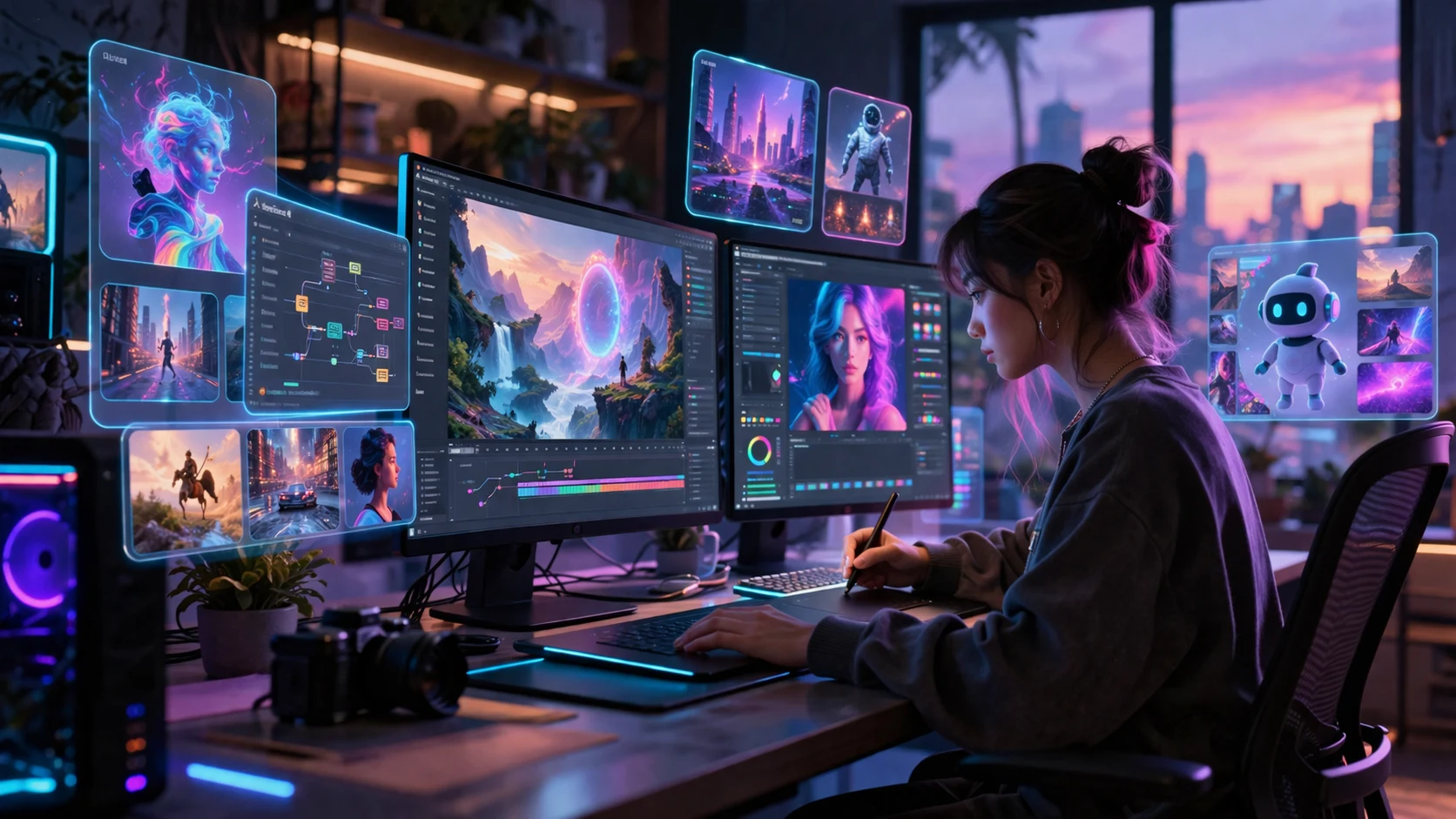
The rapid evolution of AI visual tools has fundamentally changed how content creators produce, edit, and distribute digital media in 2026. What once required a full team of designers, video editors, and motion artists can now be accomplished by a single creator using advanced artificial intelligence platforms. This transformation is not just a technological upgrade, but a complete shift in the creative economy, redefining speed, accessibility, and creative control. From YouTubers and TikTok creators to digital agencies and global brands, everyone is adapting to a new workflow powered by generative AI.
In today’s hyper-competitive digital landscape, creators are no longer judged solely by their creativity, but also by how quickly they can produce high-quality content. This is where AI-powered visual tools step in, offering unprecedented efficiency without sacrificing artistic value. The ability to generate images, videos, animations, and even entire scenes from simple prompts has democratized creativity in ways never seen before. As a result, the barrier to entry for content creation has significantly decreased, allowing more voices to participate in the global digital conversation.
What Are AI Visual Tools and Why They Matter
AI visual tools refer to software platforms that use machine learning models to generate or enhance visual content. These tools can create images from text prompts, generate videos from scripts, upscale low-resolution media, or even simulate realistic human expressions. Technologies such as generative adversarial networks (GANs) and diffusion models are at the core of this revolution, enabling machines to understand and recreate visual aesthetics with remarkable accuracy.
The importance of these tools lies in their ability to compress production timelines. A process that used to take days or weeks can now be completed in minutes. For instance, creators can generate multiple visual concepts in seconds, test them in real-time, and publish optimized content almost instantly. This shift has given rise to a new kind of creator—one who is both a storyteller and a prompt engineer.
Moreover, AI-driven content creation allows for personalization at scale. Brands can tailor visuals to different audiences, languages, and cultural contexts without needing separate production teams. This level of customization was previously expensive and time-consuming, but AI has made it both affordable and efficient.
How AI Visual Tools Are Transforming Content Production
The impact of AI visual tools can be seen across every stage of the content production pipeline. From ideation to post-production, artificial intelligence is streamlining workflows and enhancing creative possibilities.
1. Ideation Becomes Instant
Creators no longer start with a blank canvas. AI tools can generate ideas, mood boards, and visual references based on simple prompts. This eliminates creative blocks and accelerates brainstorming sessions. Instead of spending hours searching for inspiration, creators can instantly visualize their concepts and refine them in real time.
2. Design and Creation at Scale
Graphic design has been revolutionized by AI. Platforms now allow users to generate logos, social media posts, thumbnails, and illustrations with minimal effort. These tools understand composition, color theory, and branding guidelines, ensuring that outputs are both visually appealing and consistent.
For video creators, AI video generators can produce cinematic sequences, complete with lighting, camera movements, and transitions. This drastically reduces the need for expensive equipment and professional editing software. As a result, small creators can compete with large production studios in terms of visual quality.
3. Editing and Enhancement Made Effortless
Editing has traditionally been one of the most time-consuming aspects of content creation. AI tools now automate tasks such as background removal, color grading, noise reduction, and motion tracking. These features not only save time but also improve the overall quality of the final product.
Advanced tools can even analyze audience preferences and suggest edits that increase engagement. This data-driven approach ensures that content is not only visually appealing but also optimized for performance.
4. Distribution and Optimization
AI doesn’t stop at creation. It also plays a crucial role in content distribution. Platforms can analyze trends, predict audience behavior, and recommend the best times to publish content. Additionally, AI can generate multiple versions of a visual asset tailored for different platforms, ensuring maximum reach and impact.
The Rise of the Solo Creator Economy
One of the most significant outcomes of AI visual tools is the rise of the solo creator. In the past, producing high-quality content required collaboration across multiple roles. Today, a single individual can manage the entire production process, from concept to distribution.
This shift has led to the emergence of micro-creators who operate like full-scale media companies. They produce consistent, high-quality content while maintaining complete creative control. This independence has not only increased creative freedom but also improved monetization opportunities.
Platforms like YouTube, TikTok, and Instagram are seeing a surge in creators who rely heavily on AI tools. These creators can produce content faster, experiment with new formats, and adapt to trends in real time. As a result, they are often more agile and responsive than traditional media organizations.
Challenges and Ethical Concerns
Despite the many advantages, the rise of AI-generated visuals also brings significant challenges. One of the primary concerns is authenticity. As AI-generated content becomes more realistic, it becomes increasingly difficult to distinguish between real and synthetic visuals. This raises questions about trust, misinformation, and digital integrity.
Another issue is the potential loss of originality. While AI tools can generate visually stunning content, there is a risk that creators may rely too heavily on automation, leading to a homogenization of styles. Maintaining a unique creative voice is becoming more challenging in an AI-driven environment.
Additionally, there are concerns about intellectual property. AI models are often trained on vast datasets that include copyrighted material. This has led to debates about ownership, attribution, and fair use. Creators must navigate these complexities carefully to avoid legal issues.
How Brands Are Leveraging AI Visual Tools
Brands are among the biggest beneficiaries of AI visual technology. They use these tools to create personalized marketing campaigns, generate product visuals, and enhance customer engagement. AI allows brands to produce high-quality content at scale, reducing costs while increasing efficiency.
For example, e-commerce platforms use AI to generate product images in different settings, eliminating the need for physical photoshoots. Similarly, marketing teams use AI to create targeted advertisements that resonate with specific audiences. This level of precision has significantly improved conversion rates and return on investment.
Moreover, brands are using AI to stay ahead of trends. By analyzing social media data, AI tools can identify emerging visual styles and recommend strategies to capitalize on them. This proactive approach ensures that brands remain relevant in a rapidly changing digital landscape.
The Future of AI Visual Content Creation
Looking ahead, the role of AI visual tools is expected to expand even further. Advances in technology will enable more realistic and interactive content, including real-time video generation and immersive virtual experiences. These developments will open up new possibilities for storytelling and audience engagement.
We are also likely to see increased integration between AI tools and other technologies such as augmented reality (AR) and virtual reality (VR). This convergence will create entirely new forms of content that blur the line between the digital and physical worlds.
Another key trend is the rise of agentic AI, where systems can autonomously manage entire creative workflows. These AI agents will be able to generate ideas, produce content, optimize distribution, and analyze performance without human intervention. While this may raise concerns about job displacement, it also presents opportunities for creators to focus on higher-level creative tasks.
Conclusion: Creativity in the Age of AI
The transformation brought by AI visual tools is undeniable. They have redefined how content is created, distributed, and consumed, making high-quality production accessible to a wider audience. While challenges remain, the benefits far outweigh the drawbacks, offering creators new ways to express themselves and connect with audiences.
In this new era, success will depend not only on creativity but also on the ability to leverage technology effectively. Creators who embrace AI will have a significant advantage, enabling them to produce compelling content at scale while maintaining their unique voice.
As we move further into 2026, one thing is clear: AI is not replacing creativity—it is amplifying it. The future of content creation belongs to those who can combine human imagination with artificial intelligence, creating experiences that are both innovative and authentic.