
AI VFX Is Rewriting Netflix Production Costs
 Vortixel
19 minutes read
AI VFX is no longer sitting in the corner of Hollywood as a strange experiment that studios whisper about after the credits roll. It is now sliding straight into the production pipeline, and Netflix has become one of the clearest signals that the shift is already happening at scale. The company’s recent disclosure that AI tools have touched around 300 titles has turned a quiet industry trend into a mainstream visual entertainment story. For years, the promise of artificial intelligence in film and television sounded like a future-tense pitch: faster cleanup, cheaper effects, smarter editing, and more ambitious scenes for smaller budgets. Now the mood feels different, because the technology is not just being tested in demos anymore; it is showing up in real shows, real documentaries, real sequences, and real cost conversations.
That is why the phrase AI VFX matters so much right now. It captures a bigger change than one streaming company using a few fancy tools behind the scenes. It points to a new production economy where visual effects are becoming more flexible, more automated, and more accessible to teams that may not have blockbuster-level budgets. For Netflix, AI-assisted production can mean crowd scenes that are easier to build, historical environments that are faster to visualize, and post-production tasks that no longer eat the same amount of time. For the wider creative industry, it raises a sharper question: if artificial intelligence can make expensive shots possible at a lower cost, who gets to create bigger worlds next?
Why Netflix’s AI VFX Moment Feels Bigger Than a Tech Update
Netflix using AI across hundreds of titles is not just a production note buried inside a corporate update. It is a public marker that the entertainment industry has moved from cautious exploration into practical adoption. Streaming platforms are under pressure to release a constant flow of fresh shows, films, documentaries, reality formats, and international titles while keeping production budgets under control. That pressure creates the perfect opening for AI VFX, because the technology promises to solve one of the most painful parts of modern content creation: getting high-quality visuals without stretching timelines or budgets to the breaking point. When AI can help complete certain shots faster, the conversation shifts from “Can this technology work?” to “Where does it fit best in the pipeline?”
The most important detail is that this is not only about replacing giant fantasy sequences or superhero-level spectacle. AI can be useful in quieter, less glamorous areas of post-production that viewers may never notice. It can help expand backgrounds, clean up visual inconsistencies, support compositing, generate environmental details, enhance crowds, or speed up early visual exploration. Those are the kinds of tasks that often demand time, money, and a large number of skilled hands, even when they do not become obvious selling points in a trailer. That makes Netflix’s move especially relevant, because a platform with a massive global slate needs tools that improve efficiency across many different genres, not just a few prestige productions.
For VisualVortixel’s audience, the story sits at the intersection of artificial intelligence, design, digital art, and visual entertainment. The bigger trend is not simply that AI can generate pretty images. The real change is that AI is beginning to behave like production infrastructure, sitting beside editing software, color tools, animation systems, and VFX workflows. Once that happens, the technology stops being a novelty and starts becoming part of how studios plan what they can afford to show on screen. That is the moment when creative software becomes business strategy, and business strategy changes the look of entertainment.
The Cost Problem Behind Modern Visual Effects
Visual effects have always been one of the most powerful tools in film and television, but they have also been one of the most expensive. A single complex sequence can require concept artists, previs teams, modelers, animators, compositors, lighting specialists, supervisors, and multiple rounds of review before it feels believable. That process is not only costly because of the talent involved; it is costly because every revision takes time, and time is one of the most expensive resources in production. When a director wants a larger crowd, a more detailed city, a more dramatic explosion, or a cleaner period setting, every creative improvement can become a budget conversation. This is exactly where AI-powered visual effects begin to look attractive for studios trying to protect both creative ambition and financial discipline.
Streaming has made the pressure even more intense. Traditional film studios could once focus their biggest visual investments on a smaller number of theatrical releases, but streaming platforms need a much wider content pipeline. They need sci-fi shows, sports documentaries, historical dramas, animated titles, unscripted formats, international productions, and premium limited series that all look polished enough to compete for attention. Viewers may not know how much a shot costs, but they can instantly feel when a world looks thin, empty, or cheap. AI tools are appealing because they offer a possible way to add scale without forcing every production into the economics of a blockbuster movie.
This does not mean AI magically makes high-end VFX free. Professional results still require strong creative direction, experienced artists, careful review, and a deep understanding of story context. A generated effect can look impressive in isolation but still fail inside a scene if it breaks continuity, mood, physics, lighting, or character focus. The real value is not that AI removes the need for artists, but that it can compress certain repetitive or technically heavy steps. When used well, it gives artists more room to focus on taste, polish, and storytelling instead of spending endless hours on tasks that software can increasingly assist.
How AI Fits Into the Netflix Production Machine
Netflix is uniquely positioned to push this kind of workflow because its content machine is massive and global. The company does not only produce glossy American originals; it builds programming across languages, regions, budgets, and formats. That makes efficiency especially valuable, because a tool that improves post-production by even a small percentage can create a noticeable impact across a large slate. If AI helps one team make a crowd scene more affordable, another team build a historical background faster, and another team visualize a world that would have been too expensive, the cumulative effect becomes significant. This is why the report of AI being used across around 300 titles feels like a signal of industrial scale rather than a single experiment.
In practice, the most useful AI tools are likely those that blend into existing workflows instead of forcing creators to rebuild everything from scratch. Editors, VFX supervisors, and post-production teams already work with layered pipelines, from raw footage to color correction to compositing to final delivery. AI can enter that process as an assistive layer, helping with tasks such as object cleanup, background extension, rotoscoping support, motion reference, facial or environmental enhancement, and image generation for early concepts. The smoother the integration, the less the tool feels like a disruption and the more it feels like a faster brush in the same creative toolbox. That is the kind of adoption that tends to stick, because it solves real workflow pain rather than chasing hype.
The other reason Netflix’s AI adoption matters is that the company operates under constant audience demand. Viewers expect fresh releases every week, and the competition is not only other streamers anymore. Netflix is fighting for attention against short-form platforms, creator-led video, gaming, live events, podcasts, and social feeds that move at ridiculous speed. In that environment, the ability to produce visually competitive content faster becomes more than a technical upgrade. It becomes a way to keep the platform feeling alive, current, and visually ambitious without allowing every production to become financially bloated.
AI VFX and the New Budget Math of Streaming
The streaming economy has changed a lot from the early gold-rush era when platforms were spending aggressively to grow libraries at almost any cost. Today, investors and executives care more about sustainable profit, advertising growth, engagement quality, and disciplined production spending. That makes AI VFX a highly practical topic, because it connects directly to how much content a company can make and how polished that content can look. If a shot that once required a larger traditional VFX budget can now be completed faster with AI assistance, the savings may allow a production to include a sequence it would otherwise cut. That is a powerful creative and financial combination.
For mid-budget productions, this could be especially important. Huge franchises will still hire top-tier VFX houses and spend heavily on signature sequences, because spectacle is part of their identity. Smaller dramas may not need much AI-driven visual work beyond cleanup or enhancement. But the middle zone is where the technology could reshape expectations the most, because those projects often have enough ambition to need visual effects but not enough money to build everything traditionally. A historical drama, sci-fi mystery, sports docuseries, or disaster sequence can benefit from tools that add visual scale without forcing the budget into dangerous territory.
This new budget math could also change creative decision-making before filming even begins. Writers and directors may become more willing to include scenes that previously looked too expensive on paper. Producers may greenlight more ambitious ideas because AI-assisted post-production makes the risk feel more manageable. Concept artists may be asked to explore more variations earlier in development, giving teams a clearer sense of what a show could become before major spending begins. When visual experimentation gets cheaper, creative planning becomes more flexible, and that can influence the stories that reach the screen.
What This Means for VFX Artists and Creative Teams
The most emotional part of the AI conversation is what it means for artists. VFX workers have already faced intense deadlines, unstable project cycles, and pressure from studios that want premium results at lower cost. So when a major entertainment company says AI is helping make visual work faster and cheaper, it is understandable that some artists hear opportunity while others hear warning signs. The healthiest way to read the trend is not as a simple replacement story, because production work is more complicated than a before-and-after automation fantasy. Instead, it is a shift in the skills that may become more valuable inside visual pipelines.
Artists who understand composition, lighting, motion, realism, emotion, and cinematic taste will still matter because AI output needs direction. A model can produce an image or effect, but it does not automatically know whether that image serves the character, scene rhythm, genre language, or emotional beat. Skilled artists are the ones who can judge whether a shot feels expensive, whether a digital crowd looks alive, whether a matte painting supports the tone, or whether a generated background pulls attention away from the actor. In many cases, AI may become another layer that artists supervise, refine, and correct. The job becomes less about manually touching every pixel and more about guiding systems toward a result that fits the story.
At the same time, the industry cannot ignore the labor concerns. If studios treat AI purely as a cost-cutting weapon, the result could be lower rates, fewer entry-level opportunities, and more pressure on smaller teams to deliver impossible amounts of work. That would damage the creative ecosystem and weaken the talent pipeline that makes strong visual entertainment possible. The better path is using AI to remove bottlenecks while still respecting the expertise of artists and technicians. For companies building the future of visual entertainment, the question is not whether AI can reduce costs, but whether it can do so without flattening the creative workforce behind the screen.
The Visual Quality Question Nobody Can Ignore
Cheaper visual effects only matter if the final images still feel convincing. Audiences are more visually literate than ever, because they spend all day looking at high-resolution media, cinematic game footage, social video edits, and polished creator content. They may not know the technical terms, but they can sense when a face looks waxy, a crowd loops strangely, a background lacks depth, or a generated texture feels too smooth. This is why Netflix and other studios have to be careful with AI-assisted visuals. The cost advantage disappears fast if viewers feel like the image quality has dropped or if a scene becomes a meme for the wrong reasons.
The best use of AI will probably be invisible. Viewers should not finish an episode thinking about the tool that made a scene possible. They should feel the scale of a stadium, the energy of a historical crowd, the tension of a disaster moment, or the atmosphere of a fictional world without noticing where automation helped. That is the standard professional visual teams have always worked toward, and AI does not change that goal. It simply changes some of the methods used to reach it.
This is where creative direction becomes the real difference-maker. AI can generate variations quickly, but taste decides which variation survives. AI can fill a frame with detail, but storytelling decides what detail matters. AI can simulate scale, but cinematic judgment decides whether that scale feels emotionally believable. If studios chase speed without taste, the result will feel disposable; if they combine speed with strong visual leadership, the result could expand what mid-budget streaming projects can achieve.
Why International Productions Could Benefit Most
One of the most interesting angles in Netflix’s AI push is its global production footprint. International titles often operate with different budget realities than major Hollywood projects, but they still compete on the same platform homepage. A viewer scrolling through Netflix does not always separate a local-language drama from an American prestige series when judging whether something looks worth clicking. That creates pressure for productions around the world to meet high visual expectations even when they do not have the same resources. AI-assisted VFX could help close part of that gap by making certain visual enhancements more accessible.
For historical documentaries, regional dramas, sports stories, and genre series, AI could help create scenes that would otherwise be reduced, simplified, or removed. A production might use AI tools to extend locations, restore archival visuals, visualize older environments, or add scale to moments that need a stronger sense of place. This could be especially useful for stories rooted in history, culture, and local identity, where visual texture matters deeply but budget limitations can restrict execution. If handled responsibly, AI can support more diverse visual storytelling because more teams get access to tools that were once reserved for larger productions. That could make global streaming feel richer, not more generic.
However, there is a risk that AI creates visual sameness if everyone uses the same tools in the same way. International productions should not be pushed toward a single global streaming aesthetic where every background, crowd, and color palette starts to feel algorithmically polished. The real opportunity is not making every title look like Hollywood. The opportunity is giving local creative teams more power to express their own visual languages with better tools. In that version of the future, AI supports cultural specificity instead of washing it away.
AI, Post-Production, and the Rise of Faster Iteration
One of the biggest advantages of AI in visual production is iteration speed. Traditional post-production can be slow because every change may require multiple specialists, render time, asset adjustments, and approval rounds. AI-assisted workflows can make it easier to test visual ideas quickly, compare options, and decide whether a shot is worth developing further. That does not mean final shots can be rushed, but it does mean teams can explore more possibilities before locking the creative direction. In a visual industry where early decisions can shape millions of dollars in spending, faster iteration is a serious advantage.
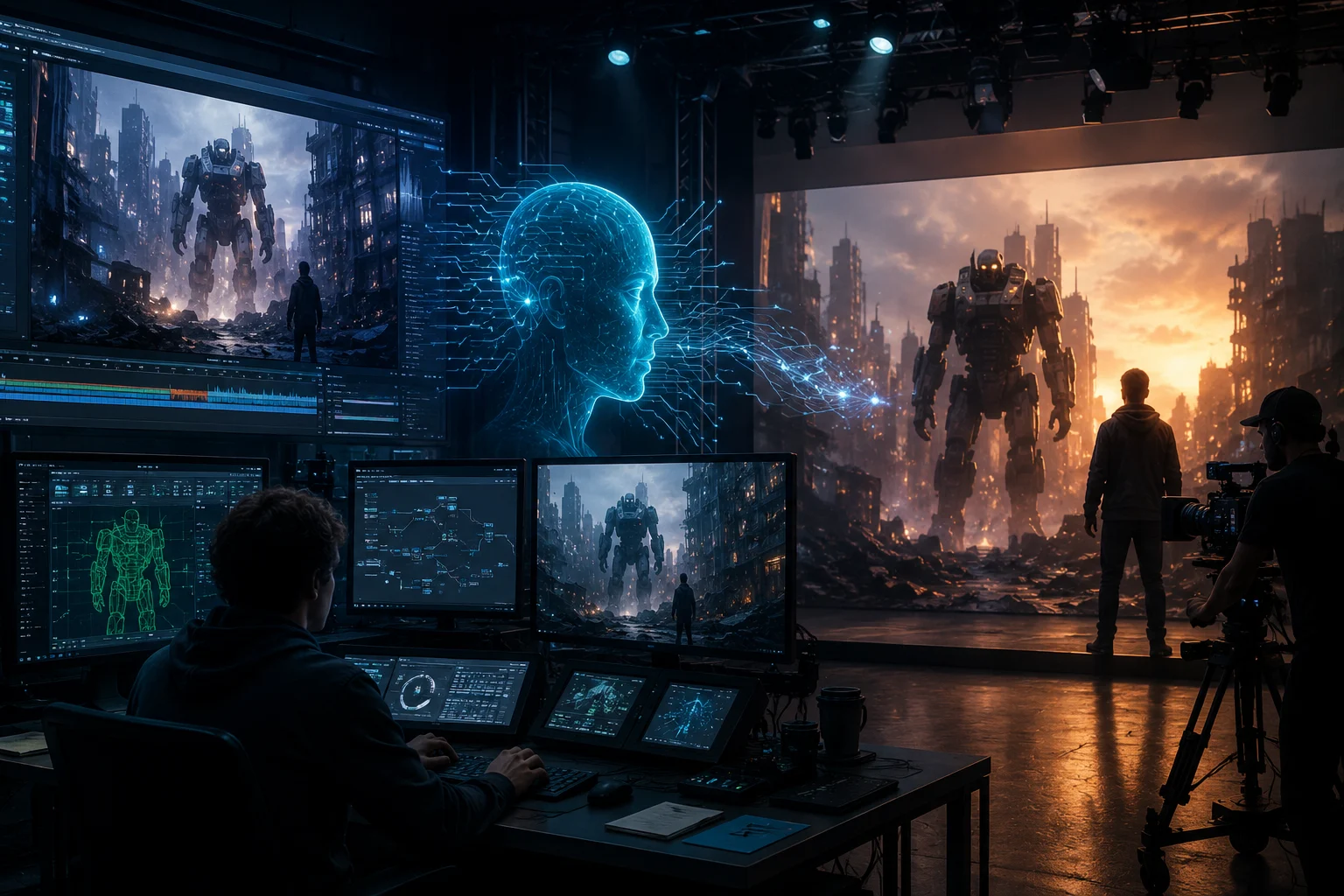
Imagine a director trying to decide how a futuristic city should feel in the background of a scene. Instead of waiting days for fully developed concepts, the team can use AI-assisted tools to explore mood, architecture, light, density, and atmosphere much earlier. A documentary team can test ways to visualize missing historical footage without committing immediately to a full traditional build. A showrunner can compare different levels of crowd scale before choosing the version that best supports the drama. These are not just technical shortcuts; they are creative decision tools.
Faster iteration also helps reduce waste. Productions often spend money developing ideas that later get cut because they do not fit the edit, the tone, or the available schedule. If AI helps teams preview and evaluate visual ideas earlier, they may avoid expensive dead ends. That could make the entire production process more efficient, from development to post. The result is not only cheaper VFX, but smarter visual planning.
The Branding Side of AI-Enhanced Visuals
Netflix’s visual identity has always depended on more than the shows themselves. Thumbnails, trailers, title cards, motion previews, and recommendation artwork all shape how viewers perceive a title before pressing play. AI has obvious potential in this area because streaming platforms constantly test visual assets to improve discovery and engagement. A single show may need different artwork for different audiences, markets, genres, and platform contexts. That makes visual personalization one of the most commercially powerful uses of artificial intelligence in entertainment.
This matters because the future of streaming visuals will not only be about what happens inside the episode. It will also be about how a title is packaged, surfaced, and visually positioned. AI can help create or evaluate more variations of promotional imagery, but the same quality problem applies here too. If thumbnails become too automated, they may feel soulless, misleading, or visually repetitive. If creative teams use AI carefully, they can make discovery more relevant while still protecting the identity of the work.
For designers and digital artists, this creates a wider field of opportunity. Visual storytelling now extends across the entire viewer journey, from homepage artwork to social clips to behind-the-scenes marketing to in-show effects. The people who understand both creative taste and AI tools will be valuable because they can connect those pieces into one coherent visual strategy. This is where digital creativity becomes less about isolated assets and more about systems. The best visual brands will not simply use AI to make more images; they will use it to make better visual decisions.
Practical Insight for Creators, Designers, and Studios
The Netflix AI story offers a practical lesson for anyone working in visual media: do not wait until AI is perfect before learning how it fits your workflow. The tools are already changing how teams think about concepting, cleanup, post-production, animation, marketing visuals, and production planning. Creators who understand the strengths and limits of AI will be better prepared than those who treat it as either magic or a threat. The smartest approach is to identify repetitive visual tasks, test AI support carefully, and keep human judgment at the center of every final decision. That balance is what separates professional adoption from cheap-looking automation.
For independent filmmakers and smaller studios, the opportunity is especially exciting. AI-assisted VFX may help them build scenes that were previously out of reach, from subtle worldbuilding to more ambitious visual moments. But they should avoid the temptation to overuse effects simply because they are easier to create. Visual impact still depends on restraint, taste, and story relevance. A cheaper effect is only valuable if it makes the scene stronger.
For designers and digital artists, the best move is to build hybrid skills. Learn prompt-based workflows, but also sharpen fundamentals like composition, lighting, typography, motion, color, and visual hierarchy. Learn how to direct AI output, but also learn how to critique it with a human eye. Understand production pipelines, because AI becomes more useful when it solves a specific workflow problem. The future belongs to creative professionals who can move between imagination, software, and strategic judgment without losing the soul of the work.
The Risks Behind Cheaper VFX
Every major technology shift comes with a cost, and AI-assisted VFX is no exception. The first risk is creative overproduction, where studios flood scenes with unnecessary spectacle because the tools make it easier to generate. The second risk is visual sameness, where different shows begin to share the same synthetic textures, lighting habits, and polished-but-empty aesthetic. The third risk is labor compression, where fewer artists are expected to produce more work at higher speed. These risks are real, and ignoring them would make the AI conversation feel shallow.
There is also a trust issue. Audiences are increasingly aware of AI-generated media, and many viewers are skeptical when they feel that companies are using automation to save money while reducing human craft. Entertainment companies need to be careful about how they communicate AI use, especially when it touches performances, voices, likenesses, or culturally sensitive imagery. The visual side may feel less controversial than replacing an actor’s voice, but the broader concern is still about authenticity and consent. If studios want AI to become a trusted creative tool, transparency and responsible boundaries will matter.
The best-case scenario is not a future where every frame is generated. The best-case scenario is a future where artists have better tools, smaller productions can dream bigger, and studios can spend more intelligently without hollowing out the creative process. That requires strong standards, ethical guidelines, and a real commitment to quality. It also requires audiences, artists, and platforms to keep asking hard questions about what kind of visual culture they want. Cheaper VFX is exciting, but cheaper should never become the only goal.
Why This Trend Will Shape the Next Era of Visual Entertainment
The Netflix update is important because it shows that AI in entertainment is moving beyond isolated experiments. It is becoming part of the operational language of streaming, production, and visual innovation. When a company with Netflix’s scale uses AI across hundreds of titles, the rest of the industry pays attention. Competitors will study where the tools save money, where they improve speed, where they create backlash, and where they unlock scenes that would not otherwise exist. This is how a technology trend becomes an industry standard.
Over the next few years, the most successful studios may not be the ones that use the most AI. They will be the ones that use it with the clearest creative purpose. A strong AI-assisted production pipeline should help teams move faster without making their work feel generic. It should support artists without turning them into button-pushers. It should make visual ambition more accessible without lowering the emotional quality of what reaches the screen. That is a difficult balance, but it is also where the most interesting innovation will happen.
For viewers, the change may arrive quietly. They may notice that more mid-budget shows suddenly have larger worlds, cleaner effects, richer backgrounds, and more cinematic sequences. They may see historical moments recreated with more confidence, documentaries using more expressive visual reconstructions, and genre shows taking bigger swings. If the work is done well, they may not think about AI at all. They will simply feel that streaming visuals have become more ambitious in places where they used to feel limited.
Conclusion: AI VFX Is Becoming the New Production Edge
AI VFX is becoming one of the clearest signs that the future of entertainment will be shaped as much by workflow innovation as by creative imagination. Netflix’s use of AI across around 300 titles shows that artificial intelligence is no longer just a futuristic concept sitting outside the studio system. It is already being tested, refined, and folded into the practical reality of making shows and films at global scale. The biggest impact may not be that AI creates impossible visuals from scratch, but that it makes previously expensive visual decisions more flexible. That shift could change what kinds of stories get made, how fast they move through production, and how much visual ambition creators can afford.
The real challenge now is making sure the technology serves the story instead of replacing the craft. Cheaper VFX can open doors for smaller teams, international productions, and mid-budget projects that deserve richer visual worlds. But it can also create pressure on artists, flatten aesthetics, and tempt studios to value speed over taste. The future will depend on how wisely companies use these tools and how strongly creative teams defend quality. If Netflix’s AI moment proves anything, it is that the next era of visual entertainment will not be built by technology alone; it will be built by people who know how to use technology without losing the human eye behind the image.