

Amoako Boafo Venice 2026 Redefines Portraiture
 Vortixel
13 minutes read
Vortixel
13 minutes read
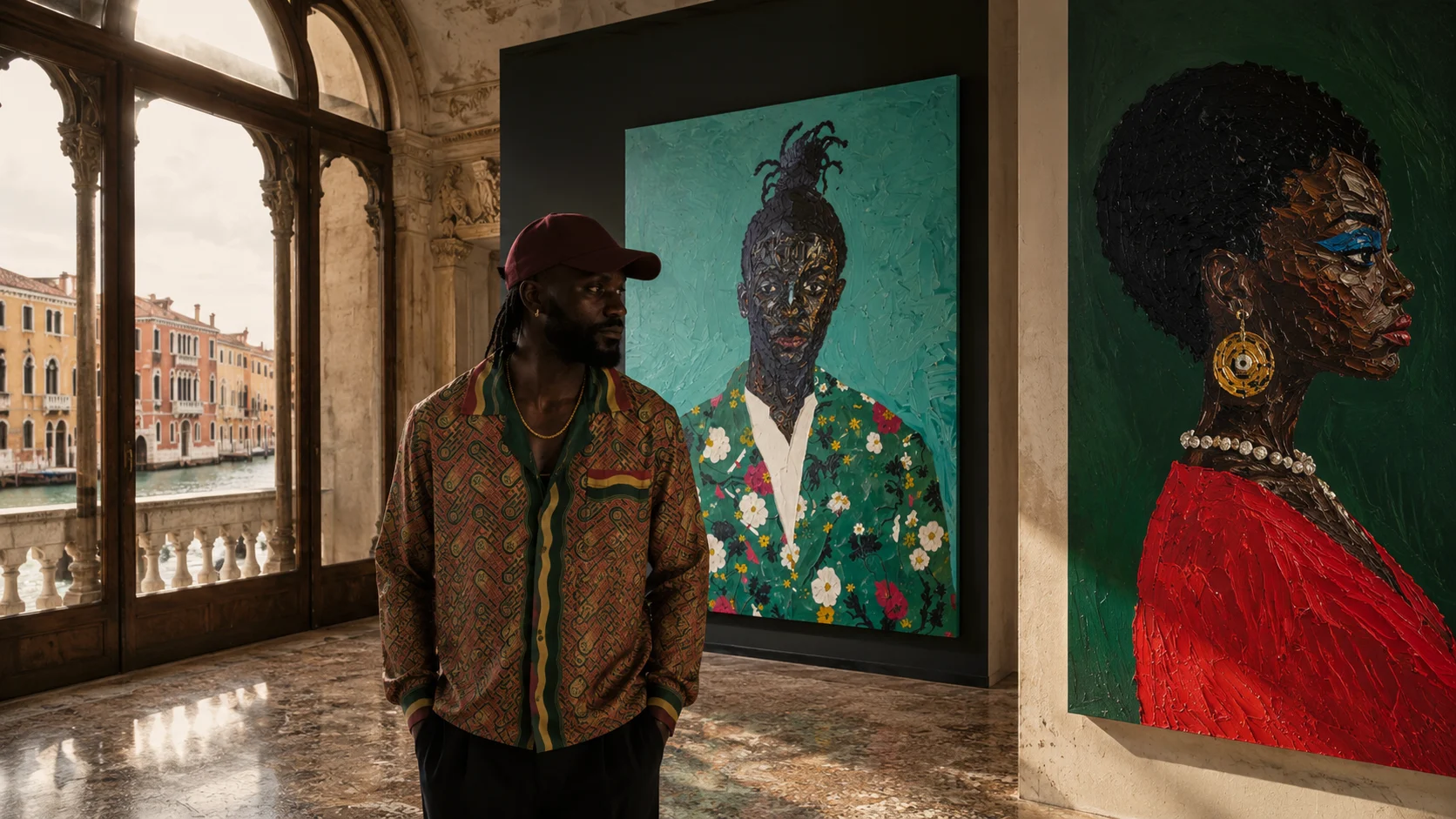
The arrival of Amoako Boafo Venice 2026 feels less like another art-world calendar moment and more like a visual conversation stepping into a room full of history. Venice has always been a city where images seem to float between water, stone, memory, and performance, but Boafo’s portraits bring a different kind of gravity into that atmosphere. His work does not shout for attention, yet it refuses to disappear inside the grandeur around it. The faces, bodies, textures, and gestures in his paintings invite viewers to slow down, look closer, and rethink what contemporary portraiture can carry in a global cultural moment. For a city used to hosting spectacle, this exhibition offers something quieter but sharper: a study of presence, identity, style, and the power of being seen on one’s own terms.
At the center of the moment is a Ghanaian artist whose visual language has become instantly recognizable without becoming predictable. Boafo is widely known for his finger-painted approach, a technique that gives the skin in his portraits a living, tactile quality that feels intimate without becoming sentimental. His subjects often appear calm, stylish, and self-possessed, yet beneath that calm sits a layered conversation about Black identity, migration, friendship, fashion, memory, and art history. That is why Amoako Boafo Venice 2026 matters beyond the walls of a single exhibition space. It positions portraiture not as a static genre from the past, but as a flexible visual system capable of holding personal stories, cultural politics, and contemporary beauty at the same time.
Why Amoako Boafo Venice 2026 Matters Now
The timing of this exhibition gives it extra cultural weight because Venice remains one of the most watched stages in the international art world. When a major portrait exhibition lands in the city during a Biennale year, it automatically enters a wider conversation about representation, global visibility, and the changing map of visual culture. For Boafo, the setting is especially charged because his portraits are not simply placed inside history; they actively speak back to it. The old architecture, classical references, and museum atmosphere create a contrast with his contemporary figures, but that contrast does not feel like a clash for attention. Instead, it feels like a dialogue between inherited European art spaces and a new generation of artists reshaping who gets to occupy them.
What makes the exhibition compelling is the way it treats the portrait as both an image and an encounter. Boafo’s figures are often framed with directness, but they do not perform for the viewer in an easy or decorative way. Their expressions can feel relaxed, alert, distant, confident, or private, depending on how long someone stays with the work. That emotional ambiguity matters because it keeps the portraits from being reduced to symbols or trends. In an online culture where faces are endlessly scanned, cropped, shared, judged, and monetized, Boafo’s paintings ask for a slower kind of looking that feels almost rebellious.
Portraiture as Presence, Not Decoration
Portraiture can easily become decorative when it is treated only as a beautiful image of a person, but Boafo’s practice pushes against that limitation. His subjects do not feel like accessories to a concept; they feel like the center of the visual event. The finger-painted skin creates a surface that looks alive because it carries the movement of the artist’s hand in every mark. That physical closeness between painter and canvas gives the portraits a sense of care, but also a sense of tension, because each face becomes a meeting point between technique, identity, and gaze. The result is a body of work that makes viewers aware of how much meaning can live in posture, color, fabric, and silence.
In the context of Venice, this focus on presence becomes even more powerful. The city is layered with images of power, wealth, religion, trade, empire, and beauty, and those histories are never neutral. Boafo’s portraits enter that environment with their own visual authority, refusing to be treated as guests in someone else’s canon. They do not need to imitate old masters to be taken seriously, yet they understand the long history of painting well enough to challenge it from within. That is why the exhibition feels relevant for digital art audiences too, even though the paintings are deeply physical. It shows that visual innovation is not only about new tools, but also about new relationships between image, body, memory, and space.
The Visual Language Behind the Hype
Boafo’s rise has often been described through market momentum, celebrity attention, and institutional recognition, but the paintings themselves deserve a slower reading. Their visual strength comes from the contrast between loose, expressive skin textures and carefully composed clothing, backgrounds, or poses. The figures often seem to hover between fashion editorial elegance and emotional interiority, which makes the work easy to recognize but difficult to flatten. Color plays a major role in that effect because Boafo uses it not just to decorate the canvas, but to structure mood and identity. His backgrounds can feel bold, minimal, patterned, or atmospheric, creating a visual field where the figure becomes both grounded and iconic.
The finger-painting technique is central because it gives the work a signature surface, but it should not be treated as a gimmick. In a world obsessed with polish, filters, and smooth digital perfection, the visible touch in Boafo’s portraits feels deliberately human. The marks remind viewers that skin is not a flat color, identity is not a single category, and presence cannot be fully captured by a clean outline. That texture also creates movement, making the portraits feel like they are still forming in front of the viewer. This is one reason his work connects strongly with younger visual audiences who are used to fast images but increasingly hungry for art that feels emotionally and materially real.
Venice as a Stage for Contemporary Black Identity
The Venice setting gives Boafo’s portraits a broader cultural frame because the city has long been associated with global exchange. Historically, Venice was shaped by trade routes, artistic borrowing, luxury materials, and cross-cultural contact, even when those histories were filtered through European power. Boafo’s presence in this environment opens a more current conversation about who defines beauty, who enters prestigious spaces, and who gets written into visual history. His paintings do not ask for permission to belong there; they arrive with confidence and complexity. That confidence is important because contemporary Black portraiture is not just filling gaps in old museums, but actively changing the language those museums use to describe value.
There is also a deep connection between Boafo’s subjects and the idea of self-fashioning. Clothing, pose, and attitude in his work often carry meaning beyond style, because style itself becomes a form of cultural authorship. The figures appear aware of how they are seen, but they do not surrender control of the image to the viewer. That tension feels especially modern because identity today is constantly shaped through photographs, feeds, profiles, avatars, and public performance. Boafo’s portraits slow that performance down and return it to the body, the hand, and the painted surface, which makes the work feel both classic and very current.
Trend Impact: Why the Art World Is Watching
The larger impact of Amoako Boafo Venice 2026 sits in the way it reflects several major shifts happening across visual culture. First, portraiture is enjoying renewed attention because audiences want images that feel personal in an era dominated by abstraction, automation, and mass-generated visuals. Second, artists from Africa and the African diaspora are increasingly shaping global conversations rather than being treated as side chapters in contemporary art. Third, museums and galleries are being pushed to rethink how architecture, history, and representation interact inside exhibition spaces. Boafo’s Venice moment brings these shifts together in a way that feels visually accessible but conceptually layered.
This impact also reaches beyond traditional art audiences because Boafo’s work sits close to fashion, photography, design, and digital visual culture. His portraits have the strong silhouettes and color confidence that travel well online, but they do not lose their depth when reduced to a screen. That balance is rare and valuable in an image economy where many artworks become famous as thumbnails before people experience them in person. Boafo’s paintings reward digital circulation while still insisting on physical presence, which gives them unusual power across platforms. For a site focused on visual creativity, that tension is exactly where the future of image culture is being negotiated.
A Practical Insight for Digital Creators
For designers, illustrators, photographers, and digital artists, Boafo’s Venice exhibition offers a practical lesson about building a recognizable visual identity without becoming trapped by it. His work proves that a signature style can be consistent while still evolving through context, scale, material, and emotional tone. Many creators chase originality by constantly changing aesthetics, but Boafo shows that depth can come from returning to a core language and expanding what it can hold. The lesson is not to copy his finger-painted technique or his portrait structure, because imitation would miss the point. The real lesson is to develop a visual system strong enough to be recognizable, but flexible enough to respond to new stories and spaces.
Another useful takeaway is the importance of cultural grounding. Boafo’s portraits feel contemporary because they are visually fresh, but they also carry personal and communal references that keep them from feeling empty. In digital creativity, where trends move at brutal speed, work can become generic when it is built only around surface aesthetics. The strongest visual projects usually carry a deeper relationship to memory, place, community, or lived experience. Boafo’s Venice moment reminds creators that style becomes more powerful when it is connected to something real enough to survive beyond the trend cycle.
The Role of Space in Visual Storytelling
One of the most interesting parts of this exhibition is the relationship between the portraits and the space around them. A painting changes when it moves from a white cube gallery into a historic Venetian building filled with architectural memory. The walls, rooms, corridors, and decorative details become part of the viewing experience, shaping how the viewer reads color, scale, and mood. Boafo’s portraits gain a new kind of resonance in that setting because they are surrounded by traces of older visual systems. Instead of being swallowed by the architecture, the works seem to activate it, turning the room into a layered conversation between past and present.
This is a valuable reminder for anyone working in visual entertainment or immersive media. The image itself matters, but the environment around the image can completely change its emotional meaning. In exhibitions, that environment may be architecture, lighting, sound, and movement through space. In digital projects, it may be interface design, scrolling behavior, screen size, typography, or the surrounding content ecosystem. Boafo’s Venice presentation shows that visual storytelling becomes stronger when creators think not only about what an image shows, but also about where and how that image is encountered.
Between Painting, Fashion, and Cultural Memory
Boafo’s portraits often feel close to fashion because clothing is never treated as a random detail. Patterns, colors, cuts, and poses help build character, and they also connect the paintings to a broader culture of self-presentation. Yet the work does not become fashion illustration because the emotional weight remains in the person, not the outfit. The clothes help tell the story, but they do not replace the subject’s interiority. This balance gives the portraits a modern editorial charge while preserving the slower psychological pull of painting.
That relationship between fashion and memory is especially important for younger audiences who understand style as language. What someone wears can signal belonging, resistance, aspiration, nostalgia, humor, or refusal. Boafo captures that reality without turning his subjects into trend boards. His figures feel stylish because they inhabit their image with confidence, not because they are dressed to satisfy a commercial fantasy. In that sense, the exhibition speaks to a wider cultural shift where visual identity is built through the overlap of art, fashion, photography, social media, and personal mythology.
Why This Moment Feels Different
Many contemporary artists arrive in Venice with ambitious installations, political statements, or large-scale conceptual environments, but Boafo’s strength lies in the intensity of the human figure. That may sound traditional at first, yet his approach feels distinctly current because the question of visibility has become one of the defining issues of our time. Who is seen, how they are seen, who controls the image, and who benefits from that visibility are no longer background questions. They sit at the center of culture, from museums to social platforms to entertainment industries. Boafo’s portraits enter that conversation without turning into slogans, which makes them more durable than simple commentary.
The Venice exhibition also feels different because it does not treat Black presence as a theme added onto an old structure. Instead, it places Black subjectivity at the center of the visual experience and lets the surrounding history adjust around it. That reversal matters because it changes the emotional architecture of the room. Viewers are not simply looking at portraits of people; they are being asked to reconsider the museum space through the people in those portraits. This is where Boafo’s work becomes more than beautiful painting and starts to operate as cultural repositioning.
What Visual Vortixel Readers Can Learn
For Visual Vortixel readers, the biggest lesson from Amoako Boafo Venice 2026 is that visual innovation does not always need to look futuristic. Sometimes it looks like a portrait that makes an old room feel newly awake. Sometimes it comes from touch, texture, and the refusal to let the human figure become just another piece of content. Boafo’s work proves that a strong visual identity can move across art markets, museum spaces, fashion conversations, and digital platforms without losing its emotional center. That is an important insight for anyone building creative work in a world where images travel faster than context.
The exhibition also reminds creators that impact is not only measured by scale. A quiet portrait can shift a room if it understands its own power. A single figure can open a conversation about history, identity, and beauty when the composition is precise enough to hold that weight. In a creative economy obsessed with speed and volume, Boafo’s work argues for depth, patience, and visual confidence. That message feels especially relevant now, when both human-made art and machine-generated imagery are forcing audiences to rethink what authenticity actually means.
Conclusion: A Portrait Moment With Lasting Weight
Amoako Boafo Venice 2026 stands out because it brings together the intimacy of portrait painting, the symbolic power of Venice, and the global urgency of contemporary representation. The exhibition is not just about one artist reaching another milestone, even though that milestone is significant. It is about how portraiture can still feel alive in a visual culture crowded with screens, filters, and endless image production. Boafo’s figures hold the room because they are painted with touch, confidence, and emotional complexity. They remind us that being seen is never a simple act when history, beauty, identity, and power are all present in the frame.
In the end, the Venice moment matters because it shows how contemporary art can enter historic spaces without becoming trapped by them. Boafo does not erase the past, and he does not simply decorate it with new faces. He creates a dialogue where Black presence, personal memory, and painterly touch become central to the way the space is understood. For viewers, creators, and visual culture watchers, that makes the exhibition more than a seasonal highlight. It becomes a reminder that the future of portraiture is not only about who appears on the canvas, but also about how powerfully they claim the right to remain there.