

AI Acting Rules Reshape the Golden Globes Era
 Vortixel
11 minutes read
Vortixel
11 minutes read
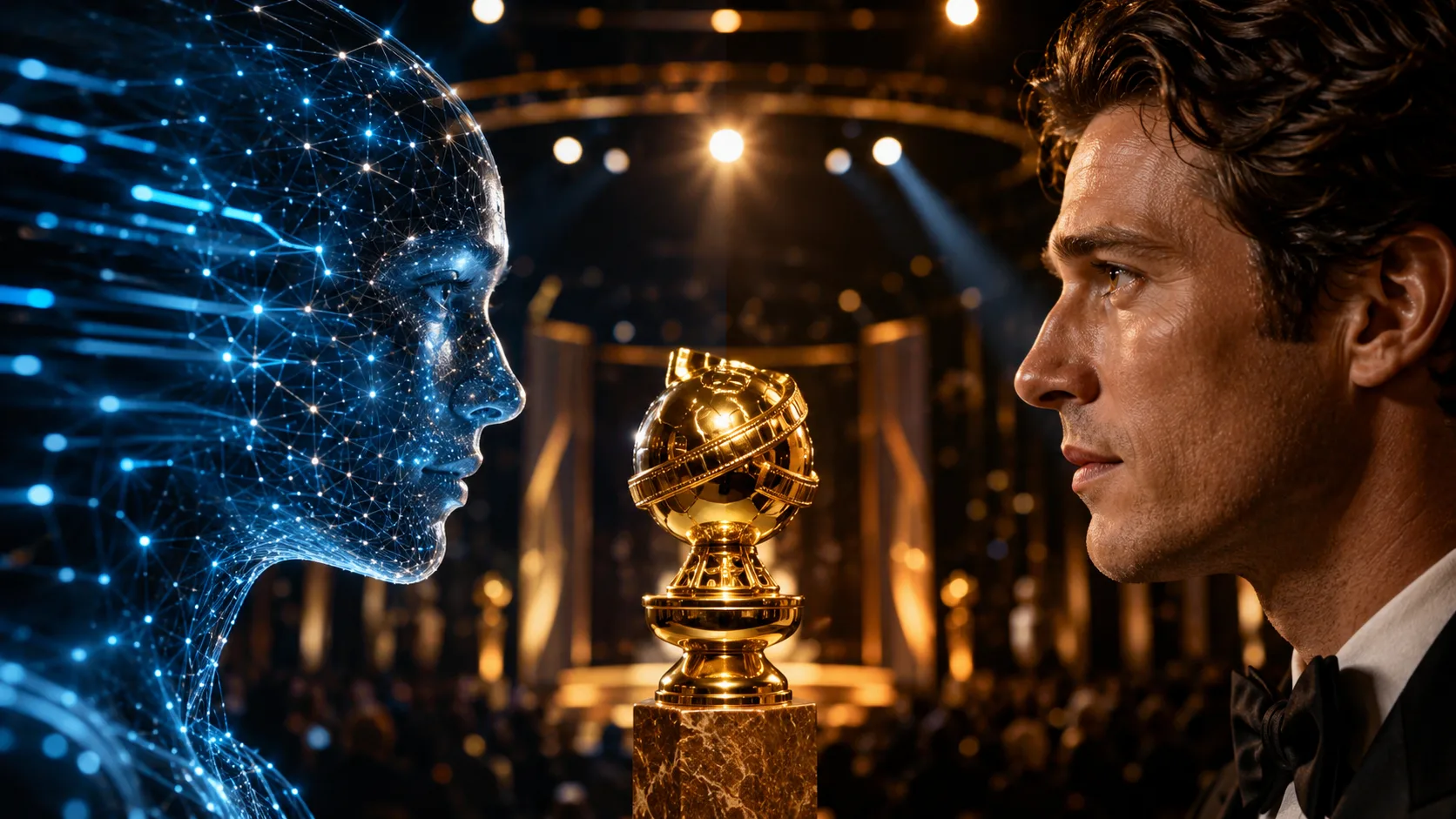
The entertainment industry has officially entered a new chapter, and nobody in Hollywood can pretend otherwise anymore. After years of debate, anxiety, experimentation, and quiet backstage negotiations, the Golden Globes finally confirmed that AI-assisted performances can still qualify for awards consideration. That single decision instantly changed the conversation around filmmaking, acting, visual production, and even the future identity of cinema itself. The announcement landed at a time when AI-generated visuals, digital voice cloning, de-aging technology, and synthetic performances were already becoming impossible to ignore. What once looked like a sci-fi discussion suddenly became a real policy shaping one of the biggest awards institutions in the entertainment world.
For years, Hollywood treated artificial intelligence like a dangerous guest standing outside the studio gates. Producers wanted the efficiency, tech companies pushed innovation aggressively, and actors feared losing ownership over their own faces and voices. Meanwhile, audiences were caught somewhere in the middle, fascinated by futuristic visuals but also worried about whether movies would slowly lose their emotional authenticity. The Golden Globes stepping into this debate feels massive because awards ceremonies do more than hand out trophies. They shape industry standards, influence studio investments, and decide what kind of creativity gets legitimized in front of the entire world.
What makes this moment even more interesting is the fact that the Golden Globes did not completely reject AI. Instead, the organization created a middle-ground approach that allows AI enhancement while still protecting human-centered performances. That balance says a lot about where modern filmmaking is heading. Hollywood clearly understands that AI is not disappearing anytime soon, but it also knows audiences still care deeply about human emotion, real performances, and authentic storytelling.
The debate now is no longer about whether AI belongs in cinema. The real question is how much AI is too much. That question is already changing contracts, movie production pipelines, actor negotiations, streaming strategies, and even how younger filmmakers approach visual storytelling. Suddenly, the line between human creativity and machine-assisted performance feels blurrier than ever before.
Why the Golden Globes AI Decision Matters
Award shows have always acted like unofficial rulebooks for the entertainment industry. Even when studios pretend they do not care about trophies, the reality is completely different. Awards increase streaming numbers, elevate actors into global icons, attract investors, and create prestige that can define careers for decades. Because of that, any policy related to AI instantly becomes more than just a technical adjustment. It becomes an industry-wide signal.
The new Golden Globes policy basically confirms that AI-assisted acting is acceptable as long as the human performer remains the core creative force behind the role. In simple terms, filmmakers can use digital tools to enhance performances, but they cannot completely replace actors with synthetic creations. That distinction may sound small, but it changes everything about how studios will approach AI moving forward.
This decision also reflects the complicated reality of modern filmmaking. AI tools are already deeply embedded inside production workflows, especially in blockbuster cinema and high-budget streaming projects. Studios use machine learning for visual effects, dialogue enhancement, facial reconstruction, dubbing localization, motion capture cleanup, and post-production editing. Completely banning AI would be nearly impossible because the technology is already intertwined with how movies and television shows are made.
What the Golden Globes essentially did was acknowledge reality instead of pretending AI does not exist. That honesty is probably why the announcement generated such intense discussion online. Some people praised the move as realistic and forward-thinking. Others immediately worried that this would slowly normalize synthetic performances until actors become secondary elements inside their own projects.
The timing of the announcement also amplified its impact. The entertainment world is still recovering from the massive Hollywood labor strikes that centered heavily around AI concerns. Writers and actors spent months warning studios about digital exploitation, unauthorized likeness replication, and algorithm-driven content creation. Because of that history, every new AI policy now carries emotional weight far beyond technology itself.
Hollywood’s Fear of Digital Replacement
One reason this conversation feels so emotional is because actors are not just worried about technology. They are worried about identity, ownership, and survival inside an industry already known for instability. Unlike traditional automation debates in other industries, acting is deeply personal. A performer’s face, voice, movement, and emotional expression are literally their career assets.
When AI systems can recreate facial performances or mimic voices with extreme realism, actors naturally start asking terrifying questions. What happens if studios can digitally reproduce performances forever? What happens after an actor dies? Who owns a digital likeness? Can an AI-generated performance emotionally replace a human one? Those questions are no longer hypothetical anymore.
Recent AI-generated recreations of legendary performers intensified these fears dramatically. The industry has already experimented with digitally resurrecting actors using archived footage, voice synthesis, and generative visual reconstruction. While some audiences find the technology fascinating, others feel deeply uncomfortable watching synthetic versions of real people appear on screen.
This is exactly why the Golden Globes emphasized consent and human-centered performances in their updated guidelines. The organization clearly understands that public backlash could explode if audiences start feeling like studios are replacing artists with digital replicas. Maintaining human authenticity has now become both an ethical issue and a branding issue for Hollywood.
At the same time, many younger filmmakers do not view AI as a threat at all. They see it as a creative amplifier capable of unlocking visuals and production techniques that previously required impossible budgets. Independent creators especially are embracing AI-assisted workflows because they reduce barriers to entry. A small creative team can now generate cinematic environments, visual prototypes, or advanced effects without needing enormous studio infrastructure.
That generational divide is becoming increasingly visible. Veteran actors often approach AI with caution and skepticism, while newer digital-native creators treat AI tools as normal extensions of creativity. The Golden Globes decision sits right in the middle of that cultural clash.
AI Enhancement Versus AI Performance
One of the biggest misunderstandings surrounding this debate is the assumption that all AI use in movies automatically means fully synthetic actors. In reality, most AI applications in filmmaking are much more subtle. Modern productions already rely on AI-assisted systems for things audiences barely notice.
De-aging technology is one major example. Several recent films used AI-supported visual processing to make actors appear decades younger without requiring traditional makeup-heavy approaches. Voice enhancement systems can also clean dialogue recordings or recreate damaged audio with incredible accuracy. AI can even assist in matching lip movements for international dubbing, making translated performances appear more natural.
The Golden Globes specifically focused on this distinction between enhancement and replacement. Their updated approach suggests that AI tools can support performances, but the emotional core must still come from the credited actor.
That sounds reasonable on paper, but in practice the line may become incredibly difficult to define. If AI modifies facial expressions, adjusts vocal delivery, or enhances emotional intensity, how much of the final performance still belongs entirely to the actor? Technology is evolving so fast that the answer may become more complicated every year.
This creates another challenge for awards organizations. How exactly do judges measure authenticity inside AI-assisted performances? Will studios eventually need to disclose every AI enhancement used during production? Could future controversies emerge around hidden digital modifications that audiences never knew existed?
The Golden Globes already hinted at transparency requirements involving AI disclosure during submissions. That alone shows how seriously the organization is taking the issue.
Interestingly, audiences themselves may not even care as much as industry insiders expect. Modern viewers are already used to heavily manipulated visuals across movies, social media, gaming, and streaming content. Younger audiences especially grew up inside digitally enhanced environments where filters, CGI, and virtual production became normal visual language. The emotional response to AI-assisted acting may therefore depend more on storytelling quality than on technical purity.
Streaming Platforms Are Accelerating the Shift
Streaming platforms are another reason why AI acting rules became unavoidable so quickly. Traditional cinema moved relatively slowly for decades, but streaming completely changed content production speed. Platforms now compete globally for attention every single day, creating enormous pressure to generate more content faster and cheaper.
AI tools naturally fit into that environment. They reduce production costs, accelerate editing workflows, and help studios localize content for international audiences more efficiently. Some streaming companies are already experimenting with AI-generated dubbing systems that preserve emotional vocal tone across multiple languages. Others are exploring AI-assisted visual production pipelines for animated and hybrid-content projects.
Because streaming audiences consume global content nonstop, studios also want technology capable of making productions adaptable for multiple regions simultaneously. AI-enhanced localization could eventually transform international entertainment distribution entirely.
This matters because award shows increasingly rely on streaming productions for relevance. Many recent Golden Globes nominees and winners came directly from major streaming services. That means the awards ecosystem itself is already connected to companies aggressively investing in AI-driven production tools.
The result is a complicated relationship where awards organizations must protect artistic integrity without alienating the very platforms dominating modern entertainment. Completely rejecting AI could create friction with studios and streaming giants rapidly building AI-powered workflows. Fully embracing AI, however, risks backlash from actors, writers, and audiences who fear creative dehumanization.
The Golden Globes decision reflects that balancing act perfectly. It does not fully endorse synthetic creativity, but it also does not attempt to freeze filmmaking in a pre-AI era that no longer exists.
The Oscars Versus the Golden Globes
Another reason the Golden Globes announcement gained so much attention is because people immediately compared it to the Oscars. The Academy recently introduced stricter language surrounding AI-generated performances and human authorship. That created the impression that the Oscars were taking a more protective stance toward traditional creative roles.
The Golden Globes, by comparison, appear more flexible. Instead of focusing primarily on restriction, their policy centers on maintaining human creative dominance while still allowing AI-assisted workflows. That difference may look subtle now, but it could eventually create major philosophical divisions between awards institutions.
If one organization becomes more open to technological experimentation while another prioritizes stricter human-authorship standards, studios may eventually tailor productions strategically depending on awards ambitions. Some filmmakers could push aggressively toward AI-driven innovation, while others market themselves around “pure human creativity” as a prestige selling point.
That possibility sounds dramatic, but Hollywood has always evolved around awards influence. Studios constantly adapt production strategies based on what award voters reward. If AI-assisted cinema starts winning major recognition, investment in those technologies will accelerate even faster.
At the same time, audiences may eventually develop separate expectations depending on genre. Big-budget science fiction films might normalize heavy AI enhancement, while intimate dramas may market authenticity and minimal digital manipulation as premium artistic qualities. The entertainment industry could become increasingly divided between hyper-synthetic visual experiences and human-centered storytelling movements.
How Actors Are Adapting to the AI Era
Actors themselves are already changing how they approach contracts and career protection. Digital likeness clauses are becoming far more detailed, especially for high-profile performers. Agencies and legal teams now negotiate not just appearance rights, but also voice replication permissions, biometric usage limitations, and posthumous digital reproduction restrictions.
For younger actors entering Hollywood today, protecting digital identity may become just as important as negotiating salary. The entertainment business is evolving into an industry where data ownership matters almost as much as physical performance.
Some performers are also starting to embrace AI proactively instead of resisting it entirely. A few actors have openly discussed licensing their digital likeness for future projects under tightly controlled agreements. Others are exploring AI-generated voice preservation systems that allow controlled creative expansion without losing ownership.
This shift suggests the industry may eventually settle into a licensing-based AI ecosystem rather than full replacement. Instead of studios secretly recreating actors, performers could monetize controlled digital extensions of themselves. That model would preserve consent while still allowing technological experimentation.
However, the ethical complications remain enormous. Questions around legacy, authenticity, emotional ownership, and audience transparency still have no universally accepted answers. The Golden Globes policy may only be the beginning of much larger legal and cultural battles.
The Future of Human Creativity in Entertainment
The biggest fear surrounding AI in entertainment is not actually technical replacement. It is emotional emptiness. People watch movies because they connect with vulnerability, imperfection, chemistry, tension, and emotional unpredictability. Human performances resonate because they feel alive in ways algorithms struggle to replicate authentically.
That emotional reality may ultimately become the strongest defense against fully synthetic cinema. Even if AI becomes technically capable of generating convincing performances, audiences may still crave the emotional chaos and authenticity that real humans bring to storytelling.
At the same time, history shows that audiences usually adapt faster than expected whenever entertainment technology evolves. People once feared sound films, digital cameras, CGI-heavy cinema, and streaming platforms. Many innovations initially faced resistance before becoming normalized industry standards.
AI may follow a similar path. Instead of replacing creativity, it could simply reshape the tools creators use. Future filmmakers may treat AI the same way modern editors treat visual effects software today: powerful, transformative, but ultimately still dependent on human artistic direction.
The Golden Globes clearly seem to believe that balance is possible. Their updated rules acknowledge technological evolution without fully surrendering the artistic center of filmmaking to machines. Whether that balance survives long-term is another question entirely.
Conclusion
The decision to allow AI-assisted performances while banning fully AI-generated acting marks one of the most important entertainment industry shifts of the decade. The Golden Globes are no longer treating AI as a distant future problem. They are officially recognizing it as a permanent part of modern filmmaking.
What makes this moment fascinating is how complicated the conversation has become. This is not a simple battle between humans and machines anymore. It is a negotiation about identity, authorship, creativity, consent, economics, and the emotional meaning of art itself. Hollywood is trying to embrace technological innovation without destroying the human connection that gives storytelling its power.
For audiences, the future will probably feel increasingly hybrid. Movies and television shows will continue blending real performances with invisible AI enhancement tools. Some viewers may never notice the difference. Others will pay closer attention to authenticity than ever before. Either way, the industry has clearly crossed a line that cannot be uncrossed.
The Golden Globes did not just update an awards policy. They opened the door to a completely new era of entertainment where human creativity and artificial intelligence will constantly collide, collaborate, and redefine what performance actually means.